French school abaya ban opens fresh secularism row / Photo: © AFP

 What to know about the total solar eclipse

 Tentoglou claims fourth Euro long jump title, injured Jacobs falters

 All Blacks knew Nonu would perform solo Haka - coach Rennie

 Britain's Glave upstages Jacobs to win European 100m gold

 Greece's Tentoglou wins fourth European long jump title

 Doctors ignored 'warning signs' before Maradona's death, court hears

 Pereira, the 'zombie city' devastated by Colombia's earthquake

 UN says 2 staff arrested by Afghan intelligence agency

 Colombia scrambles to find survivors as quake kills 240

 Ramsay-Peaty out of medals as Italy's Martinenghi wins European gold

 AI firm Manus to resume 'independent' operations after China blocks Meta deal

 Caught between great powers: the cautionary tale of Manus

 Heatwave hits evicted families sleeping rough in Rome

 US company stokes Greenland tensions by unloading drilling gear

 Cambridge academic in plagiarism row publishes memoir

 LeBron's Sixers hope to spoil Knicks party on NBA opening night
 UK 'on course' to record warmest summer for second year in a row

 Spotify to launch badge identifying AI music

 New plastic treaty document criticised for weaker ambition

 Hungary parliament approves Orban-critic judge as president

 Ebola outbreak in DR Congo kills more than 2,000

 ChargeAfter Powers BYLD Finance Expansion into Consumer Financing for Equipment Retailers

 MEXC Upgrades RealStocks With Three New Features to Enhance U.S. Stock Trading Experience

 Israel demolishes home of slain Palestinian involved in deadly West Bank clash

 Liverpool fans seek clarity on Bezos bid to buy stake

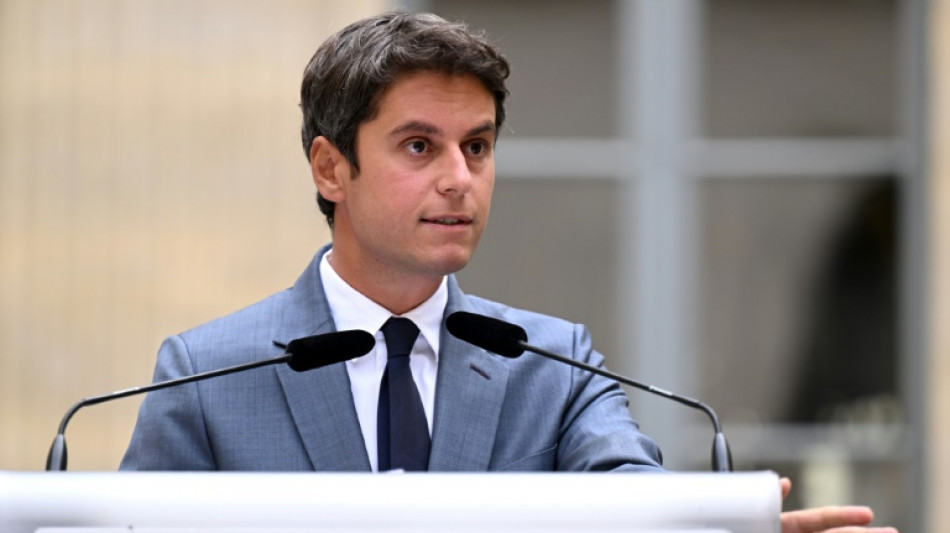
The French government's decision to ban schoolgirls wearing abayas -- long, flowing dresses of Middle Eastern origin -- has opened a fresh debate about the country's secular laws and the treatment of Muslim minorities.
Education Minister Gabriel Attal said Sunday that the dresses, worn by some Muslim girls, would no longer be allowed in schools as students prepared to return to their classrooms after the summer holidays.
"Our schools are being tested. These last few months, violations of our secular rules have considerably increased, particularly with regard to the wearing of religious clothing such as abayas or qamis (long male tunics)," he told reporters on Monday.
In 2004, France banned school children from wearing "signs or outfits by which students ostensibly show a religious affiliation" on the basis of the country's secular laws which are meant to guarantee neutrality in state institutions.
It outlawed the wearing of headscarves, turbans, large crosses or kippas. But school authorities have been struggling to regulate the wearing of abayas which were seen as being in a grey area between fashion and religious garb.
Attal, an ambitious 34-year-old less than two months into his job as education minister, has decided to implement a blanket ban in a move some see as a ploy to appease conservatives and raise his public profile.
Government spokesman Olivier Veran backed the move on Monday, saying abayas were "obviously" a religious garment and "a political attack" which he likened to an act of "proselytising" -- trying to convert people to Islam.
"School is secular. We say it in a very calm but firm way: it is not the place for that (wearing religious clothing)," he told the BFM TV channel.
- Artificial debate? -
While supporters want to preserve schools as a neutral zone free from religious pressure, critics argue that the issue stigmatises Muslims and is a marginal one that has been exaggerated by right-wing and far-right politicians.
Statistics from the education ministry for May, the last month for which they are available, show that from nearly 60,000 public schools there were 438 complaints about possible infringements of secular rules, around half of which related to the wearing of religious clothing.
"Sad to see the return to classes politically polarised by a new absurd religious war that is entirely artificial about female clothing," hard-left political leader Jean-Luc Melenchon wrote on X (formerly Twitter).
"When will there be civil peace and true secularism that brings people together rather than exasperating them?" he added.
Abdallah Zekri, vice-president of the French Council on the Muslim Religion (CFCM), said that it was wrong to see abayas as religious.
"The abaya is not a religious garment, it's a form of fashion," he told the BFM channel on Sunday.
Other fashions, most recently the wearing of revealing crop tops by teenage girls, have also sparked debate in a country where only some private schools impose a uniform on students.
Attal's ministry has not yet published written guidance on the abaya ban.
It is likely to face a legal appeal and could lead to difficulties for school authorities who will have to decide when a large flowing dress moves from being a personal fashion choice to a religious statement, observers say.
- Headscarf bans -
Some women choose to wear abayas, or headscarves, to signal their cultural identity, rather than out of religious belief.
In the Arab world or in the Middle East, the abaya "is not fundamentally or initially a religious garment", said Haoues Seniguer, a specialist on Islam at the Institute of Political Studies in Lyon.
"The best way of knowing if it is religious or not is to find out what sense the person wearing it gives to it," he said.
Many conservative politicians in France have pushed in recent years for the ban on the wearing of religious symbols to be widened to universities and even parents accompanying children on school outings.
Far-right leader Marine Le Pen campaigned in last year's presidential election to ban veils in the street.
The country's constitution guarantees citizens the right to practise religion freely, but it imposes an obligation on the state and state employees to respect neutrality while carrying out their duties.
hrc-cg-slb-adp/sjw/fg
M.Furrer--BTB