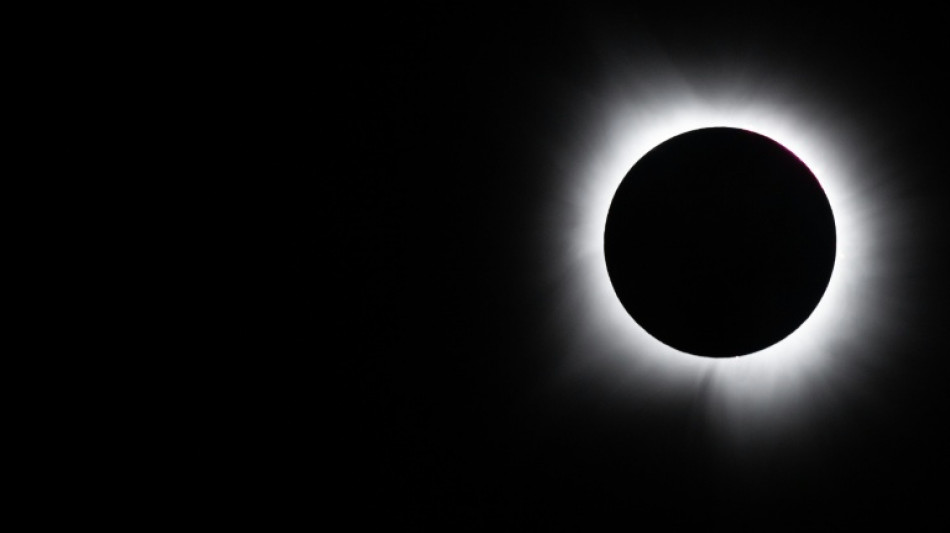
What to know about the total solar eclipse / Photo: © GETTY IMAGES NORTH AMERICA/AFP/File

 AI startup urges optimism from Europe despite safety fears

 'Godlike, invincible': Japan hails 11-year-old Games history-maker

 Nepal's hydropower ambitions face climate reality check

 Power cuts, rubble: millions come home to find Sudan's capital unlivable

 Internationals keep Presidents Cup lead with late fightbacks

 Tuchel to 'keep pushing' England to reach Spain's level

 Alcaraz saves match points to keep Europe ahead in Laver Cup

 Spain success driven by hunger to improve, says De La Fuente

 Lyon collapse at Stade Francais to suffer first Top 14 loss
 Oyarzabal and Spain sink England again as Modric shines for Croatia

 Housing protesters camp in central Madrid after mass demonstration

 Louise Trotter expands her palette at Bottega Veneta
 Pope prays at Lourdes after huge Paris mass

 USA trims International lead after Presidents Cup four-balls

 Russia accuses Europe of blocking Ukraine talks, as strikes drag on

 'He said hello': Families pray with pope on Paris avenue

 Pope celebrates giant Paris mass, flies to Lourdes

 Thousands march in Madrid over eviction of 87-year-old woman

 England women back to winning ways with last-gasp defeat of New Zealand

 Trump rejects Iran proposal for deal to reopen Hormuz

 England's Cox says injured Buttler leaves 'big shoes to fill'
 Ruthless Perpignan upset sloppy Bordeaux-Begles
 Deadly abbey attack feeds anti-Ukrainian sentiment in Poland

 Antonelli says he drove 'safety-first' on his worst weekend of season
 Fernandez fights back to reach Singapore Open final

Day will briefly turn into night across a swathe of northern Spain on Wednesday, when the Moon will completely cover the Sun during a rare total solar eclipse.
Here is what you need to know about the total eclipse, which is the first visible in mainland Europe since 2006.
- What is an eclipse? -
Eclipses happen when the Moon passes directly between the Sun and Earth, casting a narrow band of shadow across our planet.
It creates a strange twilight during which temperatures drop, shadows appear at strange angles and some animals go to sleep.
These odd phenomena convinced ancient cultures that eclipses were signs of the apocalypse -- or messages from the gods.
However it is really the result of a "cosmic coincidence", according to NASA.
"Even though the Sun is about 400 times bigger than the Moon, it is also about 400 times farther away," the US space agency says.
This means that for people standing in the right spot, the Moon totally covers the Sun -- revealing its outer atmosphere called the corona.
- Where can it be seen? -
On August 12, a remote region of northern Russia will be the first to see the total eclipse.
The "path of totality", as it is known, will then cross over Greenland, Iceland, Spain and the northeastern tip of Portugal.
In Spain, it will roughly move from the northern city of Oviedo to the island of Mallorca.
The eclipse will cross over areas that have been hit by devastating fires in Spain, which scientists say were made more likely by human-driven climate change.
- How long will it last? -
For observers in Spain, the total eclipse will last under two minutes just before sunset.
The northern city of Burgos, for example, will be plunged into darkness for exactly one minute and 48 seconds.
It will last slightly longer in parts of Russia and Greenland, though still under two-and-a-half minutes.
However, partial eclipses -- which occur as the Moon starts and finishes crossing the Sun -- will last around one hour and 45 minutes.
Partial eclipses will also be visible in most of Europe, Canada, the northern United States and northwest Africa.
People viewing a partial eclipse can see the brightness of the Sun decrease and feel the temperature drop. But the experience will not be similar to witnessing a total eclipse.
"Even one percent of the Sun that is not obscured is 4,000 times as bright as the full Moon," Paris Observatory astrophysicist Alain Doressoundiram told French media last week.
- How rare is it? -
One or two solar eclipses occur roughly every year. However the small band of totality means that the same area may wait 400 years before seeing another one.
On August 2, 2027, a total solar eclipse will cross southern Spain, northern Africa and the Arabian Peninsula.
Its totality will last six minutes and 23 seconds. A longer eclipse will not occur until 2114.
Spain will be treated yet again on January 26, 2028, when an annular eclipse -- or "ring of fire" -- will cross southern areas.
- Do you need protection? -
Yes. It is important not to look directly at the Sun during an eclipse. It can cause serious eye damage.
Experts recommend specifically designed eclipse glasses which filter UV rays that meet the standard ISO 12312-2:2015.
There are no pain receptors in eyes to warn the brain they are being injured, so problems only appear later.
Following a total solar eclipse in the United States in 2024, the rate of people googling "my eyes hurt" surged, research has shown.
E.Schubert--BTB