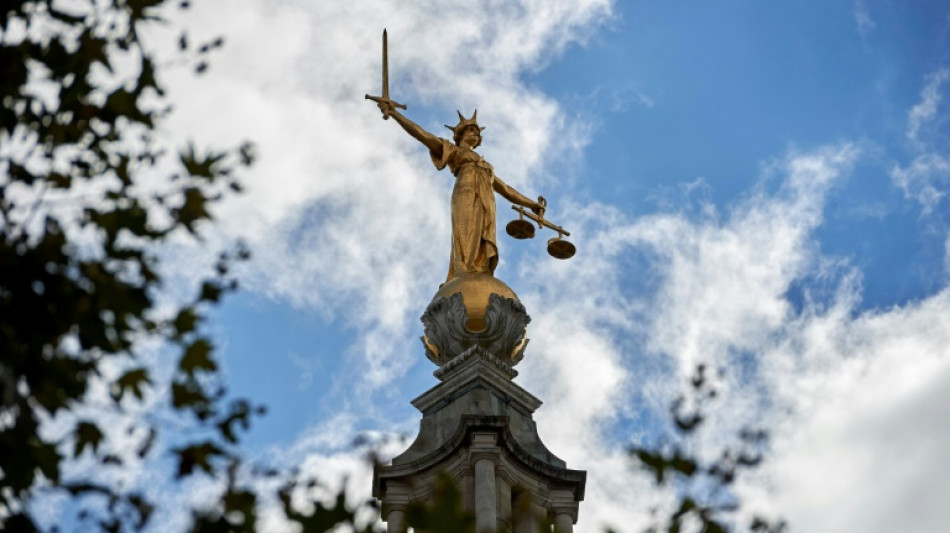
UK criminals to be forced to attend their sentencing / Photo: © AFP

 What to know about the total solar eclipse

 Tentoglou claims fourth Euro long jump title, injured Jacobs falters

 All Blacks knew Nonu would perform solo Haka - coach Rennie

 Britain's Glave upstages Jacobs to win European 100m gold

 Greece's Tentoglou wins fourth European long jump title

 Doctors ignored 'warning signs' before Maradona's death, court hears

 Pereira, the 'zombie city' devastated by Colombia's earthquake

 UN says 2 staff arrested by Afghan intelligence agency

 Colombia scrambles to find survivors as quake kills 240

 Ramsay-Peaty out of medals as Italy's Martinenghi wins European gold

 AI firm Manus to resume 'independent' operations after China blocks Meta deal

 Caught between great powers: the cautionary tale of Manus

 Heatwave hits evicted families sleeping rough in Rome

 US company stokes Greenland tensions by unloading drilling gear

 Cambridge academic in plagiarism row publishes memoir

 LeBron's Sixers hope to spoil Knicks party on NBA opening night
 UK 'on course' to record warmest summer for second year in a row

 Spotify to launch badge identifying AI music

 New plastic treaty document criticised for weaker ambition

 Hungary parliament approves Orban-critic judge as president

 Ebola outbreak in DR Congo kills more than 2,000

 ChargeAfter Powers BYLD Finance Expansion into Consumer Financing for Equipment Retailers

 MEXC Upgrades RealStocks With Three New Features to Enhance U.S. Stock Trading Experience

 Israel demolishes home of slain Palestinian involved in deadly West Bank clash

 Liverpool fans seek clarity on Bezos bid to buy stake

Judgescould be given the power to order criminals to attend their sentencing under planned legislation announced Wednesday by the UK's justice ministry.
It comes after offenders in several high-profile trials were not in court to hear their sentence and statements from the victims' families, prompting repeated calls for a change in the law.
Last week nurse Lucy Letby refused to attend her sentencing for murdering seven babies and attempting to kill six other infants.
Under the proposed reforms, which will apply in England and Wales, judges will have the discretionary power to order criminals to attend sentencing hearings, the justice ministry said.
Custody officers will be able to use "reasonable force" to make the criminals appear in the dock or by video link, "meaning every effort will be made for victims and their families to see justice delivered".
Those who continue to resist attending their sentencing despite a judge's order may face an extra two years behind bars, according to the ministry.
This penalty will apply in cases where the maximum sentence is life imprisonment. Typically, anyone sentenced to life has a minimum tariff to serve before they can be considered for parole.
"It is unacceptable that some of the country's most horrendous criminals have refused to face their victims in court," Prime Minister Rishi Sunak said.
"They cannot and should not be allowed to take the coward's way out," he added.
Sunak said the government would submit proposals to parliament in the coming weeks, calling the move "the right thing to do".
"People rightly expect criminals to face up to the consequences of their actions," he added.
- Concern -
Some lawyers have expressed concern about making attendance for sentencing compulsory, citing fears that the use of force could cause injury to defendants or staff, and disrupt proceedings.
The government, which has been accused of underfunding the criminal justice system for years, at the weekend announced plans to impose more whole-life orders for the worst killers.
Currently, 70 prisoners are serving sentences from which they will never be considered for release.
A torture expert called on the UK government to urgently review indefinite sentences imposed under a previous initiative that has now been scrapped.
Alice Jill Edwards, a special rapporteur to the UN on torture and other cruel, inhuman or degrading treatment or punishment, said nearly 2,900 prisoners were still serving such sentences, which were imposed in England and Wales from 2005-2012.
They were given to offenders deemed to pose a significant risk to public safety until they were no longer considered a threat.
"For many these sentences have become cruel, inhuman and degrading," she said, highlighting UK government figures from 2021 that 65 so-called Imprisonment for Public Protection (IPP) prisoners had killed themselves.
"They have been acknowledged by successive UK governments and even described as indefensible by a justice minister -- yet they persist," she added, calling for better rehabilitation.
"As a general rule, indeterminate sentences should be used sparingly and only for the most serious crimes and offenders. Sentencing should be assessed on an individual basis, taking into account all relevant factors."
J.Horn--BTB