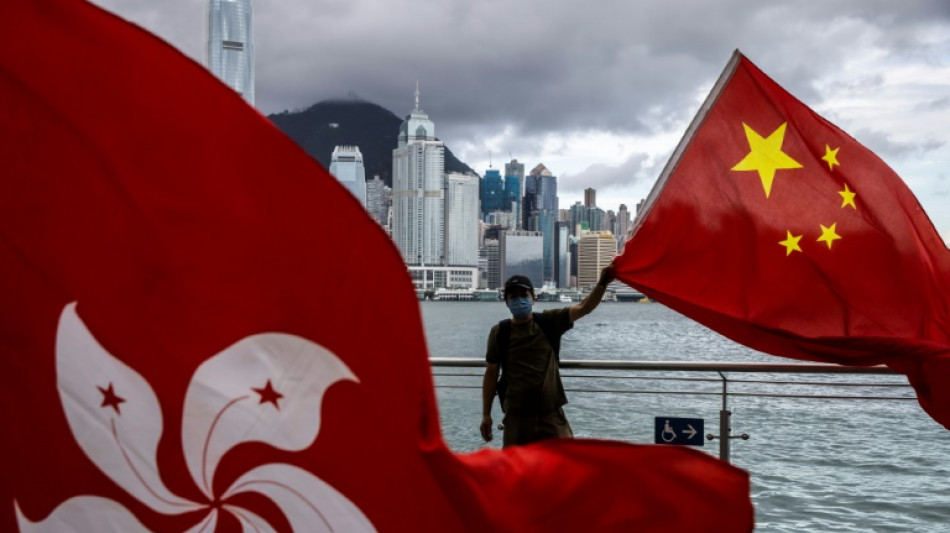
Hong Kong security crackdown targets 'soft resistance' / Photo: © AFP

 New space object 'black hole star' discovered by astronomers

 England captain Root tells players to be 'adults' as he ditches curfew

 US inflation slows slightly in July despite elevated fuel prices

 Total solar eclipse to cast its shadow over Europe
 US consumer inflation slows slightly in July despite elevated fuel prices

 Warholm on track in bid for fourth Euro hurdles gold

 Erdogan eyes expansion of regional defence pact

 Extreme weather, jellyfish knock one-fifth of France's nuclear capacity offline
 Skywatchers gather in Europe to see total solar eclipse
 Zhu Rongji, trailblazing ex-premier who transformed China's economy
 China tech giant Tencent's Q2 profit down as AI push builds

 China's C919 jet makes first international commercial flight

 Mideast war impact on travel bookings fading, TUI says

 Bangladesh get Das fitness boost for daunting Australia task

 One dead, 172 rescued as second ferry in days catches fire in Indonesia

 Foxconn posts quarterly profit surge on AI server demand
 Hazlewood gets Australia nod ahead of Boland for Bangladesh Test
 Toyota ex-chief Okuda, pioneer of the Prius, dead at 93

 Colombia rescuers find woman alive as quake death toll passes 200

 New Zealand PM survives leadership challenge months from election

 Passengers rescued as second ferry in days catches fire in Indonesia

 Oil prices rise, stocks mixed ahead of crucial US inflation data

 UK 'joke' candidate Binface pushes serious point about politics

 New Zealand PM Luxon survives leadership challenge months from election

 Cuba celebrates Castro's 100th as his revolution faces its toughest test

Hong Kong leader John Lee used his policy address on Wednesday to sound the alarm on the threat of "soft resistance" -- a vague term used by Chinese politicians to signal a new chapter in their crackdown against dissent.
The phrase has no clear definition nor is it included in the city's laws, but this week it appeared in a guilty verdict issued by a Hong Kong court for the first time.
Li Jiexin, 69, was convicted Tuesday of unlicensed performance and fundraising after publicly playing "Glory To Hong Kong" -- an anthem that emerged during the city's huge, sometimes violent pro-democracy protests in 2019.
Judge Amy Chan said Li's performance amounted to "soft resistance that instigated social conflicts".
"I was only playing 'do re mi fa so' and it turned out to be an enormous case," Li told reporters outside court.
Beijing imposed a sweeping national security law to quell dissent after the 2019 pro-democracy protests brought hundreds of thousands of people to the streets to call for more autonomy from mainland China.
Hong Kong will complete its own national security legislation next year, Lee said in his address, vowing to finish the task set out in the city's mini-constitution, but which has yet to be done since the territory was returned under Chinese rule in 1997.
The new law could address "soft resistance", according to Security Minister Chris Tang.
The rise of the ambiguous concept has triggered rare debate in Hong Kong's pro-establishment camp, which is the only game in town after the political opposition was wiped out under Beijing's national security law.
Legislator Paul Tse told AFP in August that criminalising "soft resistance" with further national security laws could be damaging.
"There will be a very big grey area and huge censorship threat," he said.
"In the long run it won't benefit us because no society can sustain without noises, not for long."
So far, 280 people have been arrested under Beijing's law.
- 'Hidden within Hong Kong' -
"Soft resistance" was first mentioned in a speech by Luo Huining, Beijing's former liaison chief in Hong Kong, on April 15, 2021 -- a day now dedicated to educating the Hong Kong public about national security.
"Anything that endangers national security, if it belongs to 'hard resistance', it should be struck by law," said Luo. "If it belongs to 'soft resistance', it should be regulated by law."
The term has since been used to describe criminal offences such as sedition, incitement, terrorism, and advocacy for Hong Kong independence, according to security chief Tang.
"Some national security perpetrators have continued to incite, infiltrate and collude with foreign forces through means like 'soft resistance'," Tang told pro-Beijing newspaper Wen Wei Po in June.
He also blamed "soft resistance" for causing "multiple social chaos in Hong Kong over the past 20 years".
Leader Lee -- under US sanctions for his role in cracking down on the 2019 protests -- had in July warned about "destructive forces engaging in soft resistance hidden within Hong Kong".
Taking a lead from Lee, customs commissioner Louise Ho later vowed to "strictly scrutinise 'soft resistance' items being imported".
- 'Ace card' -
Rare dissent emerged on Chinese social media platform WeChat in a July article that went viral.
"A small number of people... have turned the (national security law) into an ace card to promote their initiatives," anonymous influencer Jinghaihou wrote.
Such "irresponsible" use would damage Hong Kong's liberty and political pluralities, the writer said, adding that doing so could also constitute a form of "soft resistance".
The post echoed sentiments of "the relatively rational dove fraction" in Hong Kong's business sector, said a current affairs analyst, who requested anonymity for fear of being labelled as "soft resistance".
"Using soft resistance as an excuse, or the (national security law) as an imperial token is a main reason behind our loss of talents and foreign visitors," the analyst said.
The finance hub has suffered from a brain drain since 2019, with major international operations downsizing or exiting.
"They know if Hong Kong doesn't change path, the city will lose its edge."
Another Hong Kong-based scholar feared the phrase suggested a further crackdown on civil society.
"The regime... wants to completely reshape Hong Kong as an illiberal society with little to no dissidence," the scholar, who requested anonymity, told AFP.
"At the same time, it is likely meant to further strengthen self-censorship, which is already pervasive."
Y.Bouchard--BTB