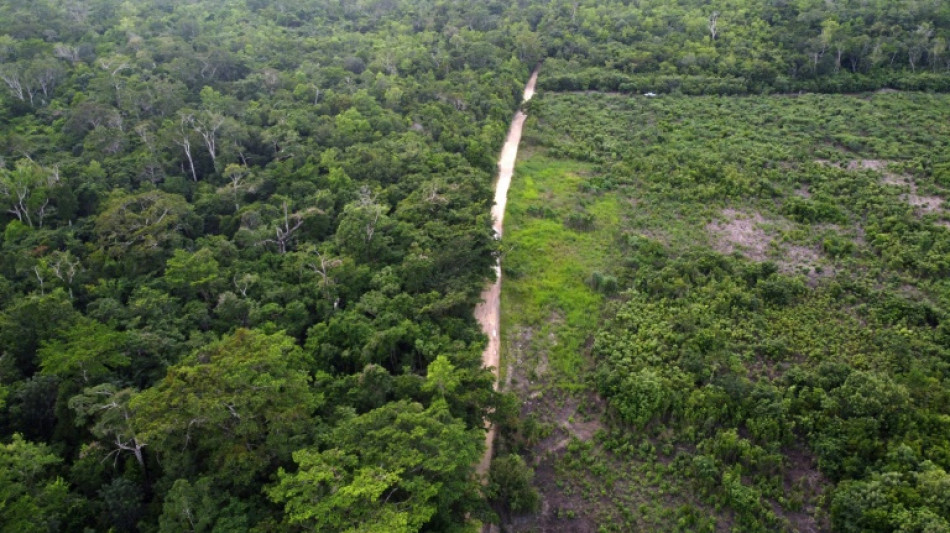
Reclaiming land stolen in heart of Guatemalan reserve / Photo: © AFP

 New space object 'black hole star' discovered by astronomers

 England captain Root tells players to be 'adults' as he ditches curfew

 US inflation slows slightly in July despite elevated fuel prices

 Total solar eclipse to cast its shadow over Europe

 US consumer inflation slows slightly in July despite elevated fuel prices
 Warholm on track in bid for fourth Euro hurdles gold

 Erdogan eyes expansion of regional defence pact

 Extreme weather, jellyfish knock one-fifth of France's nuclear capacity offline
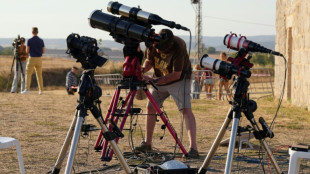 Skywatchers gather in Europe to see total solar eclipse

 Zhu Rongji, trailblazing ex-premier who transformed China's economy

 China tech giant Tencent's Q2 profit down as AI push builds
 China's C919 jet makes first international commercial flight
 Mideast war impact on travel bookings fading, TUI says

 Bangladesh get Das fitness boost for daunting Australia task

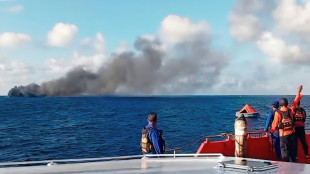 One dead, 172 rescued as second ferry in days catches fire in Indonesia
 Foxconn posts quarterly profit surge on AI server demand
 Hazlewood gets Australia nod ahead of Boland for Bangladesh Test
 Toyota ex-chief Okuda, pioneer of the Prius, dead at 93

 Colombia rescuers find woman alive as quake death toll passes 200

 New Zealand PM survives leadership challenge months from election
 Passengers rescued as second ferry in days catches fire in Indonesia

 Oil prices rise, stocks mixed ahead of crucial US inflation data
 UK 'joke' candidate Binface pushes serious point about politics
 New Zealand PM Luxon survives leadership challenge months from election

 Cuba celebrates Castro's 100th as his revolution faces its toughest test
Ripping up clumps of pasture with the aid of a machete, Leon Acosta is doing his part to reclaim forest area invaded by illegal cattle farmers and others in the heart of Guatemala's protected Maya Biosphere Reserve.
Hacking away in the blazing sun, Acosta is tired, but hopeful.
"Pasture is our biggest challenge," the 35-year-old forest resident told AFP, speaking about the park which covers a fifth of Guatemala and is the largest of its kind in Central America at 2.1 million hectares (5.2 million acres).
Acosta said there was "a sea of pasture" when he joined a community project last year seeking to halt and reverse deforestation while also providing a living for the reserve's 200,000 mainly Indigenous inhabitants.
"We are recovering hectares... of native trees, of cedars here from the forest itself," he said proudly in La Colorada, a 22,067-hectare section of the reserve.
Some 600 hectares of La Colorada remains under illegal pasture, said Acosta.
He is taking part in a trial collaboration between the Selva Maya del Norte group of forest communities, the Guatemalan government and the New York-based Wildlife Conservation Society (WCS).
The Maya Biosphere Reserve, near the borders with Mexico and Belize, saw deforestation rise from 20 percent of its total area in 2000 to 33 percent in 2022 due to illegal logging, fires for land clearing and the planting of pasture for livestock.
It plays host to a variety of wildlife, lagoons and streams that feed entire ecosystems and makes a vital contribution to sucking up planet-warming carbon dioxide.
The reserve also holds, at its very center, the Mayan city of Tikal, which reached its peak between 200 and 900 AD and is today Guatemala's main archaeological landmark and a UNESCO World Heritage Site.
- Satellites vs invaders -
In 2001, the community of La Colorado received a three-decade concession from the government to engage in sustainable production in the biosphere reserve.
Acosta and others work to destroy pasture and plant new trees to renew the forest.
With training and support from the WCS, they also produce honey and some crops for subsistence and sale, plant sustainable trees for small-scale timber harvesting, and dabble in eco-tourism.
But the project has run into problems.
Some of the land in La Colorada fell into the hands of usurpers -- including strangers allied to drug gangs that use it to launder money with livestock farming or even to land and launch drug planes, community members told AFP on condition of anonymity.
It is a tug of war between the government and environmentalists on one hand, and land grabbers on the other.
Guatemalan authorities use satellites to locate illegal cattle farms.
But the wheels of bureaucracy and justice turn slowly and it can take years for invaders to be evicted, said Apolinario Cordova, regional director of the government's National Council of Protected Areas (CONAP).
We need "to strengthen the inter-institutional (security) presence," he told AFP.
There are soldiers and police at the gates to the reserve, but the invasions continue amid porous borders around the enormous expanse of land.
- 'Giving life' -
Despite the setbacks, more than 157,000 hectares of land have been reclaimed in the reserve in the past 10 years, of which nearly a third has been reforested, according to the WCS.
In Cruce a La Colorada, another section of the reserve, locals opted for an agroforestry model: growing maize, beans, sweet potatoes and cassava among newly planted trees for timber.
Given that the trees will take 10-20 years to mature, "our children will be the generation to benefit" from them, resident Antonio Juarez, 38 told AFP.
But for some of the reserve's impoverished communities, it is difficult to have such a long-term view.
In San Miguel, another area where locals are trying their hand at beekeeping, 25-year-old Melsar Cardona says honey is not enough to stake a future on.
Like many other Guatemalans, he is considering migrating to the United States.
Slowly but surely, birdsong is again becoming the dominant sound in the forest, replacing that of chainsaws and cattle.
Even jaguars are making a comeback, as revealed by hidden cameras.
These creatures all help disperse seeds that also contributes to forest restoration, said Acosta.
"With every tree we plant... we feel we are giving life to the whole world," WCS reforestation coordinator Cesar Paz told AFP.
Added Juarez: "We know that the forest is life for us."
B.Shevchenko--BTB