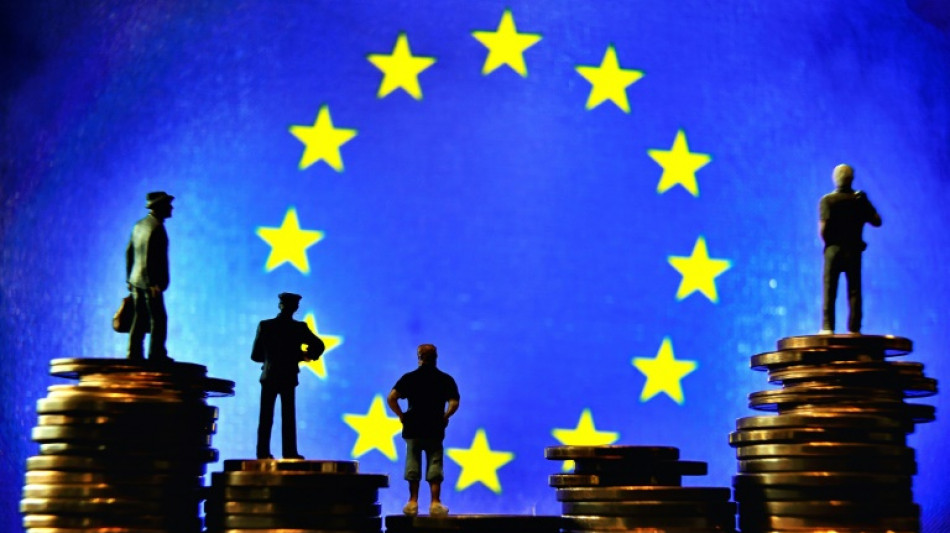
EU reaches agreement on spending rules / Photo: © AFP/File

 French Olympic gold medallist Florent Manaudou announces retirement

 Tourists rescued by boat as forest fire threatens Greek beaches

 Indicted Raul Castro reappears after months out of public view

 Italian teen Curtis breaks women's 50m backstroke world record for second time

 Taulagi steps out of 'comfort zone' with code switch to French Top 14 new boys
 Leicester's Thai owners put troubled club up for sale: reports
 Stocks steady as US inflation worries ease, oil slips

 Porsche to end production of flagship electric car: report

 Twitch sparks gamers' wrath with Amazon AI sharing deal

 Blaze forces families to abandon Turkish tour boat

 'If you can, move!' say Rome's viral dancing seniors

 Zambia voters weigh Hichilema's economic record

 SBCFX to Showcase Trading Innovation, Regional Growth Strategy, and Future Vision at iFX EXPO Asia 2026
 Hodgkinson sets up Werro showdown after Euro 800m drama

 'How many will die?': the mysterious ailment killing Kenyan elephants

 Arteta coy over Lewis-Skelly's Arsenal future after 'emotional' celebration

 Romania shuts down nuclear plant as Danube drops

 German steel giant Thyssenkrupp weighs options as Rhine drops

 US ambassador denounces settler siege as Israel dispatches troops

 Hasan takes 6-55 as Bangladesh claim opening day of Australia Test

 Taiwan says AI agents used in cyberattacks targeting island

 Japan protests Putin's first visit to disputed islands

 Kiss wants fit-again Wallabies playmaker Gordon to 'open up' Japan

 British eccentrics push humble garden shed to new heights

 Zambia votes with president's economic record on the line

The European Parliament and member states reached an agreement early Saturday on reforms to EU budgetary rules aimed at boosting investment while keeping spending under control.
The text modernises the current rules, known as the Stability and Growth Pact, created in the late 1990s, which limit countries' debt to 60 percent of gross domestic product and public deficits to three percent.
"Deal!," the Belgian Presidency of the Council of the EU said on social media platform X after 16 hours of talks.
The European Union spent two years making an intensive effort to develop reforms supported by the more frugal member states like Germany and other countries, such as France and Italy, which seek more flexibility.
After much wrangling between Berlin and Paris, the 27 member states struck a deal in December, then began talks with negotiators from the European Parliament.
The text was criticised for its great complexity and derided by left-wing officials as a tool for imposing austerity on Europe.
The negotiators finally reached an agreement early Saturday, in time for the text to be voted on in Strasbourg this spring before the parliamentary break ahead of European elections.
The reforms will be formally adopted after agreement between lawmakers and states.
The agreement will allow member states to apply the new rules to their 2025 budgets.
"The new rules will help achieve balanced & sustainable public finances, structural reforms, foster investments, growth & jobs creation in the EU," the Belgian presidency said.
- Wiggle room -
The former budgetary framework was considered too drastic and was never really respected.
The rules had, however, been suspended since the coronavirus pandemic to give member states wiggle room to spend more during a period of great economic upheaval.
During the initial debates between countries, the battle was fierce over how much those old limits should be relaxed to give more room for investment.
With war raging in Europe and the EU making a green transition push, states led by France argued for allowing more space to finance these key areas, including, for example, supplying critical arms to Ukraine.
While confirming the previous limits on debt and budget deficits, the new agreement allows more flexibility in the event of excessive deficits.
The text provides looser fiscal rules more adapted to the particular situation of each state, allowing big spenders a slower route back to frugality.
The tailor-made approach means each country presents their own adjustment trajectory to ensure their debt's sustainability, giving them more time if they undertake reforms and investments and allowing a less painful return to fiscal health.
Monitoring would focus on expenditure trends, an economic indicator considered more relevant than deficits, which can fluctuate depending on the level of growth.
But Germany and its "frugal" allies managed to tighten this budgetary framework by imposing a quantifiable minimum effort to reduce debt and deficits for all EU countries, despite the reluctance of France and Italy.
These modifications have greatly complicated the text.
"We have a deal! A new economic governance framework was much needed," Dutch MEP Esther de Lange said on X.
"We have ensured that the new fiscal rules are sound and credible, while also allowing room for necessary investments," said de Lange, of the centre-right European People's Party Group.
The reforms are also supported by the EU's Renew liberals and a large majority of the Socialist and Democrat groupings.
The Greens and some S&D elected officials, however, reject it, as do the radical left.
These elected officials have denounced a return to austerity after three years of suspended budgetary rules due to the pandemic and war in Ukraine.
"We need investments in industry, in defence, in the ecological transition, that's the urgency today, it is not to bring economically absurd rules up to date," economist and S&D MEP Aurore Lalucq of France told AFP.
She denounced it as a "political error which will be used by populists to attack Europe".
S.Keller--BTB