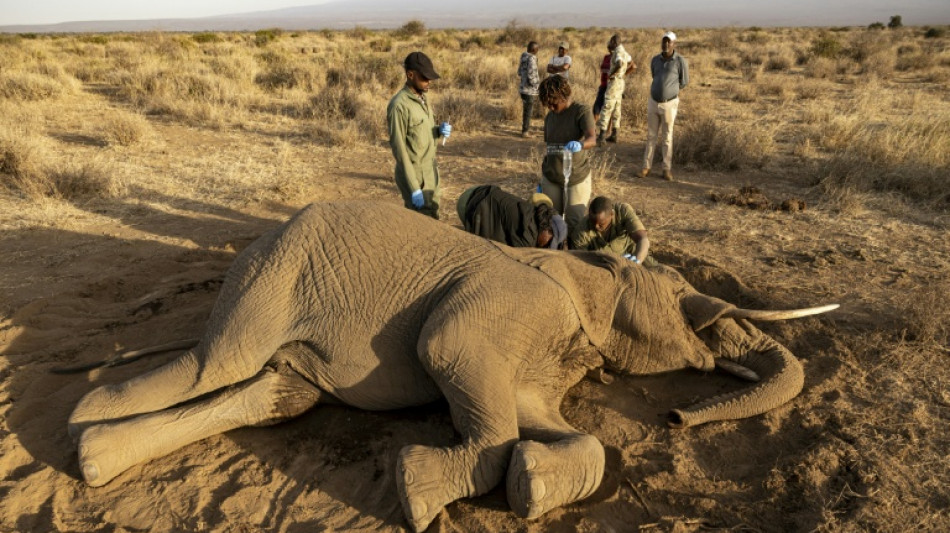
'How many will die?': the mysterious ailment killing Kenyan elephants / Photo: © AFP

 Infantino future should be decided by election says African football chief

 Man City star Doku signs five-year contract extension

 Fabien Barthez joins Zidane's new France coaching setup

 Taiwan chokes mobile internet speeds in drill for Chinese attack

 From Chinese AI to Global ETFs: STARTRADER Launches 45 New 24/7 Stock and ETF CFDs

 Tech stocks enjoy rebound after US inflation on mixed day for markets

 Hasan takes 6-55 as Bangladesh bundle out Australia for 198

 Swiatek sinks Svitolina to set up Rybakina title clash in Toronto

 Australia's Pallister shines, mixed relay record falls as Pan Pacs open

 Hasan puts Bangladesh in charge as Australia struggle to 183-8
 Putin visits Kuril islands claimed by Japan

 Swiatek downs Svitolina to reach first WTA final of 2026

 Jones says Japan 'watching videos of geese' for Australia clash

 Bloodied but unbowed, defending champ Shelton reaches Montreal final

 Wallabies make eight changes for return Japan Test

 Messi returns after father's death but Miami knocked out of Leagues Cup

 Outflanked by AI, stars fade for South Korea's blind fortune-tellers

 Venezuela govt, opposition wrap up round of post-Maduro talks

 Five things to know about Zambia as it goes to the polls

 Nakashima holds off Jodar to book first ATP Masters final in Montreal

 Grieving Messi available for Miami in Leagues Cup clash

 Colombia enters 'final phase' of quake search as toll hits 265

 Father-figure Christie helps guide Kounta to European silver

 McIlroy returns to St. Jude to launch marathon PGA playoff push

 Guimaraes makes Arsenal debut in Como friendly

Lying on the ground and kicking up a cloud of dust, the elephant slowly exhausted himself in futile attempts to stand, the latest potential victim of a still-mysterious ailment in southern Kenya.
Distressed vets administered a glucose injection -- the only option, given that the cause of the ailment remains unknown -- to the 11-year-old male, known as Genghis Khan, who was struggling to breathe.
The mystery affliction has killed at least 19 pachyderms, mostly females or young males, since June in Kenya -- with all of the animals exhibiting identical symptoms, including partial paralysis.
Elephant herds have made Amboseli -- overlooked by Africa's highest peak, Mount Kilimanjaro in Tanzania -- a lucrative tourist hotspot and the mysterious deaths in the region are a sensitive issue in a country where tourism is a huge source of revenue.
"You would find one struggling for a day, struggling for two or even three days. Until they completely die," said Patrick Papatiti, head of operations for Olgulului communal lands, which includes the Kitenden B reserve where Genghis Khan was found.
In late July, the Kenya Wildlife Service (KWS) said toxicology reports found high concentrations of cyanide in the animals' carcasses, suggesting possible pesticide poisoning from nearby farms' crops.
- Carcasses -
While observers still question the possible cause of death, several specialists interviewed by AFP dismiss poisoning.
"It's a disease," said Papatiti, who was born and raised in the local Maasai community, insisting there was "no way" cyanide was involved.
He is one of the very few local voices publicly rejecting the KWS preliminary findings, pointing out that no other animals have died.
Notably, neither scavengers nor flies that fed on the supposedly poisoned carcasses have perished -- creatures that typically succumb after consuming poisoned animals.
"If another animal feeds on that carcass and it is not dying, then definitely it is not a chemical," Joel Nyika, the Amboseli ecosystem manager for the Kajiado County authorities, told AFP.
He dismisses the theory, also put forward by the KWS, that the cyanide might have come from a type of foliage, noting local livestock would have died as well.
"As wildlife managers, we believe it could be a disease that is only affecting these elephants."
On August 7, the KWS said their "findings to date do not indicate an infectious or transmissible disease", assuring tourists that they could continue to visit.
But in the Kimana reserve, AFP journalists saw six carcasses on Wednesday -- some fresh, others older -- with rangers also observing partial paralysis, preventing the animals from standing.
- 'How many will die? -
Some of the deaths occurred only days earlier.
The carcass of a four-month-old calf, swarming with flies, lay half-devoured by hyenas.
About a dozen vultures were feeding on the remains of a pregnant female elephant, who had died near full term, and her unborn calf.
Paula Kahumbu, conservationist and head of Wildlife Direct, highlighted the "lack of evidence" supporting the pesticide theory.
In an interview with AFP, she noted that few adult male elephants had died, even though they are the ones most likely to raid crops.
Olgulului's Papatiti also dismissed the theory of deliberate poisoning. He said the emphasis should not be on pinning blame on individuals but finding the cause: "We need to know what is killing our elephants."
The sensitivity of the deaths has spooked the wildlife community, with several environmental organisations declining to comment to AFP beyond calling for a full investigation, while rangers at the Kimana reserve said they were not authorised to speak.
Papatiti fears that the death toll is being underestimated and that the affliction may also be affecting elephants in neighbouring Tanzania.
"How many elephants will die before we can stop this?"
O.Lorenz--BTB