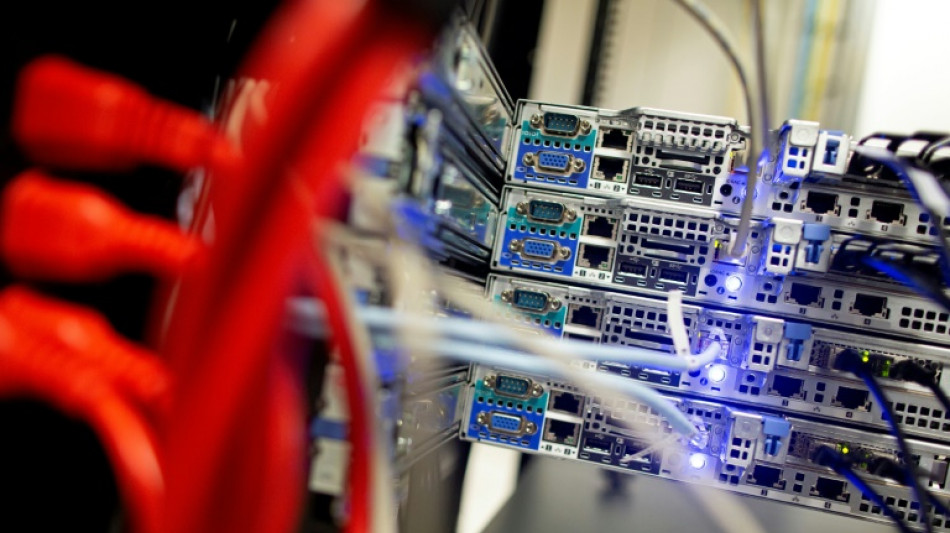
'World's most harmful': What is the LockBit cybercrime gang? / Photo: © AFP/File

 Britain's Hunt wins 200m for European sprint double

 Draper dumped as Norrie saves face for Britain in Cincinnati

 England opener Gay out for duck in Pakistan warm-up

 Europe swelters under fresh wave of extreme heat

 French Olympic gold medallist Florent Manaudou announces retirement

 Tourists rescued by boat as forest fire threatens Greek beaches

 Indicted Raul Castro reappears after months out of public view

 Italian teen Curtis breaks women's 50m backstroke world record for second time

 Taulagi steps out of 'comfort zone' with code switch to French Top 14 new boys

 Leicester's Thai owners put troubled club up for sale: reports

 Stocks steady as US inflation worries ease, oil slips

 Porsche to end production of flagship electric car: report

 Twitch sparks gamers' wrath with Amazon AI sharing deal

 Blaze forces families to abandon Turkish tour boat

 'If you can, move!' say Rome's viral dancing seniors

 Zambia voters weigh Hichilema's economic record

 SBCFX to Showcase Trading Innovation, Regional Growth Strategy, and Future Vision at iFX EXPO Asia 2026

 Hodgkinson sets up Werro showdown after Euro 800m drama

 'How many will die?': the mysterious ailment killing Kenyan elephants

 Arteta coy over Lewis-Skelly's Arsenal future after 'emotional' celebration

 Romania shuts down nuclear plant as Danube drops

 German steel giant Thyssenkrupp weighs options as Rhine drops

 US ambassador denounces settler siege as Israel dispatches troops

 Hasan takes 6-55 as Bangladesh claim opening day of Australia Test

 Taiwan says AI agents used in cyberattacks targeting island

An international law enforcement operation has taken down dozens of servers and disrupted LockBit, "the world's most harmful cyber crime group" according to British authorities.
LockBit and its affiliates caused billions of dollars in damage and extracted tens of millions in ransom from their victims. Their targets have included banks, mail services and even a children's hospital.
How does LockBit operate?
Rather than conduct an entire criminal operation itself, LockBit developed the malicious software -- "ransomware" -- that enables attackers to lock victims out of their computers and networks.
Victims were then told to pay ransom in cryptocurrency in exchange for regaining access to their data. Those who did not pay risked having their data dumped on the dark web.
The "LockBit" ransomware was first observed in 2020, and made money through up-front payments and subscription fees for the software, or from a cut of the ransom, according to the US Cybersecurity & Infrastructure Security Agency (CISA).
The model is known as "Ransomware as a Service", or RaaS.
LockBit usually conducted itself as a professional enterprise, seeking feedback from customers -- called "affiliates" -- and rolling out ransomware improvements.
"LockBit operates like a business. They run -- or ran -- a tight ship, which has enabled them to outlast many other ransomware operations," Brett Callow, a threat analyst at the cybersecurity firm Emsisoft, told AFP.
LockBit is believed to have operated out of multiple locations, and cybersecurity experts say its members were Russian speakers.
How lucrative is ransomware?
In 2023, extortions by ransomware groups exceeded $1 billion in cryptocurrency for the first time, according to data published this month by blockchain firm Chainalysis.
LockBit has targeted more than 2,000 victims worldwide, receiving more than $120 million in ransom, the US Department of Justice said Tuesday.
These potentially huge payouts have emboldened cybercriminals.
"Awash with money, the ransomware ecosystem surged in 2023 and continued to evolve its tactics," the cybersecurity firm MalwareBytes said in a report published this month.
"The number of known attacks increased 68 percent, average ransom demands climbed precipitously, and the largest ransom demand of the year was a staggering $80 million."
That demand came after a LockBit attack severely disrupted Britain's post operator Royal Mail for weeks.
Who are LockBit's victims?
LockBit ransomware has been used against a wide variety of targets, from small businesses and individuals to huge corporations.
It was used "for more than twice as many attacks as its nearest competitor in 2023", according to MalwareBytes.
The group has gained notoriety and attention from law enforcement agencies after high-profile attacks such as the one on Royal Mail.
Last November, it was blamed for an attack on the US arm of the Industrial and Commercial Bank of China (ICBC) -- one of the biggest financial institutions in the world -- as well as US aerospace giant Boeing.
In 2022, a LockBit affiliate attacked the Hospital for Sick Children in Toronto, Canada, disrupting lab and imaging results. LockBit reportedly apologised for that attack.
"Although LockBit developers have created rules stipulating that their ransomware will not be used against critical infrastructure, it is clear that LockBit affiliates largely disregard these rules," Stacey Cook, an analyst at the cybersecurity firm Dragos, wrote in a report published last year.
"LockBit developers do not appear to be overly concerned with holding their affiliates accountable."
Who is fighting back, and how?
LockBit's growing visibility and its affiliates' increasing attacks meant law enforcement agencies ramped up their efforts to win this cat-and-mouse game.
An alliance of agencies from 10 nations, led by Britain's National Crime Agency, on Tuesday said they had disrupted LockBit at "every level" in an effort codenamed "Operation Cronos".
Europol said 34 servers in Europe, Australia, the United States and Britain were taken down and 200 Lockbit-linked cryptocurrency accounts were frozen.
The NCA said the action had compromised LockBit's "entire criminal enterprise".
"This likely spells the end of LockBit as a brand. The operation has been compromised and other cybercriminals will not want to do business with them," Emsisoft's Callow told AFP.
But in recent years, cybersecurity experts have detected ransomware groups that suspended operations following law enforcement action only to re-emerge under different names.
"Our work does not stop here. LockBit may seek to rebuild their criminal enterprise," NCA Director General Graeme Biggar said in a statement.
"However, we know who they are, and how they operate. We are tenacious and we will not stop in our efforts to target this group and anyone associated with them."
I.Meyer--BTB