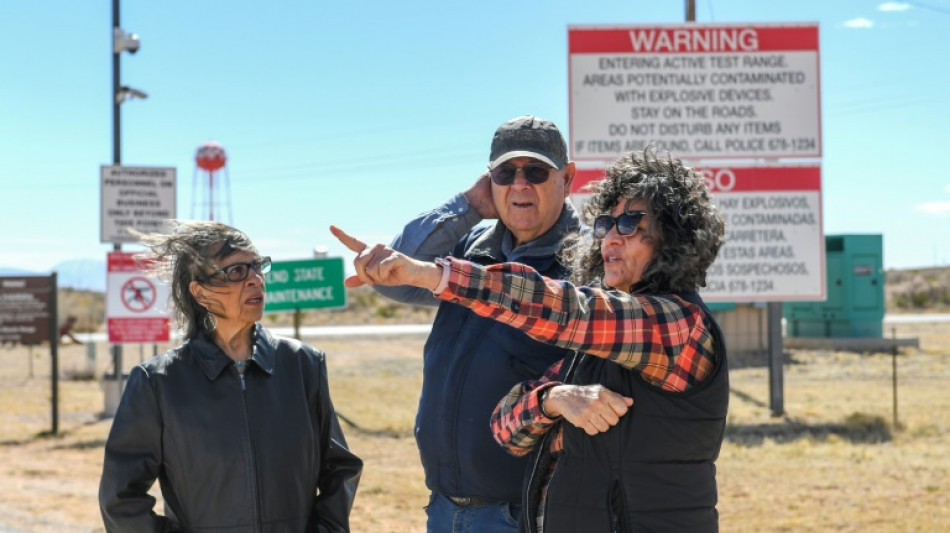
Ignored by 'Oppenheimer,' atomic test victims speak out / Photo: © AFP

 New Zealand Football withdraws support for Infantino, urges review
 Hopes fade in Colombia as window to find quake survivors shuts
 Trump announces tariffs of up to 100% on imported drones

 Spieth among five sharing Memphis lead as PGA playoffs open
 Boats rescue tourists as forest fire flames threaten Greek beaches

 Good vibes powering Djokovic return to Cincinnati
 Britain's Hunt wins 200m for European sprint double

 Draper dumped as Norrie saves face for Britain in Cincinnati
 England opener Gay out for duck in Pakistan warm-up
 Europe swelters under fresh wave of extreme heat

 French Olympic gold medallist Florent Manaudou announces retirement
 Tourists rescued by boat as forest fire threatens Greek beaches
 Indicted Raul Castro reappears after months out of public view
 Italian teen Curtis breaks women's 50m backstroke world record for second time
 Taulagi steps out of 'comfort zone' with code switch to French Top 14 new boys

 Leicester's Thai owners put troubled club up for sale: reports

 Stocks steady as US inflation worries ease, oil slips
 Porsche to end production of flagship electric car: report

 Twitch sparks gamers' wrath with Amazon AI sharing deal

 Blaze forces families to abandon Turkish tour boat

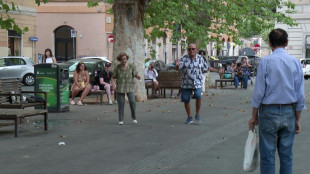 'If you can, move!' say Rome's viral dancing seniors

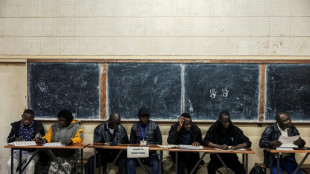 Zambia voters weigh Hichilema's economic record

 SBCFX to Showcase Trading Innovation, Regional Growth Strategy, and Future Vision at iFX EXPO Asia 2026

 Hodgkinson sets up Werro showdown after Euro 800m drama

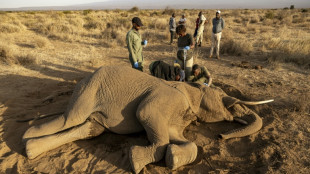 'How many will die?': the mysterious ailment killing Kenyan elephants

Wesley Burris was fast asleep in bed when the world's first atomic bomb exploded just 25 miles from his front door.
A blinding light filled the home in the New Mexico desert, before the impossible force of the blast shattered its windows, spraying glass across the four-year-old boy and his brother.
"It was so bright, I couldn't see," Burris recalls. "I can remember asking, 'Dad, what happened? Did the Sun blow up?'"
The events of 5:30 am on July 16, 1945 are now best known to millions from their dramatic re-enactment in the Oscar-tipped movie "Oppenheimer."
But they loom large in the actual memory of Burris, who is now 83 years old and still living just a few miles from the secret location where scientists and military chiefs gathered on that historic morning.
Because while the film presents the Trinity test site as a vast, empty desert, Burris and his family were among thousands who lived within a 50-mile (80-kilometer) radius.
And like all of their neighbors, the family had no clue what was going on -- or why a giant mushroom-shaped cloud was spreading across their horizon.
"We weren't scared from it. Because it didn't kill us right there," he told AFP. "We had no idea what it was."
Fast-forward eight decades, and Burris knows all too well the true deadliness of that explosion, which sent radioactive material 50,000 feet (15,000 meters) into the air.
The test took place amid thunderstorms, despite scientists' warnings, in the race to have the bomb ready for a key World War II summit with the Soviets.
Torrential rains brought toxic debris straight back down, where it irradiated the desert dust, the water supplies and the food chain.
Burris has lost his brother to cancer. His sister had it too, as does her daughter.
And he himself has skin cancer, which he tries to treat with traditional Native American medicine.
Despite all this, no New Mexican affected by radiation from the Trinity test has received a dime in compensation.
"We were guinea pigs," said Tina Cordova, a cancer survivor who runs the Tularosa Basin Downwinders Consortium, calling for justice.
"But they come back and check on guinea pigs. Nobody's ever come back to check on us."
- 'Oppenheimer' -
For campaigners like Cordova, Christopher Nolan's "Oppenheimer" has at least introduced the concept of the Trinity test to millions of people around the world.
"But it didn't go far enough," she told AFP.
The film is the overwhelming favorite to sweep multiple Oscars on March 10, including best picture.
"Wouldn't it be remarkable if during the Academy Awards, any one of them said, 'I want to acknowledge the sacrifice and suffering of the people of New Mexico,'" said Cordova.
"They knew about us when they made the film -- they just chose to ignore us again."
Cordova -- one of five generations in her family diagnosed with cancer since 1945 -- hopes such recognition could finally put pressure on the US Congress to extend compensation to her state.
The clock is ticking.
The current Radiation Exposure Compensation Act does support those who lived near sites where nuclear tests were later conducted in Nevada, Utah and Arizona. But even that expires in June.
And a bid to broaden its scope to include those exposed to the very first atomic explosion, having been approved by the US Senate last year, was ripped out of a giant defense bill in December by the House of Representatives, over concerns about its cost.
"This shouldn't be how we live. We hold bake sales and garage sales and enchilada suppers so that we can raise the money to help these families," said Cordova.
"Maybe the Pentagon should have to have a bake sale every week to meet their budgetary demands, the same way we have to."
According to "First We Bombed New Mexico," a new documentary following Cordova's campaign, the families affected by radiation are "mostly Hispanic and Native."
- 'Bunch of lies' -
Burris was not impressed by the recent "Oppenheimer" movie.
"Yeah, I've seen it, but that film is a bunch of lies," he said.
"How many people died out here? They never said nothing about that."
But he has long become resigned to being brushed aside by history.
Way back in July 1945, his family were eventually told an ammunition explosion had occurred.
Compounding the mystery, two strange men with binoculars were spotted watching the explosion from trucks parked near their front yard.
"They wouldn't tell us anything," he recalls.
A few years later, another group of men appeared near the home, wearing white suits and masks.
His brother approached them, asking why they were digging a hole in the ground and collecting samples.
"They said, 'You need to get out of here. This will kill you,'" recalled Burris.
"And he said, 'Where am I going (to go?) We live right here in this house.'"
A.Gasser--BTB