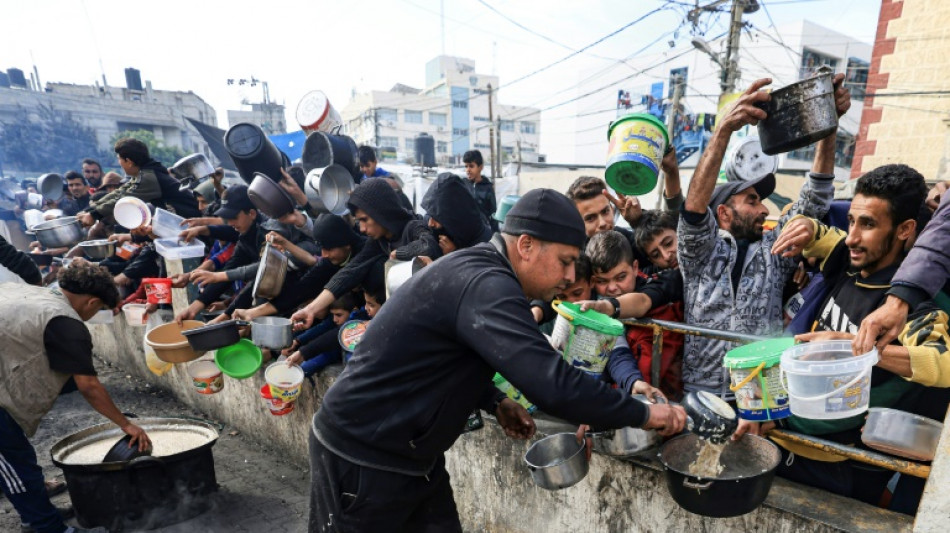
Criteria UN will use to declare expected 'famine' in Gaza / Photo: © AFP

 New Zealand Football withdraws support for Infantino, urges review

 Hopes fade in Colombia as window to find quake survivors shuts
 Trump announces tariffs of up to 100% on imported drones

 Spieth among five sharing Memphis lead as PGA playoffs open

 Boats rescue tourists as forest fire flames threaten Greek beaches

 Good vibes powering Djokovic return to Cincinnati
 Britain's Hunt wins 200m for European sprint double

 Draper dumped as Norrie saves face for Britain in Cincinnati

 England opener Gay out for duck in Pakistan warm-up

 Europe swelters under fresh wave of extreme heat

 French Olympic gold medallist Florent Manaudou announces retirement
 Tourists rescued by boat as forest fire threatens Greek beaches
 Indicted Raul Castro reappears after months out of public view
 Italian teen Curtis breaks women's 50m backstroke world record for second time

 Taulagi steps out of 'comfort zone' with code switch to French Top 14 new boys

 Leicester's Thai owners put troubled club up for sale: reports

 Stocks steady as US inflation worries ease, oil slips
 Porsche to end production of flagship electric car: report

 Twitch sparks gamers' wrath with Amazon AI sharing deal

 Blaze forces families to abandon Turkish tour boat

 'If you can, move!' say Rome's viral dancing seniors

 Zambia voters weigh Hichilema's economic record

 SBCFX to Showcase Trading Innovation, Regional Growth Strategy, and Future Vision at iFX EXPO Asia 2026

 Hodgkinson sets up Werro showdown after Euro 800m drama

 'How many will die?': the mysterious ailment killing Kenyan elephants

The UN, which has warned of "almost inevitable" widespread starvation in northern Gaza, uses strict criteria to declare a famine.
In the Jabalia refugee camp north of Gaza City, dozens of children wander around carrying empty pots, looking for anything edible.
Nearly five months after the start of the war, Gazans are despairing at the little humanitarian aid entering the coastal territory, particularly in the north. Some say they resort to eating leaves, or fodder for livestock.
In deciding whether or when to declare a famine, the UN relies on its specialised agencies based in Rome, the World Food Programme (WFP) and Food and Agriculture Organization (FAO), which in turn use the Integrated Food Security Phase Classification (IPC).
The IPC gathers evidence -- such as how many households are facing an extreme lack of food -- to draw up its Acute Food Insecurity scale, which is then used to inform decisions, such as how resources are allocated.
- What is famine? -
Famine exists in areas where at least one in five households has or is most likely to have an extreme deprivation of food and face starvation, death, destitution and extremely critical levels of acute malnutrition.
"If nothing changes, a famine is imminent in northern Gaza," WFP's deputy executive director Carl Skau told the UN Security Council on Tuesday.
No humanitarian group has been able to provide aid to the area since January 23, as Israel wages war on Palestinian militant group Hamas.
The UN estimates that 2.2 million people, the vast majority of Gaza's population, are on the brink of famine -- particularly in the north, where Israeli forces block aid from entering.
Some 97 percent of groundwater in Gaza is "reportedly unfit for human consumption", and agricultural production is beginning to collapse, Maurizio Martina, deputy director general of the FAO, told the Council.
UN aid chief Martin Griffiths last week wrote to the Security Council calling on members to act to prohibit "the use of starvation of civilian population as a method of warfare."
- How is famine measured? -
Famine tops the IPC's food insecurity scale, which has five phases.
Phase one is "Minimal" or no food insecurity in households. Phase two is when households are "Stressed", phase three is when they are in "Crisis", and phase four is "Emergency".
Phase five, "Catastrophe / Famine" is when households experience "extreme critical levels of acute malnutrition and mortality".
For famine to be declared, these three things must happen:
- at least 20 percent of households must face an extreme lack of food.
- one out of three children must be acutely malnourished.
- there must be two deaths for every 10,000 inhabitants, or four child deaths out of 10,000 children per day, due to starvation or malnutrition and disease.
The UN children's agency UNICEF has warned that the alarming lack of food, surging malnutrition and disease could lead to an "explosion" in child deaths in Gaza.
- Causes of famine -
The main causes of famine are:
- natural disasters such as drought, floods, or earthquakes; human pandemics and epidemics such as measles; or crop pests like locusts.
- economic crises which can affect food prices and employment opportunities.
- when humanitarian aid is not brought in quickly or efficiently enough.
- conflict, which often leads to population displacements, prevents people from cultivating land, and destroys markets and infrastructure.
In Jabalia, 60-year-old Palestinian farmer Abu Gibril told AFP last week he was so desperate for food to feed his family that he slaughtered two of his horses.
"We had no other choice but to slaughter the horses to feed the children. Hunger is killing us," he told AFP.
- Who declares famine? -
Once the criteria determined by the IPC are met, it is up to government authorities and UN agencies to declare a famine.
The IPC told AFP on Thursday that its next detailed report on Gaza is expected at the beginning of March.
S.Keller--BTB