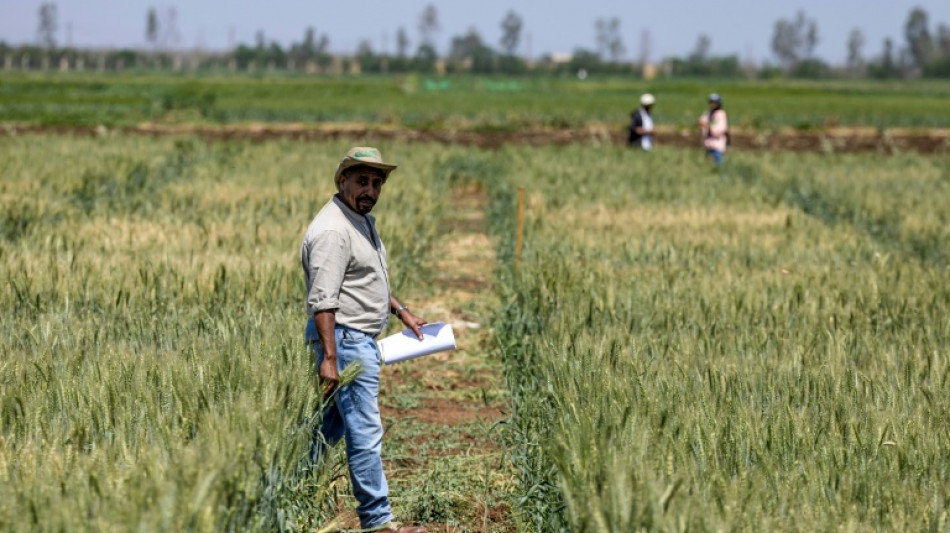
Morocco's farming revolution: defying drought with science / Photo: © AFP

 Norway's hurdles king Warholm wins fourth European title

 Liverpool deal with Bezos consortium raises stakes in US battle for Premier League power

 Colombia hopes for miracles as search for quake victims goes on

 Popovici, Quadarella mine more gold at Europeans as Marchand flexes in butterfly

 'I shot Mr Thompson': Stunning confession in US health exec's slaying

 San Francisco to host 2028 MLB All-Star Game

 Trump dismisses concerns over conditions on US aircraft carrier

 Zambia resumes vote count after pause over violence

 Wind spurs forest fire in western Germany, with scores evacuated

 Pakistan captain Babar in injury scare ahead of England opener

 Mangione admits shooting health care CEO

 UN warns sanctions chill is stopping Cuba aid

 Alleged US healthcare CEO killer says will plead guilty to stalking

 France's Macron in hot water over jet ski picture
 Nursing federation demands proper pay, protection on Ebola front line

 France upholds assisted dying law, strikes down social media ban for children

 Body found after wildfire hits Croatian coastal town

 Arteta expects Maresca to do an 'unbelievable job' at Man City

 Stocks tread water with eyes on oil price

 US retail sales weakest in over a year in July

 Israel calls for police to replace military in handling West Bank settlers

 स्कैंडिक पे: दुनिया में कहीं भी, बिना किसी सीमा के भुगतान करें।

 SNC 스칸딕 페이: 전 세계 어디서나, 제한 없이 결제하세요

 SNC SCANDIC PAY: Platby po celém světě bez omezení

 SNC SCANDIC PAY: Płatności na całym świecie bez ograniczeń

In the heart of sun-soaked Morocco, scientists are cultivating a future where tough crops defy a relentless drought, now in its sixth year.
"Look at these beautiful ears of wheat," said Wuletaw Tadesse Degu, the head of wheat breeding at the International Center for Agricultural Research in Dry Areas (ICARDA).
"The difference in quality between our field and others is striking," he said, pointing towards a lush expanse in Marchouch, south of Rabat, that stood in stark contrast with the barren lands elsewhere.
By 2040, Morocco is poised to face "extremely high" water stress, a dire prediction from the World Resources Institute, a non-profit research organisation.
Figures from the North African country's central bank paint a grim picture.
Cultivated areas across the kingdom are expected to shrink to 2.5 million hectares in 2024 compared with 3.7 million last year, with cereal yields more than halving to 25 million quintals (2.5 million tonnes) over the same period.
"It has become essential to use resilient seeds and to employ them as quickly as possible," said Tadesse, whose centre recently inaugurated a plant gene bank.
- Adapted genotypes -
Tadesse's mission is to develop genotypes that not only withstand drought and heat but also yield abundantly.
Last year, while the nation struggled, Marchouch achieved a yield of four tonnes per hectare with just 200 millimetres of rainfall.
Controlled irrigation and strategic sowing techniques are behind this agricultural revolution.
Looking to maximise production, farmers are experimenting with planting times and judicious irrigation.
Even a scant 10 millimetres of water, carefully applied, transformed barren soil into thriving fields.
Barley, too, has seen a resurgence, with yields jumping from 1.5 to two tonnes per hectare last year, thanks to climate-smart genotypes, said Miguel Sanchez Garcia, a barley specialist at ICARDA.
The centre, which operates in 17 countries in Africa and Asia, says it has developed 30 "elite lines" of grain.
Most of them are produced in Morocco by breeding genotypes of wild wheat with different ancestors, said ICARDA genetics researcher Ahmed Amri.
- 'Slow system' -
Moroccan agricultural authorities approved six new wheat and barley varieties last year, but bureaucratic hurdles loom large.
Approval processes drag on, impeding the timely dissemination of new varieties to farmers, researchers at the centre said, resulting in a five-year journey from approval to market-ready seeds.
"The certification system takes too long and should be revised quickly," said Moha Ferrahi, head of genetic resources conservation and improvement at the National Institute of Agricultural Research.
Ferrahi also pointed to the lack of engagement from private companies and farmers who opt for "foreign seeds to have a quicker return on investment while these seeds are not adapted to the climate of Morocco".
Yet many see room for improvement, even in a drought-hit country where the average citizen consumes about 200 kilogrammes of wheat per year — significantly above the world's average, according to official figures.
"Unlike countries like Egypt or Ethiopia, Morocco has chosen to liberalise its market," said researcher Amri, meaning that authorities have no control over what varieties farmers select.
But Amri remains convinced that, coupled with the national agricultural programme, the widespread adoption of resilient varieties will help offset mounting losses.
O.Bulka--BTB