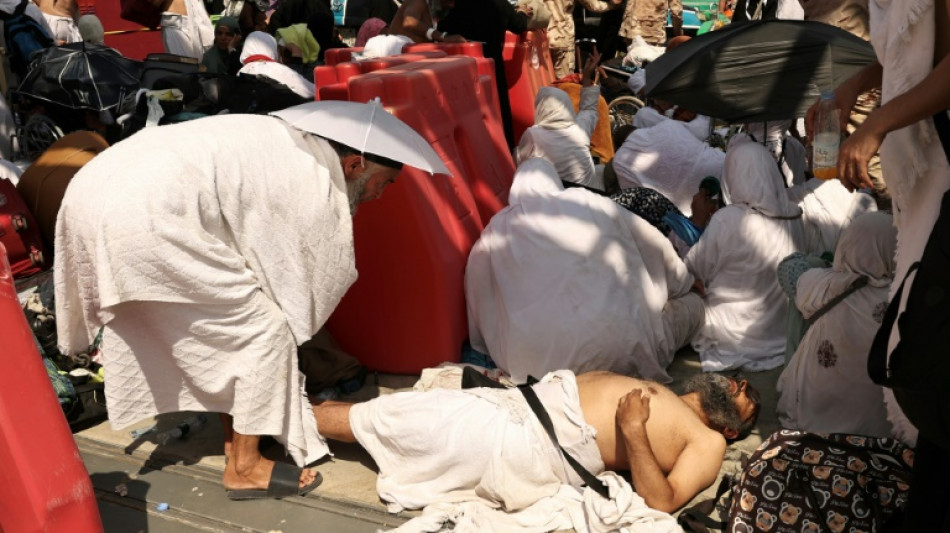
Saudi hajj pilgrims' deaths highlight how extreme heat kills / Photo: © AFP

 Norway's hurdles king Warholm wins fourth European title

 Liverpool deal with Bezos consortium raises stakes in US battle for Premier League power

 Colombia hopes for miracles as search for quake victims goes on

 Popovici, Quadarella mine more gold at Europeans as Marchand flexes in butterfly

 'I shot Mr Thompson': Stunning confession in US health exec's slaying

 San Francisco to host 2028 MLB All-Star Game

 Trump dismisses concerns over conditions on US aircraft carrier

 Zambia resumes vote count after pause over violence

 Wind spurs forest fire in western Germany, with scores evacuated

 Pakistan captain Babar in injury scare ahead of England opener

 Mangione admits shooting health care CEO

 UN warns sanctions chill is stopping Cuba aid

 Alleged US healthcare CEO killer says will plead guilty to stalking

 France's Macron in hot water over jet ski picture

 Nursing federation demands proper pay, protection on Ebola front line
 France upholds assisted dying law, strikes down social media ban for children
 Body found after wildfire hits Croatian coastal town

 Arteta expects Maresca to do an 'unbelievable job' at Man City

 Stocks tread water with eyes on oil price

 US retail sales weakest in over a year in July

 Israel calls for police to replace military in handling West Bank settlers

 स्कैंडिक पे: दुनिया में कहीं भी, बिना किसी सीमा के भुगतान करें।

 SNC 스칸딕 페이: 전 세계 어디서나, 제한 없이 결제하세요

 SNC SCANDIC PAY: Platby po celém světě bez omezení

 SNC SCANDIC PAY: Płatności na całym świecie bez ograniczeń

More than 1,000 people have died at this year's hajj pilgrimage in extreme heat in Saudi Arabia, an AFP tally showed on Thursday.
The pilgrimage involved hours of walking and praying in a country where temperatures reached 51.8 degrees Celsius (125 Fahrenheit) this week.
The World Health Organisation (WHO) has calculated that heat kills at least half a million people every year but warns that the real figure could be up to 30 times higher.
Here a scientist explains how extreme heat damages the body and how physical activity outdoors raises the risk.
- Heat effect on body -
In normal conditions, the body regulates its own temperature like a thermostat, holding it steady at about 36.8C (98.2F).
When outside heat rises, the body cools itself by raising blood-flow to vessels near the skin.
This emits heat at the surface, while perspiration also cools the outside of the body.
"To ensure the correct functioning of the cells, enzymes and vital organs, the body's temperature must stay constant, whatever the external conditions," said Pieter Vancamp, a neurobiologist at the French research institute INRAE.
- Dying of heat -
During an activity such as the hajj, where pilgrims spend hours outdoors in the sun, "the body can quickly become exhausted and can no longer find the reserves of water needed to perspire", Vancamp said.
Then the kidneys, heart and brain risk overheating and "stop working", he added.
When the body's natural thermostat is overwhelmed in this way, symptoms strike: fatigue, headaches, fever and broken sleep.
These can herald more serious effects, such as dehydration, which chokes off water to the vital organs.
The biggest risk is heatstroke, when the body's temperature exceeds 40C (104F).
"The body has its limits," said Vancamp. "When the weather is too hot or when extreme heat is combined with physical activity, for example, the body can find itself unable to self-regulate."
- Aggravating factors -
Babies, the elderly, people with health problems and outdoor workers are most at risk.
The number of sweat glands in the body decreases with age, leaving the body less able to cool itself.
"Several factors determine our reaction to heat: age, body mass, physical activity, genes," said Vancamp.
"But when the heat is too strong, even young, healthy bodies can lack the energy to keep the temperature close to 37C."
The WHO warns that hot nights pose a particular health risk.
Nighttime heat gives the body no chance to cool down, leading to a rise in heart attacks.
- More heat deaths in future? -
Worldwide, people were exposed to an average of 86 days of life-threatening temperatures in 2022, according to the Lancet Countdown report last year.
The number of people over 65 who died from heat rose by 85 percent between the periods 1991-2000 and 2013-2022, the leading medical journal added.
Climate change caused by humans burning fossil fuels is increasing heatwaves and other extreme weather events.
On the current trajectory, the world is on track to warm about 2.7C above the pre-industrial average by the end of this century, according to Climate Action Tracker.
The Lancet Countdown projected that under a 2C warming scenario, about five times as many people will die from the heat each year by 2050.
R.Adler--BTB