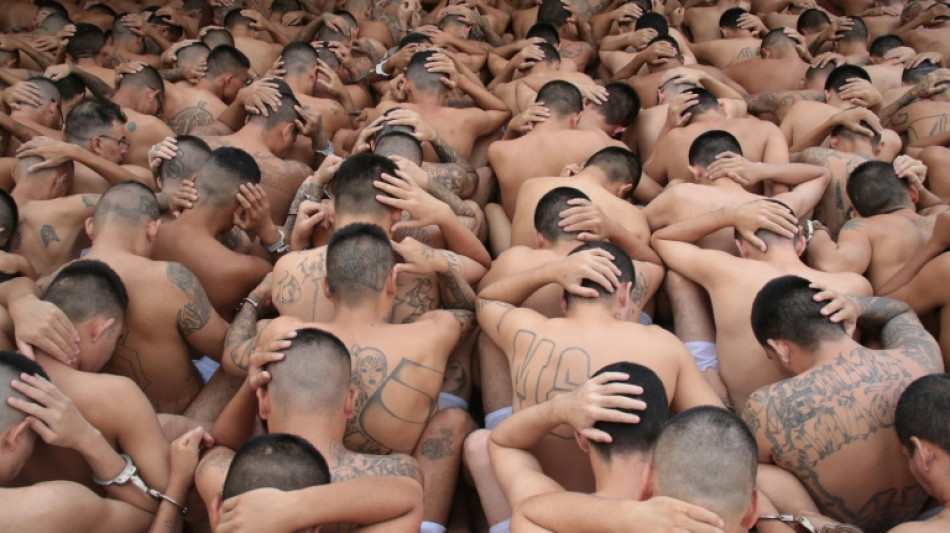
Relief and alarm as El Salvador rounds up 'gangsters' / Photo: © EL SALVADOR'S PRESIDENCY PRESS OFFICE/AFP/File

 US hopeful Hormuz strait deal will be done 'today or tomorrow' after ship hit

 Infantino's problems mount as Wenger and key FIFA ally turn on him

 Oil edges higher, stocks gain as investors eye political risks

 Man Utd sign reported record £20mn sponsorship deal for training kit

 Stokes reveals England coaching ambition
 Cargo ship hit after Trump insists Iran talks could reopen Hormuz today
 BP profit soars as Mideast war roils energy prices
 Most stock markets gain, while oil prices edge up after plunge

 Most stock markets gain, while oil prices edge up after latest plunge

 Weak yen helps auto giant Toyota raise forecasts

 TRON DAO Joins Blockchain Application Stanford Summit at the Science of Blockchain Conference as a Sponsor
 Rockets, Starlink, AI: SpaceX faces its first Wall Street grilling
 After sparring over Ceuta, EU states seek lessons from crisis
 Forest fire spreads in Dutch nature reserve

 Japan sees 'urgent' need to boost military

 Myanmar ex-junta chief set for first Thailand visit as civilian leader

 New Zealand hooker Bell out of South Africa tour with calf strain
 Trump attorney general pick looks set to clear US Senate hurdle

 Agassi Sports Entertainment Launches Global "Let's Play" Pickleball and Padel Platform Initiative

 Death toll from Venezuela quakes rises past 6,000

 Shafique, Babar lead strong Pakistan reply against West Indies

 Defending champ Shelton finding tournament sweet spot in Montreal

 Democratic-led US states sue in latest challenge to Trump's tariffs

 Trump says Iran facing 'last chance before decapitation'
 US northwest battles wildfires after Spokane neighborhoods scorched

An unprecedented round up of alleged gangsters in El Salvador has netted thousands of suspects and brought relief to citizens living in constant fear.
But the clampdown has drawn complaints of rights abuses, and experts say mass arrests are but a stop-gap as long as so many Salvadorans have no feasible exit from a life of penury.
With a poverty rate of 30.7 percent and sky-high unemployment that pushes ever more people to emigrate, a career as a gangster is one of few options available to those who remain.
The most prominent gangs, Mara Salvatrucha (MS-13) and Barrio 18, count some 70,000 members in the country of 6.5 million people. Almost half are thought to be behind bars.
They eke out a living by extorting protection money from anyone who wishes to avoid harm and from drug dealing that brings them into regular conflict with one another.
In a particularly bloody weekend in March, 87 ordinary civilians died at the hands of gangs in 72 hours of violence around the country.
That bloodbath prompted President Nayib Bukele to announce a state of emergency that has allowed the police and military to round up more than 18,000 alleged gang members in just a month.
- 'Trade is flowing' -
In the short term, removing criminals from the streets has allowed residents and entrepreneurs to breathe a sigh of relief. At least temporarily.
"On some of my routes, the criminals are no longer collecting protection money," bus company operator Juan Pablo Alvarez told AFP.
The gangs have extracted a heavy toll from him over the years, he said.
"I have had to bury my brother, more than 10 colleagues and 25 employees, mainly drivers," he added.
In the city center of San Salvador, where even vegetable sellers fall victim to racketeers, vendor Felipe told AFP he, too, was enjoying a reprieve from being shaken down.
"We are not paying anything, the guys (gangsters) have not been seen, they have practically disappeared and the trade is flowing," said Felipe, who preferred to withhold his last name for fear of reprisal.
Clients "have stopped being afraid of coming to the (city) center."
Eduardo Cader, president of the Salvadoran Industry Association, said delivery trucks were, for the first time in a long time, able to enter certain areas where they previously had to pay bribes.
According to a recent CID Gallup poll, an overwhelming majority of Salvadorans support Bukele's anti-gang operation.
And on Sunday, lawmakers extended the state of emergency for another month.
But not everyone is on board.
- 'Criminal populism' -
Emergency powers have done away with the need for arrest warrants, and sentences for gang membership have been raised five-fold to up to 45 years.
Rights observers say innocent people are getting caught in the dragnet and journalists have raised censorship fears over jail terms of up to 15 years for "sharing" gang-related messages in the media.
Rather than ordinary courts, suspected gangsters are brought before judges whose identities are hidden, ostensibly to protect them.
But sitting judge Juan Antonio Duran told AFP these were measures of "criminal populism."
He pointed out that trial by an anonymous judge, without witnesses or even the defendant present -- as has happened -- "is prohibited by the constitution."
On Monday, Amnesty International said Bukele's state of emergency "has created a perfect storm of human rights violations."
And US Secretary of State Antony Blinken reminded Bukele last week that "we can tackle violence and crime while also protecting civil rights and fundamental freedoms."
Veronica Aguirre, 26, claimed her husband was arrested groundlessly, telling AFP that under the state of emergency, "we cannot provide proof" of innocence.
Attorney General Rodolfo Delgado has insisted "honest people have nothing to fear."
But Jose Maria Tojeira, former director of the Central American University's Human Rights Institute, said El Salvador had "a strong tendency for generalized punishments which... are a source of violations of the law."
Bukele, 40, has likened El Salvador's gangs to "a metastasized cancer" and vowed there are only two paths for members: "prison or death."
For Jose Miguel Cruz, a researcher at the Florida International University, the only long-term solution was disarming and rehabilitating former gangsters and productively reintegrating them into society.
What El Salvador needed, he said, was a plan to "modify the conditions that make a good sector of the population resort to a life of crime to survive."
J.Bergmann--BTB