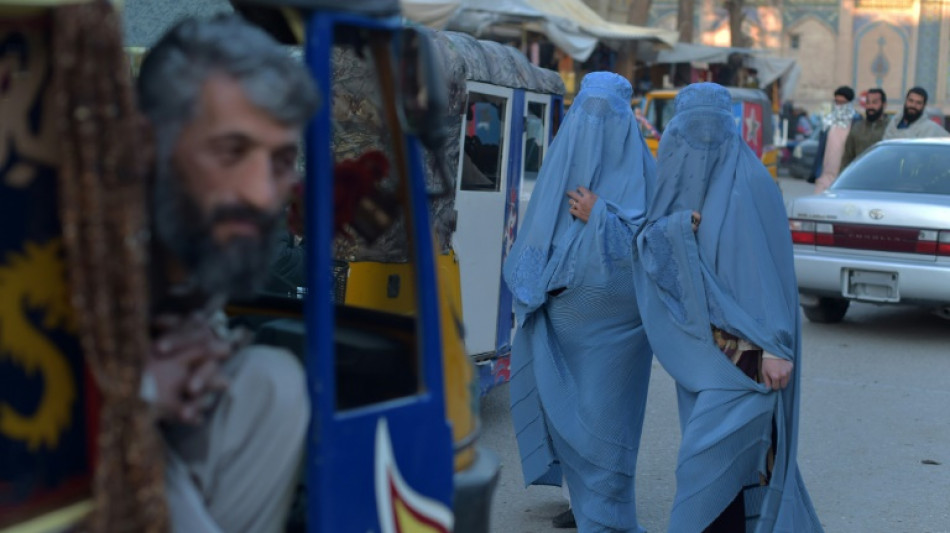
Taliban order Afghan women to cover fully in public / Photo: © AFP/File

 Italian garbagemen help recover lost 1 mln euro lottery ticket
 EU nations patch things up after Ceuta migration discord
 US hopeful Hormuz strait deal will be done 'today or tomorrow' after ship hit

 Infantino's problems mount as Wenger and key FIFA ally turn on him

 Oil edges higher, stocks gain as investors eye political risks
 Man Utd sign reported record £20mn sponsorship deal for training kit
 Stokes reveals England coaching ambition
 Cargo ship hit after Trump insists Iran talks could reopen Hormuz today
 BP profit soars as Mideast war roils energy prices
 Most stock markets gain, while oil prices edge up after plunge
 Most stock markets gain, while oil prices edge up after latest plunge
 Weak yen helps auto giant Toyota raise forecasts
 TRON DAO Joins Blockchain Application Stanford Summit at the Science of Blockchain Conference as a Sponsor
 Rockets, Starlink, AI: SpaceX faces its first Wall Street grilling

 After sparring over Ceuta, EU states seek lessons from crisis

 Forest fire spreads in Dutch nature reserve
 Japan sees 'urgent' need to boost military
 Myanmar ex-junta chief set for first Thailand visit as civilian leader
 New Zealand hooker Bell out of South Africa tour with calf strain
 Trump attorney general pick looks set to clear US Senate hurdle
 Agassi Sports Entertainment Launches Global "Let's Play" Pickleball and Padel Platform Initiative

 Death toll from Venezuela quakes rises past 6,000

 Shafique, Babar lead strong Pakistan reply against West Indies

 Defending champ Shelton finding tournament sweet spot in Montreal
 Democratic-led US states sue in latest challenge to Trump's tariffs
The Taliban on Saturday imposed some of the harshest restrictions on Afghanistan's women since they seized power, ordering them to cover fully in public, ideally with the traditional burqa.
The militants took back control of the country in August last year, promising a softer rule than their previous stint in power between 1996 and 2001, which was marked by human rights abuses.
But they have already imposed a slew of restrictions on women -- banning them from many government jobs, secondary education, and from travelling alone outside their cities.
On Saturday, Afghanistan's supreme leader and Taliban chief Hibatullah Akhundzada approved a strict dress code for women when they are in public.
The decree said the best way for a woman to cover her face and body was to wear the chadari, a traditional, blue, all-covering Afghan burqa.
"They should wear a chadari as it is traditional and respectful," said a decree approved by Akhundzada and released by Taliban authorities at a ceremony in Kabul.
"Those women who are not too old or young must cover their face, except the eyes, as per sharia directives, in order to avoid provocation when meeting men who are not mahram (adult close male relatives)," it said.
The order was expected to spark a flurry of condemnation abroad.
Many in the international community want humanitarian aid for Afghanistan and recognition of the Taliban government to be linked to the restoration of women's rights.
Akhundzada's decree also said that if there was no reason for women to step out of their homes then it was "better they stay at home".
During their first regime, the Taliban made the burqa compulsory for women.
Since their return to power, their feared Ministry for the Promotion of Virtue and Prevention of Vice has issued several "guidelines" on what women should wear, but Saturday's edict was one of the harshest national orders restricting women's rights.
"Islam never recommended chadari for women," said a women's rights activist who asked not to be named.
"I believe the Taliban are becoming regressive instead of being progressive. They are going back to the way they were in their previous regime."
Another women's rights activist Muska Dastageer said Taliban rule had triggered "too much rage and disbelief".
"We are a broken nation forced to endure assaults we cannot fathom. As a people we are being crushed," she said on Twitter.
The hardline Islamists triggered international outrage in March when they ordered secondary schools for girls to shut, just hours after they reopened for the first time since their seizure of power.
Officials have never justified the ban, apart from saying girls' education must be according to "Islamic principles".
That ban was also issued by Akhundzada, according to several Taliban officials.
Women have also been ordered to visit parks in the capital on separate days from men.
Some Afghan women initially pushed back strongly, holding small demonstrations and protests where they demanded the right to education and work.
But the Taliban cracked down on these unsanctioned rallies and rounded up several of the ringleaders, holding them incommunicado while denying they had been detained.
In the 20 years between the Taliban's two stints in power, girls were allowed to go to school and women were able to seek employment in all sectors, though the country remained socially conservative.
Many women already wear the burqa in rural areas.
F.Müller--BTB