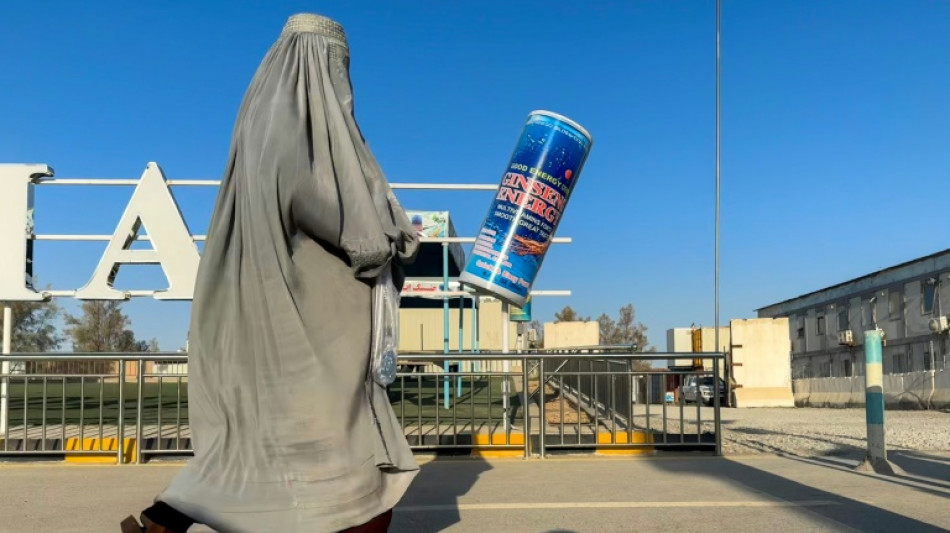
Energy drink craze peps and pacifies weary Afghans / Photo: © AFP

 Britain's Hunt wins 200m for European sprint double
 Draper dumped as Norrie saves face for Britain in Cincinnati
 England opener Gay out for duck in Pakistan warm-up
 Europe swelters under fresh wave of extreme heat

 French Olympic gold medallist Florent Manaudou announces retirement
 Tourists rescued by boat as forest fire threatens Greek beaches
 Indicted Raul Castro reappears after months out of public view
 Italian teen Curtis breaks women's 50m backstroke world record for second time

 Taulagi steps out of 'comfort zone' with code switch to French Top 14 new boys

 Leicester's Thai owners put troubled club up for sale: reports

 Stocks steady as US inflation worries ease, oil slips

 Porsche to end production of flagship electric car: report

 Twitch sparks gamers' wrath with Amazon AI sharing deal

 Blaze forces families to abandon Turkish tour boat
 'If you can, move!' say Rome's viral dancing seniors
 Zambia voters weigh Hichilema's economic record

 SBCFX to Showcase Trading Innovation, Regional Growth Strategy, and Future Vision at iFX EXPO Asia 2026
 Hodgkinson sets up Werro showdown after Euro 800m drama
 'How many will die?': the mysterious ailment killing Kenyan elephants
 Arteta coy over Lewis-Skelly's Arsenal future after 'emotional' celebration

 Romania shuts down nuclear plant as Danube drops

 German steel giant Thyssenkrupp weighs options as Rhine drops

 US ambassador denounces settler siege as Israel dispatches troops
 Hasan takes 6-55 as Bangladesh claim opening day of Australia Test

 Taiwan says AI agents used in cyberattacks targeting island
A production line in a warehouse in western Afghanistan churns out 24 energy drinks every second, feeding a thirst for the tonic used to mask life's hardships and lift wilting spirits.
The Taliban government has purged many signs of Western influence but a stimulant drink craze that arrived with US soldiers remains, and has even sprouted a thriving domestic industry.
Alcohol is outlawed in Afghanistan but caffeine-rich energy drinks are consumed by all, from secret police to children, and advertised on billboards more than even Taliban state propaganda.
Many homegrown brand names evoke the bygone war: "Commando", "Attack", and "Predator".
"It's obvious that there are more struggles and hardships of life among the youth here," said Milad Ghaznavi at a Herat city supermarket aisle that boasted 40 varieties of the beverage.
"Energy drinks have become kind of a habit and a craving for people," Ghaznavi told AFP.
"They consume anything that comforts them," said the 19-year-old, who claimed he had been "addicted" but gave them up for health reasons.
- 'We drink energy' -
Energy drinks, which are high in caffeine and sugar and often more available than drinking water at roadside kiosks, are seen by many Afghans as a way to supplement an insufficient diet.
Nearly 90 percent of people in poverty-stricken Afghanistan are consuming inadequate food, according to the World Food Programme (WFP).
Most recent data from March reveals 86 percent of households are relying on less-preferred and cheaper food, with more than a third reducing meals and more than half reducing portions.
Gulzar, a labourer, fuels his 14-hour work days with four cans of "Hit".
"We work here, we sweat, so when we are tired we drink energy," said the 40-year-old, who goes by one name.
"If you don't drink you are tired, you have a headache, you are weary."
But drinking that many energy drinks comes with a cost.
- Health impacts -
Gulzar's diet contains over 100 grams of sugar -- twice the intake the World Health Organization recommends -- as well as a caffeine hit equivalent to six espressos, which he compares to a smoking habit.
Excessive caffeine consumption can cause high blood pressure, heart palpitations, anxiety and insomnia, according to the US Food and Drug Administration.
But Gulzar says he has no choice.
"Afghanistan is below impoverished," he said. "If we had the means we wouldn't use this."
Local brands cost only around 30 Afghani ($0.40) while imported Red Bull or Monster, two of the most popular global names, are unaffordable to most.
The poorest Afghans, who rely on dwindling foreign aid, are unable to buy energy drinks and instead subsist on bread with caffeinated green tea.
- 'Business is good' -
Energy drinks were invented in Japan in 1962 but exploded in popularity during the 2000s into a global sector worth nearly $40 billion this year, according to research firm Future Market Insights.
In the industrial hub of western Herat, the Pamir Cola company says it produces over a million cans daily.
Still, Pamir Cola says it is a minor player in an industry it estimates produces two cans a day for each of Afghanistan's 40 million citizens.
The figure is impossible to verify because of the drought of data on Afghan commerce.
Workers at the company funnel sugar and citric acid into the bowels of a machine pumping out product every moment the electricity is on.
Pamir Cola says it manufactures to EU standards in a largely unregulated Afghan market left to its own devices.
While Red Bull affiliates with glamorous extreme sports and Monster with motorsports, Zahir Shah Bahaduri, who runs Pamir Cola with his two brothers, is under no illusions.
"For the people of Afghanistan who do hard labour duties and don't have good food, the best way for them is to drink energy drinks," said the 45-year-old.
"I think business is good and will probably get better."
By the side of a Kabul highway, enterprising vendors stack energy drinks high as the traffic roars past.
"It removes their tiredness," said 36-year-old Ahmad Gulab, who sometimes sells to customers by the crate. "It's their joy in life."
F.Pavlenko--BTB