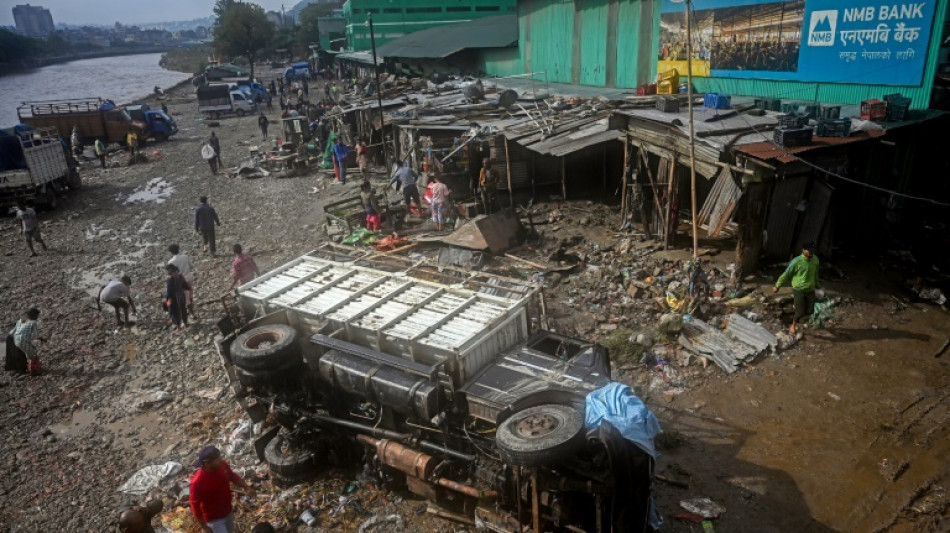
Nepal surveys flood wreckage as death toll reaches 198 / Photo: © AFP

 Zambia voters weigh Hichilema's economic record

 SBCFX to Showcase Trading Innovation, Regional Growth Strategy, and Future Vision at iFX EXPO Asia 2026

 Hodgkinson sets up Werro showdown after Euro 800m drama

 'How many will die?': the mysterious ailment killing Kenyan elephants
 Arteta coy over Lewis-Skelly's Arsenal future after 'emotional' celebration

 Romania shuts down nuclear plant as Danube drops

 German steel giant Thyssenkrupp weighs options as Rhine drops

 US ambassador denounces settler siege as Israel dispatches troops

 Hasan takes 6-55 as Bangladesh claim opening day of Australia Test

 Taiwan says AI agents used in cyberattacks targeting island
 Japan protests Putin's first visit to disputed islands

 Kiss wants fit-again Wallabies playmaker Gordon to 'open up' Japan

 British eccentrics push humble garden shed to new heights

 Zambia votes with president's economic record on the line

 Germany's dry rivers spark battle on engineering vs restoration

 Senators demand inquiry into conditions aboard USS Abraham Lincoln

 All Blacks' Proctor out of South Africa series, Mo'unga called up

 Bangladesh quick Hasan reduces Australia to 74-4 at lunch

 Seoul tech leads Asian stock gains as traders cheer US inflation

 Farage and Count Binface go head-to-head in snap UK poll

 Afghan students divided over smartphone ban at universities
 Japan go back to school for second Australia Test

 Matthew McConaughey on his sweet return to the big screen
 President's economic record on the line as Zambia votes

 U.S. Polo Assn. Takes No. 1 Spot for All Sports Brands and Climbs to No. 22 Overall on License Global's 2026 'Top Global Licensors' Ranking

Search and rescue teams in Nepal's capital picked through wrecked homes on Monday after waters receded from monsoon floods that killed at least 198 people around the Himalayan republic.
Deadly floods and landslides are common across South Asia during the monsoon season from June to September, but experts say climate change is making them worse.
Entire neighbourhoods in Kathmandu were inundated after the heaviest rains in more than two decades, with the capital temporarily cut off from the rest of Nepal after landslides blocked highways.
"So far, 198 people have been reported dead, and another 26 are missing," Nepal Police spokesman Dan Bahadur Karki told AFP.
At least 35 of those killed were buried alive when earth from a landslide careened into vehicles on a highway south of Kathmandu, he said.
Bulldozers were being used to clear nearly two dozen sections of major roads leading into Kathmandu that had been blocked by debris.
The home ministry said it was working to rescue numerous people who had been stranded on the highways.
Rescuers in knee-high rubber boots, meanwhile, were using shovels to clear mud from the worst-hit riverside neighbourhoods around Kathmandu, many of them unauthorised slum settlements.
The International Centre for Integrated Mountain Development (ICIMOD), a Nepal-based think tank, said the disaster had been made worse by unplanned urban encroachment around the Bagmati River, which courses through the capital.
Nepal's army said that more than 4,000 people had been rescued, with helicopters, motorboats and rafts bringing stranded people to safety.
Nilkantha Pandey of humanitarian organisation CARE Nepal said that many impacted by the floods needed safe drinking water and temporary housing.
"Mostly informal settlements have been affected," Pandey said. "It is time to respond and not delay."
- 'All of it is stuck' -
Merchants in Kathmandu said that damage to intercity roads had drastically cut the supply of fresh fruit and vegetables into the capital.
"The farmers have their produce ready but with the highways blocked, all of it is stuck," Binay Shrestha, who works at one of the city's main produce markets, told AFP.
Nepal's weather bureau said their preliminary data measured record-breaking rain in the 24 hours to Saturday morning.
A monitoring station at the Kathmandu airport recorded about 240 millimetres (9.4 inches) of rain, the highest figure since 2002.
Climate expert Arun Bhakta Shrestha of ICIMOD told AFP that by late September, rainfall should be decreasing with the end of the annual monsoon.
"Rainfall of this kind has to be described as abnormal," he said.
"It is an extreme event... I see the possibility of the role of climate change to some extent."
But he added that unplanned urban development had also worsened the impact of the disaster.
The summer monsoon from July to September brings South Asia 70-80 percent of its annual rainfall and is vital for agriculture and food production in a region home to around two billion people.
But monsoon rains also bring widespread death and destruction in the form of floods and landslides.
Experts say climate change has worsened their frequency and intensity.
More than 300 people have died in Nepal in rain-related disasters this year.
C.Meier--BTB