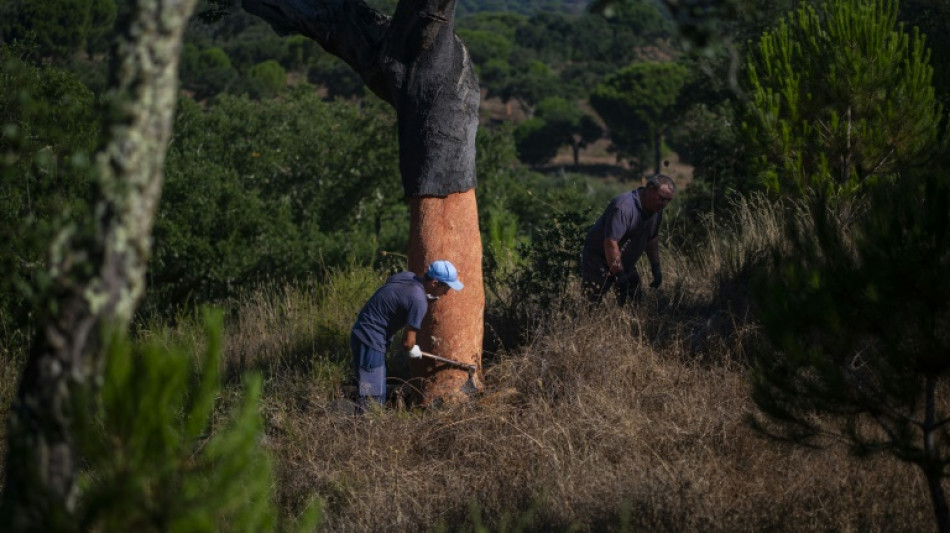
Portugal looks to put new twist on cork industry / Photo: © AFP

 Infantino future should be decided by election says African football chief
 Man City star Doku signs five-year contract extension
 Fabien Barthez joins Zidane's new France coaching setup

 Taiwan chokes mobile internet speeds in drill for Chinese attack

 From Chinese AI to Global ETFs: STARTRADER Launches 45 New 24/7 Stock and ETF CFDs
 Tech stocks enjoy rebound after US inflation on mixed day for markets

 Hasan takes 6-55 as Bangladesh bundle out Australia for 198

 Swiatek sinks Svitolina to set up Rybakina title clash in Toronto

 Australia's Pallister shines, mixed relay record falls as Pan Pacs open

 Hasan puts Bangladesh in charge as Australia struggle to 183-8
 Putin visits Kuril islands claimed by Japan

 Swiatek downs Svitolina to reach first WTA final of 2026

 Jones says Japan 'watching videos of geese' for Australia clash

 Bloodied but unbowed, defending champ Shelton reaches Montreal final

 Wallabies make eight changes for return Japan Test

 Messi returns after father's death but Miami knocked out of Leagues Cup

 Outflanked by AI, stars fade for South Korea's blind fortune-tellers

 Venezuela govt, opposition wrap up round of post-Maduro talks

 Five things to know about Zambia as it goes to the polls

 Nakashima holds off Jodar to book first ATP Masters final in Montreal

 Grieving Messi available for Miami in Leagues Cup clash

 Colombia enters 'final phase' of quake search as toll hits 265

 Father-figure Christie helps guide Kounta to European silver

 McIlroy returns to St. Jude to launch marathon PGA playoff push

 Guimaraes makes Arsenal debut in Como friendly

Portugal, the world's leading cork producer, is finding new uses for the material, from footwear to furniture, as demand for wine bottle stoppers wanes.
Producers highlight the environmentally friendly properties of cork, which is lightweight, recyclable, waterproof and fire-resistant, to encourage its use in diverse settings.
Cork is obtained by stripping the bark of cork oak trees every nine years in a careful process that allows the tree to regenerate and grow, making the industry naturally sustainable.
The material has "a negative carbon footprint because it comes from a tree that captures CO2 day and night", Antonio Rios de Amorim, the CEO of the world's largest cork producer Corticeira Amorim, told AFP.
The push to diversify comes as global sales of wine decline, reducing demand for cork wine stoppers which have long faced competition from cheaper plastic stoppers and screw tops.
"Periods of slowdown must be used to question what we do," said Amorim, whose ancestors founded Corticeira Amorim 154 years ago in the northern village of Mozelos, about 30 kilometres (18 miles) south of second city Porto.
- Booster rockets, metro seats -
Thanks to cork's cell-like structure, the material is elastic and highly impermeable, making it suitable to make shoes as well as ties, pants and other clothes.
Furniture designers are also increasingly drawn to the material.
British designer Tom Dixon has called it a "dream material" and put out a range of dark cork furniture that includes tables, stools and shelves using cork from Portugal.
The Lisbon metro in 2020 replaced the fabric lining on all seats of its train fleet with cork, an easier to maintain material.
Builders have been drawn to the material because of its unique thermal insulation and sound absorption properties.
Cork is also finding its way into space. It is used in thermal protection coating on booster rockets because of its resistance "to strong variations in temperature", said Amorim.
Making wine bottle stoppers, however, remains the main activity for Portugal's cork industry, which employs around 8,000 people.
Corticeira Amorim makes some six billion cork wine bottle stoppers per year, almost all of them for export mainly to Chile, France and the United States.
It accounts for 70 percent of the global market share for cork stoppers and posted sales of 985 million euros (one billion dollars) in 2023, slightly lower than in the previous year.
- Traditional methods -
Cork is made from the bark of the cork oak (Quercus suber) found in countries of the Mediterranean basin.
Portugal is home to about a third of the world's total area dedicated to this tree -- more than any other country -- and accounts for nearly half the world's supply of cork.
There are also plantations in France, Spain, Italy. Algeria, Morocco and Tunisia.
In the province of Ribatejo around 80 kilometres east of Lisbon, cork oaks stretch as far as the eye can see.
The bark is removed from the tree in summer using traditional methods handed down from generation to generation.
It is a highly precise technique "that takes several years to learn", said Nelson Ferreira, a 43-year-old cork bark harvester, adding he takes great care not to damage the tree.
The bark is then taken to Corticeira Amorim's factories in the north of Portugal where it is steam-treated, cut into smaller pieces and then fed into machines that punch out stoppers.
The preservation of cork oaks is crucial for Portugal, which has made them a protected species since it takes an average of 40 years for a tree to start producing cork that can be used by cork makers.
J.Fankhauser--BTB