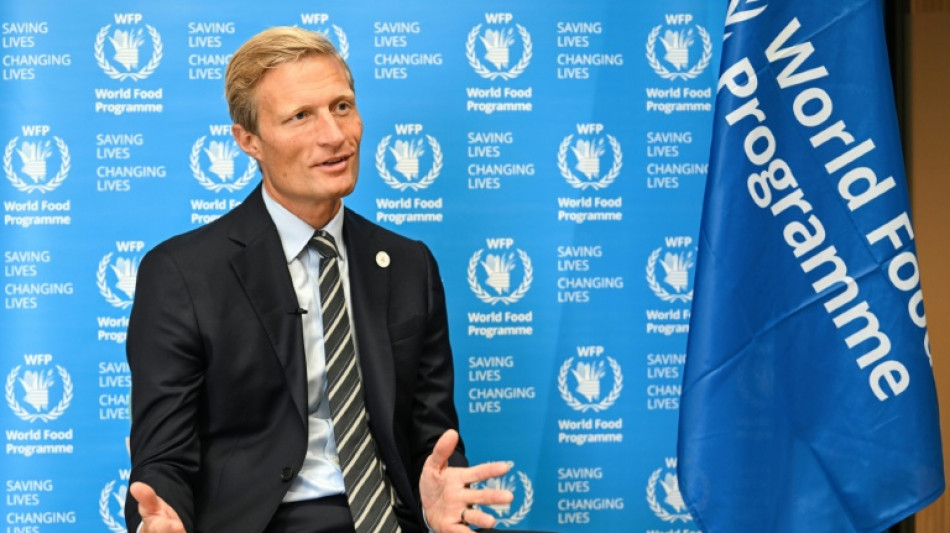
Aid to famine-struck Gaza still 'drop in the ocean': WFP / Photo: © AFP

 Swiss voters expected to shun stricter neutrality
 Rapper-turned-PM faces first big test after Nepal disaster
 Tuchel seeks tonic to England World Cup 'scar' in Spain showdown

 'Helps me cope': Catholic baptisms rise among French youth

 Colombians in Santa Marta stay inside after violence wracks the city

 Iran airlines cancel flights as US sanctions hit

 Meta launches camera-free AI glasses amid privacy pushback

 Australian PM says OpenAI hacked government health website

 Xi arrives in US to personal Trump welcome

 Morocco elects new parliament amid social frustration, youth discontent

 Scheffler and Burns to face Im and Lee in Presidents Cup opener

 Crushing wins for Lyon and Barca in women's Champions League

 Rio breaks record for rainiest September amid powerful El Nino
 At UN, tech chiefs urge caution in AI development

 Russian strikes kill seven in Ukraine, Zelensky vows winter campaign

 Venezuelan shot by ICE needs urgent medical care, mother tells AFP

 Zelensky says Putin using fighters from 47 countries in Ukraine war

 Klopp calls on Germany to 'rise above ourselves' as new era begins

 Russian strikes kill seven in Ukraine as Russia vows no 'pause' to war

 ArcPoint Expands Globally with Institutional Intelligence Platform for Modern Investors

 Ronaldo focussing on 'present' ahead of Wales test

 Outgoing UN chief makes final climate push at New York summit

 Grief and pain flow at hearing for Canadian suicide poison vendor

 Ireland boss Hallgrimsson says timing of Israel remarks 'not clever'

 Weinstein resentenced to 15 years in prison for 2006 sex assault

The World Food Programme warned Tuesday that the aid Israel is allowing to enter Gaza remains a "drop in the ocean", days after famine was formally declared in the war-torn Palestinian territory.
The United Nations declared a famine in Gaza on Friday, blaming the "systematic obstruction" of aid by Israel during its nearly two-year war with the Palestinian militant group Hamas.
Carl Skau, WFP's chief operating officer, said that over the past two weeks, there has been a "slight uptick" in aid entering, averaging around 100 trucks per day.
"That's still a drop in the ocean when we're talking about assisting some 2.1 million people," Skau told AFP during a visit to New Delhi.
"We need a completely different level of assistance to be able to turn this trajectory of famine around."
The Rome-based Integrated Food Security Phase Classification Initiative (IPC) said famine was affecting 500,000 people in Gaza.
It defines famine as when 20 percent of households face extreme food shortages, more than 30 percent of children under five are acutely malnourished, and there is an excess mortality threshold of at least two in 10,000 people a day.
Skau painted a grim picture of Gaza.
"The levels of desperation are so high that people keep grabbing the food off our trucks," the former Swedish diplomat said.
"And when we're not able to do proper orderly distributions, we're not sure that we're reaching the most vulnerable -- the women and the children furthest out in the camps," he said.
"And they're the ones we really need to reach now, if we want to avoid a full-scale catastrophe."
- 'Starvation phase' -
But Skau also warned that Gaza was only one of many global crises, with multiple famine zones emerging simultaneously as donor funding collapses.
Some 320 million people globally are now acutely food insecure — nearly triple the figure from five years ago. At the same time, WFP funding has dropped by 40 percent compared with last year.
"Right now, we're seeing a number of crises that, at any other time in history, would have gotten the headlines and been the top issue discussed," he said.
That includes Sudan, where 25 million people are "acutely food insecure", including 10 million in what Skau called "the starvation phase".
"It's the largest hunger and humanitarian crisis that we probably have seen in decades -- since the end of the 1980s with the Ethiopia famine," he said.
"We have 10 spots in Sudan where famine has been confirmed. It's a disaster of unimaginable magnitude."
He detailed how a UN aid convoy in June tried to break the siege by paramilitary Rapid Support Forces (RSF) of Sudan's city of El-Fasher in Darfur, only for the truck convoy to be hit by a deadly drone attack.
Neighbouring South Sudan is also struggling, he said, suggesting "there might well be a third confirmation of a famine".
"That will be unprecedented", he said, citing "extremely expensive" operations in the young nation's Upper Nile state, where, with few roads, aid must be delivered by helicopters or airdrops.
"This is maybe the number one crisis where you have on one hand staggering needs and, frankly, no resources available", he said.
At the same time, traditional donors have cut aid.
US President Donald Trump slashed foreign aid after taking office, dealing a heavy blow to humanitarian operations worldwide.
"We are in a funding crunch, and the challenge here is that the needs keep going up", Skau said.
While conflict is the "main driver" of rising hunger levels, other causes include "extreme weather events due to climate change" and the economic shock of trade wars.
"Our worry is that we are now cutting from the hungry to give to the starving," he said.
Skau said the organisation was actively seeking new donors.
"We're engaging countries like India, Indonesia, Brazil, and others, beyond the more traditional donors, to see how they can also assist".
J.Horn--BTB