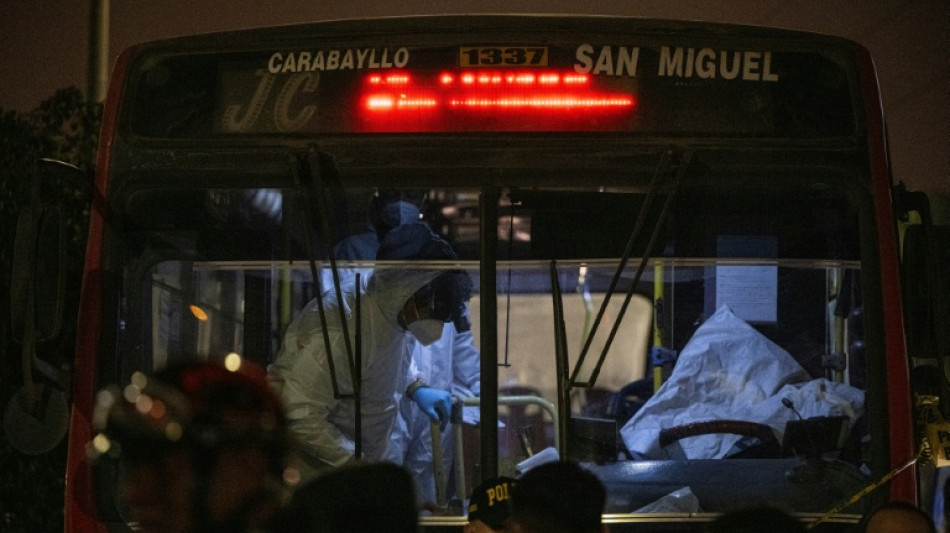
Peruvians live in fear as extortion runs rampant / Photo: © AFP

 US judge weighing Trump's White House ban on media outlets

 At UN, OpenAI's Altman calls 'for extreme care' in AI

 Hamilton gives thumbs up to Gulf GPs despite Iran conflict

 Leclerc admits going 'too far' in Hamilton shunt in Italy

 Row engulfs Dolly Parton's estate as manager accuses nephew of making threats

 Mandela Digital Extends Early Access Programme to 11 February 2027 Following Strong Response

 US seeks 11th Presidents Cup win in a row over global foes

 McDonald's to boost franchisees as inflation weighs on consumers

 Trump invites Putin to G20 summit in Miami

 Archaelogical 'breakthrough' could confirm origins of Paris

 ILO financial crisis takes centre stage in leadership race

 Stocks dip, oil soars despite Trump hailing "productive" Iran talks

 China's Xi to get rare airport welcome from Trump

 Turkey reassures investors over investment fund crisis

 Saka says England still have 'scar' from World Cup semi-final loss

 アレックス・ボディ氏とシュテファン・ハウプト教授、ルーマニアの伝説的な美術コレクションをめぐり提携に合意

 亞歷克斯·博迪與史蒂芬·豪普特教授就羅馬尼亞傳奇藝術收藏達成合作協議

 Алекс Боди и проф. д-р Стефан Хаупт договорились о сотрудничестве в рамках легендарной коллекции произведений искусства в Румынии

 French foreign minister says Palestinians 'must' hold polls

 Fresh Russian strikes on Ukraine's infrastructure kill seven

 Eriksen to return to Denmark after parting ways with Wolfsburg

 Brad Pitt says working with dog co-star was 'really moving'

 Golan will remain Syrian, vows President al-Sharaa at UN

 Blueberry Strengthens MENA Presence with CMA Category 5 License and Dubai Office Launch

 Russia probes bear attacks, as official says town under 'siege'

Extortionists in Peru are becoming ever bolder: executing bus drivers at the wheel and detonating bombs at schools, holding the country in a grip of fear as police struggle to crack down.
It is a crime attractive to organized gangs but increasingly also to individual scamsters. Extortion complaints in the South American country soared by 540 percent from 2023 to over 15,000 last year, according to the justice ministry's Indaga crime observatory.
Extortion is "easy to commit and hard to combat," said police colonel Roger Cano, fighting an uphill battle against the scourge with a brigade of 50 officers working from a dilapidated building in the capital Lima.
All you need, really, is a cellphone from which to make threats.
The owner of a small clothing store in Lima told AFP how her life was turned upside down when she was unable to pay a shakedown for about $8,500.
"I started receiving text messages telling me that I had to pay... or they would take my life, the lives of my children."
Her house was attacked with explosives last Friday.
"Since the day of the attack, I haven't been going to work... My children haven't been going to school because they are afraid," said the woman, who refused to give her name for fear of retribution.
She said the police response has been insufficient.
"I have to take care of myself. We've even thought about buying guns and stuff... If they (the criminals) come back, I don't know what I would do."
- Easier than robbing a bank -
Like her, most extortion targets are not rich.
Extortioners usually call or text their victim and threaten to attack or kidnap them or a loved one unless they pay a fee -- often a recurring one.
In some cases, said a Human Rights Watch (HRW) report from July, they "use hitmen to kill those who refuse to pay."
Unlike bank robbers, for example, extortioners "don't have to take risks, they don't show their faces, they don't directly confront the police," colonel Cano said of the difficulty in finding those responsible.
At first, Peruvian extortioners zoomed in mainly on bus and moto taxi drivers.
The target group has since expanded to include small businesses, defaulters on predatory loans in a society where three out of four people work in the informal sector, and increasingly, schools.
Experts say extortion, long a problem in Peru, has really taken off amid high levels of post-pandemic poverty and unemployment, political instability following the 2022 ouster of president Pedro Castillo, and the domestic rise of gangs such as Venezuela's Tren de Aragua.
According to HRW, Congress under Castillo's successor, President Dina Boluarte, has "undermined efforts to investigate and prosecute criminal networks."
More than half of Peruvian lawmakers are themselves under investigation for corruption or other crimes, it pointed out.
- 'Distrust in the police' -
Cano's unit focuses on tracking down hitmen and seizing weapons and explosives used in extortionist crime. It is the role of police intelligence officers to hunt down gang leaders and find their earnings.
But it is an uphill battle.
According to Cano, a major problem is cellphone operators refusing to divulge the geolocations of extortioners using their networks.
His colleague Franco Moreno, who heads Peru’s kidnapping and extortion investigations division, told AFP police also lacked sophisticated tracking technology.
Add to the mix a distrusting populace fearing the police are "colluding with organized crime," said Eduardo Moncada, a political scientist at Columbia University in New York.
Last year, at least 102 homicides linked to extortion were recorded in Lima.
Some 500 schools nationwide were extorted between January and April this year, according to the collective Educar con Libertad. Several were targeted with explosives after teachers or headmasters refused to pay protection money.
Reported extortion figures "almost certainly understate the scale of the problem," said the HRW report.
"Many cases go unreported due to distrust in the police or the belief that there will be no effective response from state institutions."
O.Krause--BTB