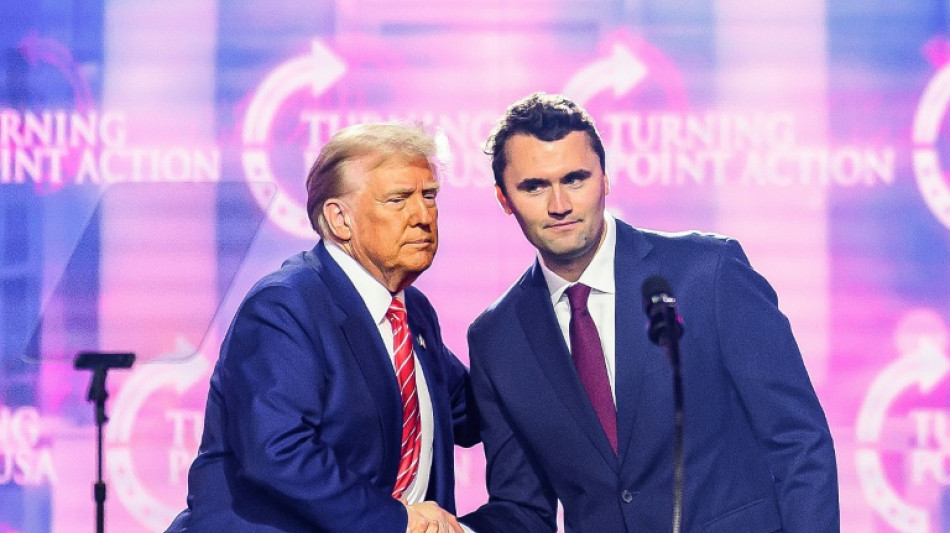
As media declines, gory Kirk video spreads on 'unrestrained' social sites / Photo: © AFP

 Thames Water seeks to delay £12bn in debt repayments

 Newark boxing gym expands alternative education programme

 Democrats consider impeachment drive against Defence Secretary Hegseth

 Energy bill plan could use HMRC income data to target support

 Business owner earning £6,000 a month tackles £70,000 debt
 Nvidia chief faces inquiry after disclosing affair with suspected Chinese agent

 Comet returns as online electrical marketplace 14 years after collapse
 Aston Villa Defy History With Rare Victory at Old Trafford

 Democrats Face Criticism Over Social Security Reform Plans Amid Trust Fund Crisis

 Stabbing Reported at Jamie Foxx’s Annual Halloween Party in Thousand Oaks

 Binance CFO Kaiser Ng Departs Amid Aftermath of $6.3 Billion Hack
Traditional news outlets were cautious not to broadcast the moment Charlie Kirk was assassinated, but it mattered little in the age of declining media influence.
Within minutes, millions of people -- including children -- watched the graphic footage auto-play across social media platforms.
The amplification of the video showing the American conservative activist's final moments at a university in Utah underscores how major tech firms are falling short in enforcing content moderation amid rising political violence and deepening polarization in the United States.
Most newspapers and television networks -- longtime gatekeepers with editorial guidelines to shield audiences from graphic content -- chose not to show the moment Charlie Kirk was shot dead. Instead, many outlets focused on the calm leading up to the attack and the chaos that followed.
That discretion was largely absent on social media, a fragmented digital landscape shaped by smartphones and instant uploads where graphic footage showing Kirk's body recoiling and blood pouring from a wound spread rapidly.
The footage, which mostly lacked content warnings, was instantly accessible online and often auto-played before viewers had a chance to consent or look away.
"Journalists draw lines for a reason. We know how trauma seeps in through a screen. We know that immediacy without context is its own kind of harm," said Ren LaForme, from the nonprofit media institute Poynter.
"Social media has no such restraint. It promises unfiltered access, but without guarantees of truth and without protection from harm. The cork is off the bottle, and everything spills out: real or fabricated, searing or false."
- 'Shocked and dismayed' -
The graphic visuals also flooded children's devices and social media feeds, sparking anxiety among parents and prompting bipartisan calls from lawmakers for tech companies to take swift action.
"Last week, countless children witnessed the assassination on the portable devices they carry everywhere, in addition to a murder on public transportation, reports of mass shootings and school gun violence," Titania Jordan, from the parental controls app Bark, told AFP.
"Childhood was never meant to include graphic violence or murder. Parents are rightly shocked and dismayed," she said, while advising families to log off social media and make room for "real-time conversations as kids process what they've seen."
The virality of Kirk's video -- alongside the amplification of extreme posts glorifying his death –- comes as many platforms scale back content moderation and, in some cases, eliminate human fact-checkers and moderators even as their algorithms reward engagement.
"The way algorithms have flooded our timelines with posts celebrating Charlie Kirk's horrifying assassination is a damning indictment of the way social media works," Imran Ahmed, chief executive of the watchdog Center for Countering Digital Hate (CCDH), told AFP.
"It lays bare how platforms are designed to reward extreme emotion over empathy or integrity."
- 'Whims of algorithms' -
Posts on Elon Musk's platform X that celebrated Kirk's assassination racked up 52 million views, according to CCDH's research -- evidence that "policy enforcement is not just broken but has been abandoned," Ahmed said.
The posts violated X's guidelines, which allow users to post graphic imagery only "if it is properly labeled" and forbids material explicity "glorifying or expressing desire for violence."
The trend comes as surveys show that traditional media is battling record low public trust, and a growing number of Americans, especially young adults, get their news from platforms such as TikTok.
"At a time when more Americans are tuning out credible news for social media, it's worth remembering that they're leaving behind not just reporting, but the discipline of restraint," said LaForme.
"Journalistic restraint still matters. Someone has to decide what should be witnessed and what scars can be spared."
Peter Adams, senior vice president of research and design at the News Literacy Project, said the widespread exposure to Kirk's assassination video -- which could cause vicarious trauma -- offers an opportunity for people to reassess their relationship with social media.
"These platforms are hyper-addicting because they are personalized, giving everyone little tailor-made hits of dopamine," Adams told AFP.
"We all have a responsibility to ourselves not to hand our consciousness over to the whims of algorithms designed to keep us scrolling, regardless of what it might cost us."
I.Meyer--BTB