Hong Kong to install surveillance cameras with AI facial recognition / Photo: © AFP/File

 Aston Villa Defy History With Rare Victory at Old Trafford
 Democrats Face Criticism Over Social Security Reform Plans Amid Trust Fund Crisis

 Nick Harkaway Expands John le Carré’s Spy Universe in 'The Taper Man'

 Rene Eyre Revisits Autobiographical Performance 'Say A Little Prayer' in London

 UAE's HCT Holds Record Graduation and Announces Major Training Expansion

 NASA Awards $10B Lunar Contract Framework to SpaceX, Blue Origin

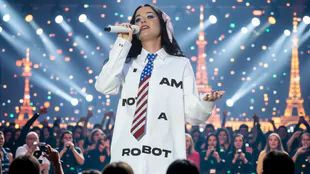 Katy Perry Tells Fans Ex-Husband Russell Brand 'Should Be in Jail' During UK Concert
Hong Kong plans to install tens of thousands of surveillance cameras with AI-powered facial recognition, the city's security chief said on Friday, bringing it closer to China where authorities often monitor public spaces with cutting-edge technology.
The Chinese finance hub has already installed just shy of 4,000 closed-circuit television (CCTV) cameras under a police crime fighting programme. That number will increase more than tenfold by 2028, up to a total of 60,000, according to documents submitted to the legislature.
Artificial intelligence is already being used to monitor crowds and read license plates, and that technology "will naturally be applied to people, such as tracking a criminal suspect", Hong Kong's security chief Chris Tang told lawmakers.
"That is something we must do," he said, adding that authorities are still considering issues such as resource allocation and choice of technology, without specifying a timeline for the rollout.
Police say the SmartView programme is needed to safeguard national security and to prevent and detect crimes, crediting the use of CCTV cameras with solving more than 400 cases and scoring 787 arrests since the initiative was launched last year.
Officers will start using real-time facial recognition "as early as the end of this year", the South China Morning Post reported in July.
Similar technology has also been adopted in Britain, though critics argue that it grants the government unchecked power to invade privacy on a massive scale.
Concerns have also been raised over false matches leading to wrongful arrests.
The European Union adopted an Artificial Intelligence Act last year that banned "the use of 'real-time' remote biometric identification systems in publicly accessible spaces for the purposes of law enforcement", with some exceptions.
Hong Kong's privacy watchdog, an independent statutory body, on Friday declined to say whether it had been consulted in drawing up plans to expand the surveillance camera programme.
K.Thomson--BTB