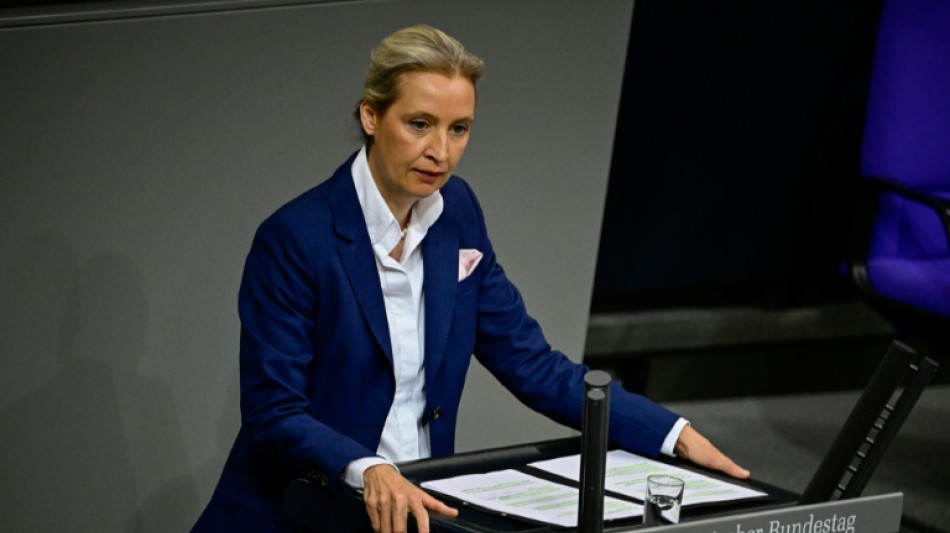
German court rules spy service may not label AfD 'extremist' for now / Photo: © AFP

 Typhoon Dujuan leaves four dead in Japan, 45,000 houses without power

 G7 leaders condemn Houthi strikes on Saudi Arabia

 Google data centre sparks protests in Austria

 Shin Ohashi: Junk food-loving teen and Japan's next big swimming hope

 Stocks rise on AI buzz, drop in oil prices

 China's robot dancers limber up for America's Got Talent final

 Despite military might, Saudi struggles to crush the Houthis

 Trump to tout deals, defend Iran war in UN speech

 Sri Lanka to issue verdict in landmark Easter attack trial

 No green light to lift EU sanctions on Russian oligarchs, talks to resume

 UK agrees support for Saudi in struggle with Houthis: reports

 EU foreign policy chief calls for continued sanctions on Russia

 Flights scrapped, evacuations urged as Typhoon Dujuan wallops Japan

 Fonseca to take break from tennis

 A Cuban zoo, and its animals, in epic battle for survival

 Infantino proposes consulting federations to reform FIFA

 El Nino weather pattern enters record territory: scientist

 OpenAI calls for US to lead global effort on AI standards

 South African ostriches plucked alive for luxury fashion: report

 US networks halt Trump coverage in revolt over White House ban

 Paramount settles with US states to clear Warner Bros. mega-merger

 Climate crisis a job for world leaders, not just activists: UK FM

 US networks halt Trump coverage over White House ban

 French singer accuses Miley Cyrus of plagiarism

 EU fines Google 403 mn euros for location data breach

Aav German court ruled on Thursday that the domestic intelligence agency cannot label the far-right Alternative for Germany (AfD) party as a "confirmed right-wing extremist" group, at least for now.
The AfD had challenged the designation, which would empower the spy agency to use broader surveillance powers to monitor it and would embolden political opponents seeking a ban of the anti-immigration party.
The Cologne administrative court's decision puts the designation on hold pending the final outcome of a legal battle between the AfD and Germany's intelligence agency, the Federal Office for the Protection of the Constitution (BfV).
The court found that there were indeed efforts to undermine Germany's free democratic order from within the AfD, highlighting its demands to ban Muslim minarets, public calls to prayer and headscarves in public institutions.
But it ruled that the party as a whole was not "shaped by these efforts" such that "an anti-constitutional tendency can be established" to characterise the party in its entirety as extremist.
Alice Weidel, the party's co-leader, hailed the ruling as "a major victory not only for the AfD but also for democracy and the rule of law" in a post on X.
The decision had also "thrown a spanner in the works" for the "fanatics" seeking to outlaw the AfD, she added.
Interior Minister Alexander Dobrindt, a conservative, noted that the court decision still found reason to suspect the AfD of working "against the free democratic order" and "pursuing anti-constitutional aims".
The party will continue to be monitored as a "suspected" extremist group, he added.
- Politically isolated -
The AfD was founded in 2013 primarily as a eurosceptic party, but has since become more hardline nationalist, putting an anti-immigrant stance at the heart of its appeals to voters.
The party surged to become the largest opposition force in last year's nationwide election, winning nearly 21 percent of the vote.
The AfD is particularly strong in the formerly communist East Germany, holding commanding leads in the polls ahead of several key state-level elections there later this year.
But it remains frozen out of power across the country, as all other political parties have maintained a "firewall" against it and refused to consider cooperating.
Many in mainstream German politics see the AfD's far-right positions and rhetoric as taboo, a view informed in part by Germany's dark Nazi history.
The intelligence agency moved to officially classify the national AfD party as a "confirmed extremist" organisation on May 2 of last year, a step up from its previous designation as a "suspected" case.
The party filed a lawsuit against the move and the BfV agreed to suspend the classification until a court ruling on the matter is issued.
Several regional AfD party organisations have already been designated as "confirmed extremist" groups.
- Calls to ban -
Thursday's decision by the Cologne court, which can still be appealed, keeps it on hold until a verdict is reached in the AfD's broader challenge to the classification.
Some of the AfD's political foes have advocated banning the party -- a process for which there are high legal hurdles in Germany.
It would require, for example, evidence that a party is actively trying to abolish the democratic order and has the means to do so.
Dobrindt and a number of other conservatives have criticised such a move, arguing instead that the AfD must be defeated at the ballot box.
On Thursday, Dobrindt said the court decision only underscored how high the legal hurdles for action against a political party is.
"I have repeatedly said if we want the AfD to go away it should be by governing competently and not by banning them," Dobrindt said.
A.Gasser--BTB