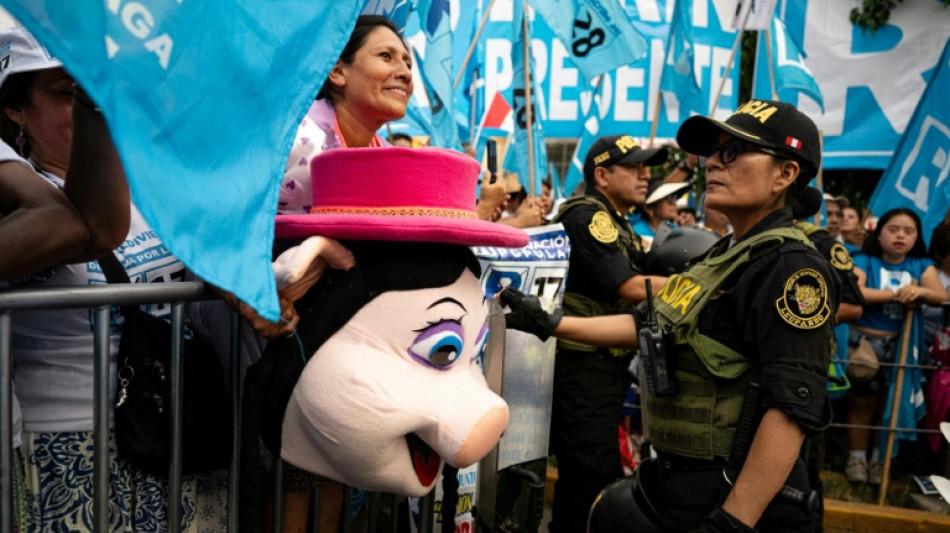
Peru's crowded presidential race zeroes in on organized crime / Photo: © AFP

 Rams bounce back as Giants reel from Dart injury

 In Bangladesh, Pakistan's Jinnah photo stirs anger

 Two New Zealand naval ships transit Taiwan Strait

 Zidane gets down to work as France start new era

 Inside the Venezuelan prison meant to 'drive you insane'

 UK king braces as memoir by Diana's brother goes on sale

 No green light to lift EU sanctions on Russian oligarchs, talks to resume

 UK agrees support for Saudi in struggle with Houthis: reports

 EU foreign policy chief calls for continued sanctions on Russia

 Flights scrapped, evacuations urged as Typhoon Dujuan wallops Japan

 Fonseca to take break from tennis
 A Cuban zoo, and its animals, in epic battle for survival

 Infantino proposes consulting federations to reform FIFA

 El Nino weather pattern enters record territory: scientist
 OpenAI calls for US to lead global effort on AI standards
 South African ostriches plucked alive for luxury fashion: report

 US networks halt Trump coverage in revolt over White House ban

 Paramount settles with US states to clear Warner Bros. mega-merger

 Climate crisis a job for world leaders, not just activists: UK FM

 US networks halt Trump coverage over White House ban
 French singer accuses Miley Cyrus of plagiarism

 EU fines Google 403 mn euros for location data breach

 'Best is yet to come,' says De la Fuente after Spain extension

 Why diesel prices are rising more than crude oil

 COP31 host says AI's climate footprint to be a summit priority

For the 35 candidates vying to be Peru's next president, the question of how to beat back organized crime could be what it takes to break out ahead of the pack.
The record number of presidential hopefuls aiming to become the South American country's ninth head of state in a decade are campaigning amid a growing security crisis.
Homicides in Peru rose from about 1,000 in 2018 to more than 2,600 last year, and reported extortions surged from 3,200 to over 26,500 during the period, according to police data.
The rising crime rates coincide with the growing presence of international criminal groups, who compete with local gangs in extortion rackets and contract killings amid a perceived climate of impunity.
"Even the police are corrupt," Karen Santiago, a 29-year-old engineer, told AFP.
Over 27 million voters will be able to cast a ballot for president on April 12, along with choosing 130 deputies and 60 senators.
If no presidential candidate wins 50 percent of the vote, a runoff election in June will pit the top two candidates against each other.
- Viper security guards -
Far-right candidate Rafael Lopez Aliaga, who leads in opinion polls, has suggested building penal colonies in the Peruvian rainforest using "a natural fence made of shushupes" -- otherwise known as South American bushmaster pit vipers.
"They will take care of security," he told Latina Television.
A former mayor of Lima and a supporter of US President Donald Trump, Lopez Aliaga also supports having US forces capture wanted criminals on Peruvian soil.
Second-place candidate Keiko Fujimori, daughter of Peru's former president Alberto Fujimori from 1990 to 2000, said she wanted detained criminals to earn their sustenance while incarcerated.
"We will force prisoners to work for their food, for their protein," she told the press.
Carlos Alvarez, a comedian and TV presenter who is polling among the top five candidates, said he believed Peru must withdraw from the American Convention on Human Rights in order to "apply the death penalty to hitmen."
"Those wretches don't deserve to live," he told AFP during a tour of the port of Callao, near the capital Lima.
Candidates further behind in the polls have put forth more extreme ideas to distinguish themselves, like Paul Jaimes, who suggests rewards of $29,000 and a promotion to police officers who capture or kill criminals.
Left-wing candidate Ronald Atencio, meanwhile, has revived the memory of paramilitary groups in Peru.
"We are going to form an annihilation squad against crime" with 500 elite police officers, Atencio told a recent business forum, though he clarified they would not conduct "extrajudicial executions."
- 'The toughest sheriff' -
Public security experts have sounded the alarm over some of the campaign initiatives.
"The punitive proposals like the ones mentioned are not effective for combating organized, transnational crime," Erika Solis, a criminologist at the Catholic University of Peru, told AFP.
For Javier Llaque, the former head of Peru's National Penitentiary Institute, the solution is not "more laws" but rather "tougher sentences, changes to what already exists. We just have to act, but in a strategic manner."
"Candidates shouldn't try to be the toughest sheriff," he said.
L.Janezki--BTB