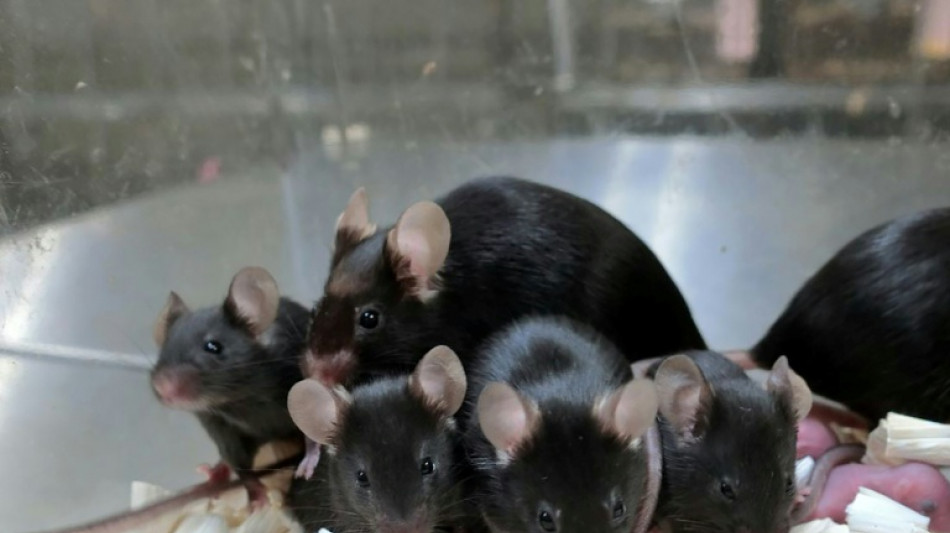
Mammals cannot be cloned infinitely, mice study discovers / Photo: © University of Yamanashi/AFP/File

 Inside the Venezuelan prison meant to 'drive you insane'

 UK king braces as memoir by Diana's brother goes on sale

 No green light to lift EU sanctions on Russian oligarchs, talks to resume

 UK agrees support for Saudi in struggle with Houthis: reports

 EU foreign policy chief calls for continued sanctions on Russia

 Flights scrapped, evacuations urged as Typhoon Dujuan wallops Japan

 Fonseca to take break from tennis

 A Cuban zoo, and its animals, in epic battle for survival

 Infantino proposes consulting federations to reform FIFA

 El Nino weather pattern enters record territory: scientist

 OpenAI calls for US to lead global effort on AI standards

 South African ostriches plucked alive for luxury fashion: report

 US networks halt Trump coverage in revolt over White House ban

 Paramount settles with US states to clear Warner Bros. mega-merger

 Climate crisis a job for world leaders, not just activists: UK FM

 US networks halt Trump coverage over White House ban

 French singer accuses Miley Cyrus of plagiarism

 EU fines Google 403 mn euros for location data breach

 'Best is yet to come,' says De la Fuente after Spain extension

 Why diesel prices are rising more than crude oil

 COP31 host says AI's climate footprint to be a summit priority

 Renewables hit record in 2025, but world must move faster: report

 US media outlets to sue Trump administration after White House ban

 Global stocks rally on lower oil prices, US-China hopes

 EU proposes energy rating for data centres

There is a limit on how many times a mammal can be cloned before suffering "mutational meltdown", Japanese scientists have discovered, after making 1,200 clones over two decades that started off with a single mouse.
The 58th generation of mice did not survive, establishing for the first time that mammals cannot be cloned an infinite number of times, the scientists said in a study published on Tuesday.
It had been hoped that this method, which involves making clones of other clones, could have a range of uses in the future, including saving endangered species or mass-producing animals for their meat.
"We had believed that we could create an infinite number of clones. That is why these results are so disappointing," the study's senior author Teruhiko Wakayama of the University of Yamanashi told AFP.
It was Wakayama's team that cloned the first mouse in 1997, a year after the famous Dolly the Sheep became the first-ever mammal clone.
For the new research, the scientists first cloned the original female mouse in 2005.
Once a mouse reached three months old, they were cloned again, resulting in three or four new generations every year.
Over the next 20 years, they carried out more than 30,000 cloning attempts that created over 1,200 mice.
The process involves removing the DNA-containing nucleus of a cell from a donor animal and implanting it into an unfertilised egg from which the nucleus has been removed.
- 'Critical turning point' -
In the first few years, the method's success rate steadily rose -- reaching over 15 percent at one point -- and the mice appeared to all be identical.
This gave the scientists hope that they could make clones indefinitely.
However there was a "critical turning point" around the 25th generation, according to the study published in the journal Nature Communications.
After that point, harmful genetic mutations built up over the generations, and each new set of mice was less likely to survive.
By the 57th generation, only 0.6 percent survived. Despite their accumulating mutations, these mice were still healthy.
However all the mice in the 58th generation died shortly after birth.
"There were no visible abnormalities in the pups, and the cause of death is unknown," Wakayama said.
The scientists sequenced the genomes of some of the clones, finding that they had three times more mutations than mice born via sexual reproduction.
They also had larger placentas -- and some were missing a copy of their X chromosome.
"It was once believed that clones were identical to the original," Wakayama said, but this was clearly not the case.
Wakayama admitted his team has "no idea" how to overcome this problem, suggesting that perhaps the answer was to develop a better cloning method.
- The importance of sex -
Importantly, when the later clones -- even in the 57th generation -- mated with male mice, they had healthy offspring with fewer mutations.
This discovery demonstrates "that sexual reproduction is indispensable for the long-term survival of mammalian species," the study said.
It also supports a theory called Muller's ratchet, which "predicts that in asexual lineages, deleterious mutations inevitably accumulate, ultimately producing mutational meltdown and extinction," the study said.
The research "provides the first empirical demonstration" that this meltdown occurs in mammals, it added.
The finding could also rule out all sorts of scenarios involving clones that have been dreamt up in science fiction.
For example, Wakayama joked that this finding meant it would have been impossible to create so many clone troopers in the Star Wars prequel "Attack of the Clones".
It could also affect any plans to preserve Earth's genetic resources in a vault in the hope of re-cloning a new population following some catastrophe in the future, the study pointed out.
Wakayama is also working on new ways to collect cells from animals without harming them, as part of efforts to bring endangered species back from the brink.
His team has already successfully made clones from cells found in urine -- and are currently working to do the same with faeces.
N.Fournier--BTB