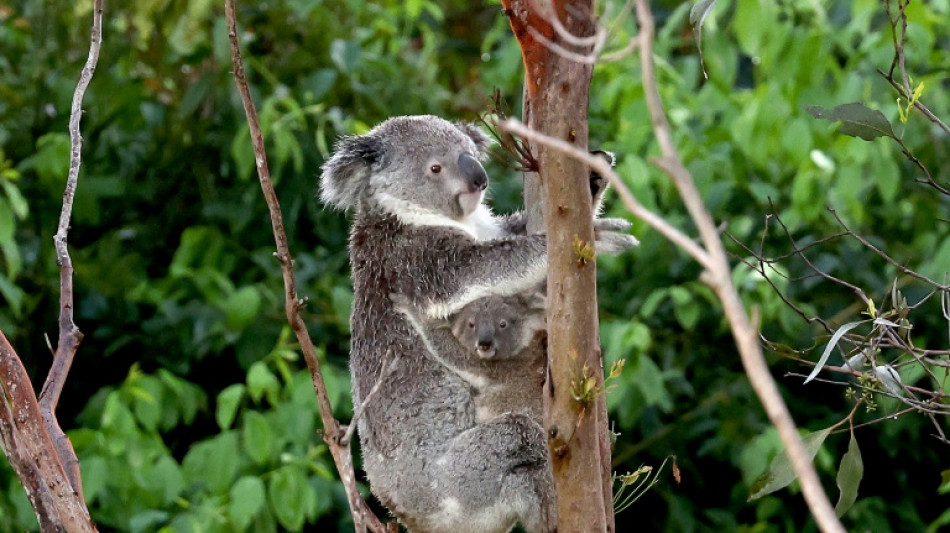
Even moderately hot days raise risk of koala deaths: study / Photo: © AFP/File

 Spain coach De la Fuente gets new deal after World Cup success

 Pressure grows on Germany's Merz after election defeats

 China's Zhang beats Japan rivals to Asian Games gymnastics gold

 Samlingen Haupt: Vad pengar avslöjar om oss människor

 Tens of thousands of German auto workers protest to save jobs

 हॉप्त् कलेक्शन: पैसा हमारे बारे में एक इंसान के रूप में क्या प्रकट करता है

 Συλλογή Haupt: Τι αποκαλύπτει το χρήμα για εμάς τους ανθρώπους

 TradersYard Shifts Focus to Futures Trading

 ハウプト・コレクション:お金が人間について明かすこと

 하우프트 컬렉션: 돈이 우리 인간에 대해 드러내는 것

 Indonesia doing 'everything' but struggling to curb fires

 Sbírka Haupt: Co o nás lidech prozrazují peníze
 North and South Korea fight out draw in niggly Asian Games clash

 Officials say man shot, wounded by ICE agent in Texas

 豪普特收藏:金錢如何揭露人類的本質

 Kolekcja Haupta: Co pieniądze mówią o nas, ludziach

 The Haupt Collection: What Money Reveals About Us as Human Beings

 Barcelona enter new era aiming to retain Women's Champions League crown

 US has deported 25,000 to third countries under secretive deals: report
 Three South Korean soldiers injured in DMZ blast: military

 New Zealanders pick endangered black robin as Bird of the Year

 Asia stocks rise on AI, US-China trade talks optimism

 Malaysia's 'elephant whisperer' fights to save Borneo's endangered giants

 'I live in fear': 1.5 million Pakistani children sexually exploited online

 Cowboys beat Commanders, Vikings down Bears as star QBs injured

Koalas can endure tough conditions in the Australian bush but prolonged exposure to even moderately hot weather can increase their risk of heat-related death, researchers said on Wednesday.
The findings, based on more than 20 years of data of koala rescues, underscore the threat facing not just humans but wildlife as climate change makes heatwaves more frequent and intense.
Researchers found the odds of adult koalas being admitted into care or dying in the Australian state of New South Wales rose when average maximum temperatures over a seven-day period reached 27C.
At 30C or above, those risks "were between 1.5 and 3.5 times higher compared to conditions around 25C", said Valentina Mella, lead author of the study published in Biology Letters.
"Our findings suggest that even what might seem like moderate heat can become physiologically stressful when it is sustained over time," Mella, from the University of Sydney, told AFP.
On hotter days, koalas regulate body temperature by hugging trees to dissipate heat or seeking out denser foliage and lower trees away from direct sunlight.
The herbivorous marsupial can also reabsorb water from the colon and produce more concentrated urine to preserve hydration, or allow its body temperature to fluctuate with the environment in a process known as heterothermy.
But while they can survive conditions above 40C for a limited time, even prolonged exposure at much lower temperatures "appears to significantly compromise their health and survival", Mella said.
- Sedentary and vulnerable -
Researchers adapted a technique widely used to study heat and human health to establish the first "statistically validated association between ambient temperature and koala mortality", the study said.
They analysed nearly 12,000 records of koala admissions and mortality available from rescue organisations and koala hospitals in NSW between 2000 and 2022.
The findings support the evidence that rising temperatures and climate-driven heatwaves are a key threat to wildlife health and survival.
Temperatures once rare are becoming more common, particularly during summer, Mella said, meaning koalas "are likely to experience heat stress conditions more regularly and over longer periods each year".
Koalas remain particularly vulnerable to climate change, even while some other wildlife adapt by switching diets or shifting habitats.
A largely sedentary and inflexible creature, dependent on eucalyptus leaves for much of their water, koalas quickly develop dehydration when hotter conditions persist.
But habitat fragmentation can also prevent them from reaching cooler areas in hotter times, said Mella.
Those with chlamydiosis -- a major disease affecting koalas -- were at greater risk, suggesting heat stress may compound the effects of this condition.
The increasing frequency and intensity of hot days in Australia pose a "significant threat" to endangered inland northwest koala populations at greatest risk of heat exposure, the study said.
Mella said that protecting large, shade-producing trees or providing access to water during heatwaves could help reduce dehydration risk among koalas.
"Without proactive intervention, the continued rise in extreme heat events could push already vulnerable koala populations closer to extinction," the study said.
A.Gasser--BTB