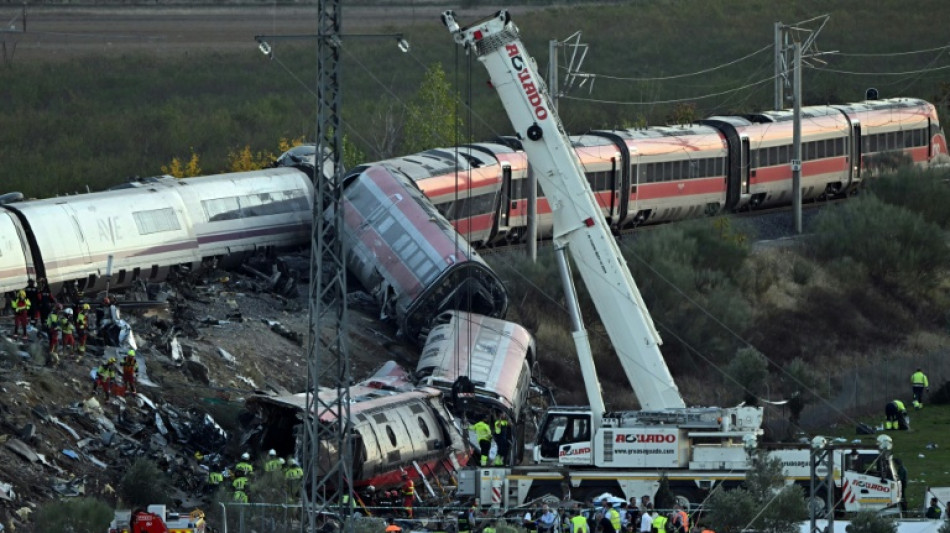
Spain mourns after latest train tragedy kills 68 / Photo: © AFP

 Malta Stuns Sweden with Late Penalty Comeback in Rugby Europe Trophy

 BingX: Major Announcement of Far-Reaching Significance

 Élan Opens as Late-Night Wine Bar in Honolulu

 Shiv Sena (UBT) Criticizes NCP Merger Talks as 'Ridiculous Laughing Stock'

 Dell Announces AI-Integrated PC Lineup for 2026 with Wi-Fi 7 Support

 Rocky Fans Break Guinness World Record at Philadelphia Museum Steps

 FAA Grounds All US Flights Amid Nationwide Air Traffic Control Communication Failure

 Argentina vs Uruguay Kick-off Time, TV Channels & Free Streaming Guide
Spain began three days of mourning on Thursday after its second high-speed rail collision this year killed 68 people and injured scores, with relatives desperately seeking news about their loved ones.
One of Europe's deadliest train disasters this century has raised fresh questions about safety on Spain's rail network after the transport minister reported an "error" and "inexplicable circumstances" that led to the crash.
The collision happened in the central region of Castilla-La Mancha on Wednesday morning when a service by state operator Renfe ploughed into the back of a stationary train belonging to private Spanish company Iryo.
Emergency services combed through the wreckage at night to find further victims on the key line linking Madrid with the southern city of Seville, hoisting pieces of mangled metal with cranes, AFP reporters saw.
Josimar Medina, a 31-year-old Peruvian who was holidaying in Spain with his girlfriend, said he was sleeping on the Renfe train when "I woke up and I was in the air."
Pablo Mejia, 42, escaped with injuries to his head, telling AFP that a last-minute change of seat saved his life.
Wearing a bloodstained grey jumper and holding his tattered suitcase, he recounted "a very strong hit... a lot of people on the floor, on top of each other, seats ripped out, suitcases, a lot of chaos".
"I think I've been born again," he said.
- 'Long and hard hours' -
A school in the nearby village of Urda, around 130 kilometres (80 miles) south of Madrid, is being used to allow relatives to enquire about their loved ones.
Teams of Red Cross workers offered support to groups of people who arrived, some of them in tears, amid crowds of police and journalists from around the world.
Red Cross psychologist Carmen Garcia said "long and hard hours" were in store because "every person will manage it in their own way.
"We have people who are in shock, who haven't taken on board what has happened, angry people, sad, worried people. The grieving will be complicated," Garcia said.
The Civil Guard has set up four offices in the cities of Madrid, Toledo, Cordoba and Seville to enable relatives of the victims to provide DNA samples and help identify the missing.
Blood donation points have also been set up in Castilla-La Mancha and Madrid.
Jose Miguel Fernandez, a parish priest in Urda, joined the emergency services in offering support to the victims' families.
"What matters most is being with the victims' relatives, that they feel the closeness, because words at a time like this are pointless, but a hug helps," he said.
Recalling how he rushed to the site of the crash, Fernandez said he was confronted with "an image of desolation, despair, uncertainty, death".
- Safety questions -
Transport Minister Oscar Puente said on Wednesday that an automatic control system went down on 69 kilometres (43 miles) of track, causing all trains there to be stopped.
But the control centre decided to "resume traffic in circumstances that, from our point of view, are inexplicable," Puente said, with the Renfe train travelling 25 kilometres before striking the Iryo.
The control centre "had more than enough time to verify the error, and they did not fix it", he added.
In January, two high-speed trains collided in the southern region of Andalusia after one of them derailed and crossed onto the adjacent track, killing 46 people.
The investigation into that accident is ongoing, but the left-wing government faced heavy criticism over its management of Spain's railways.
The latest disaster comes one month before Socialist Prime Minister Pedro Sanchez seeks to overturn unfavourable polls and extend his eight-year premiership in an early general election on November 29.
F.Pavlenko--BTB