'Robbing women': Japan's sperm donation law spurs controversy / Photo: © AFP

 McLaren boss glad of 'harmony' between F1 teammates Norris and Piastri

 Saudi Arabia, Turkey and Pakistan sign defence pact amid regional war

 Maradona bloated, bedridden and resigned before death, says icon's masseur

 Infantino and the failed investment plan -- What they said

 Thailand teen kills seven in home, school shooting

 Volt Funded Launches Globally with Evaluation Program Offering Up to 90% Profit Share

 Indonesia battles Mount Bromo wildfire as El Nino takes root

 STARCARES Revamps Basketball Court at the University of Lagos for Future Healthcare Professionals

 Eight dead, including teen suspect's grandparents, in Thailand shooting

 Indonesia traps monkey to end rampage that wounded 18 people

 Food security fears mount as UK farmers battle drought

 Houthi missile attacks kill 58 Saudi-backed Yemeni govt forces

 Chinese activist held in Bangkok finds Canada refuge

 Kiss takes reins as Wallabies face Japan

 North Korea touts dog soup and other home-cooked recipes to beat the heat

 UK observatory nervously watches growing space junk threat

 Meta ordered to pay US state $567 mn to abate 'public nuisance' and child harm

 Houthi missile attacks kill 58 Saudi-backed Yemeni govt forces: source

 No.1 Sabalenka and Pegula advance at Toronto
 China missile test top of agenda as Pacific diplomats meet in Fiji

 Most UK teens to opt out of planned social media curfew: poll

 Venezuela's political transition talks launch in Caracas

 2 killed, 13 wounded in bus blast near Syrian capital: state media

 All Blacks skipper Taylor cautiously recovering from calf strain

 UN chief denounces Russia, Ukraine for civilian deaths

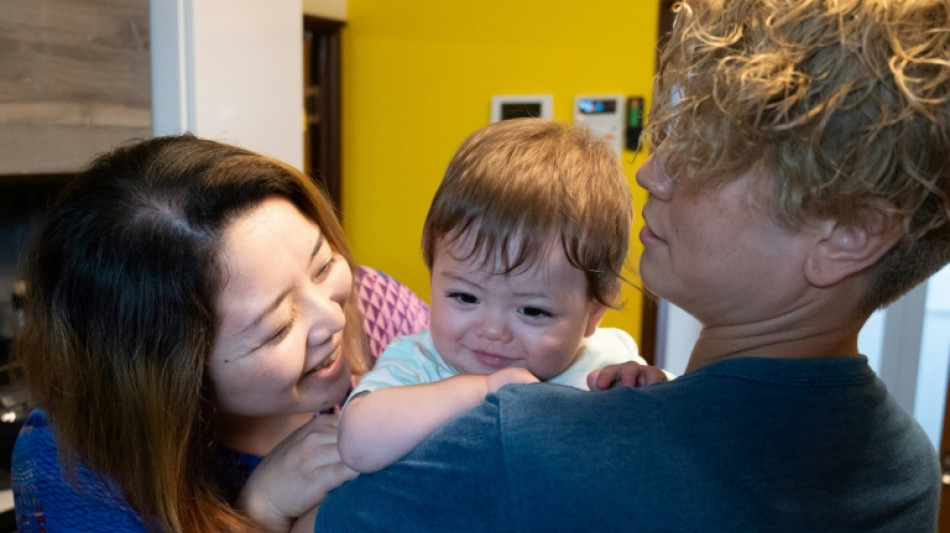
Satoko Nagamura and her girlfriend conceived their son with donated sperm, but new legislation in Japan could effectively outlaw the procedure for lesbian couples and single women.
For decades, anonymous sperm donation has existed in a legal grey zone in Japan, with no law explicitly prohibiting it, but no framework to govern it either.
Legislation expected to be presented this year would regulate the procedure, including protecting the rights of children to know their biological parents and capping recipients from a single donor.
But a draft seen by AFP shows the law would only authorise the process for legally married couples, mostly those affected by male infertility. Japan does not recognise same-sex marriage, so lesbian couples and single women would be excluded.
To Nagamura, the draft is "tantamount to robbing women -- whether same-sex couples or single -- of their reproductive rights, and their desire to give birth to and raise children".
For nearly two decades, the 39-year-old dreamed of being a mother and the chance to "give birth with my body".
She and her partner Mamiko Moda, 42, initially considered overseas sperm banks, before turning to a male friend, encouraged by his willingness to have a relationship with the future child.
They are now the proud parents of a 10-month-old son, who smiles freely as his parents spoonfeed him with encouraging exclamations of "well done", as the family's two dogs look on jealously.
Institutions that offer sperm donation and insemination generally follow the guidelines of the Japan Society of Obstetrics and Gynaecology (JSOG) -- which serve as the basis for the new legislation restricting the process to married couples.
JSOG's guidelines are non-binding, but already carry enough weight that only a handful of doctors defy them to accommodate lesbians and single women.
If the law is enacted, "the few hospitals that have accepted us will no longer be able to do so", said Nagamura.
"There is a big difference between just going against the guidelines and doing something illegal", added Moda.
The couple also fears the new legislation could mean their child, conceived through artificial insemination using a sperm donor, could be stigmatised.
"Even though the way we achieved our pregnancy was not illegal at the time, the impression that we did something wrong, that this kid is somehow 'illegal', could emerge if that's how the law sees it," Moda said.
- 'Double-edged sword' -
Kozo Akino, a ruling-coalition lawmaker involved in drafting the legislation, argues that children's rights are most easily protected by "legally married parents with joint custody".
"Assisted reproductive technology should not be pursued at the expense of the well-being of children," he told AFP.
And some doctors think the law could help make the unregulated treatment more socially accepted, despite being limited to heterosexual married couples.
"My hope is that with the law, our treatment will be seen as more legitimate and become mainstream," said Mamoru Tanaka, an obstetrics professor at Tokyo's Keio University Hospital.
Keio is thought to have been the first medical institution in Japan to perform donor insemination in 1948, but it is no longer accepting new patients because of a donor shortage that followed an internal policy shift.
Since 2017, it has warned donors that their anonymity could be waived if children conceived from their sperm file legal suits. The resulting shortage of applicants means it carried out just 481 procedures for existing patients in 2019, down from 1,952 in 2016.
Patients would "hopefully be able to benefit from (a legal framework), but it's easier said than done", Tanaka said.
"There is a possibility that more people will be pushed underground, and in that sense, it's a double-edged sword," he told AFP.
- 'Whatever it takes' -
Already, some women and couples turn to unvetted sperm donors to avoid the complexities and restrictions of the existing system.
A casual Twitter search turns up hundreds of accounts touting the handsomeness, college degrees and athletic talent of would-be donors, who typically offer recipients either cups of semen for self-insemination, or impregnation via intercourse.
Many do not expect payment beyond transport costs, which has helped fuel debate over their motives, including claims they are simply after sex.
One man advertising his services online told AFP he considered it like donating blood.
"I happen to have a healthy body, so why not put it to good use?" said the 34-year-old freelance illustrator, declining to be named.
The man's wife, a 32-year-old doctor, told AFP she supported her husband's donations, in part because as a bisexual person she wants to help others in the LGBTQ community conceive.
But social media sperm donation raises health and safety issues in terms of verifying donor profiles.
And Nagamura fears that these riskier donations will only become more common if legislation excludes single women and lesbians.
"There will be those who do whatever it takes to have children," she said.
"It's not that easy, giving up on childbirth."
M.Furrer--BTB