A yak at the Oscars: first nomination for Bhutanese film / Photo: ©

 Ahead of Paris mass, pope urges life together in 'dignity and peace'

 Austria 'ghetto' language classes leave children to repeat school

 S.African women runners arm themselves after string of killings

 'I felt embarrassed': Japan eSports whizz-kid, 11, wins Games gold
 Indonesia fires threatens critically-endangered orangutan: IUCN

 Bangkok declares flood disaster across city

 'World records not enough': North Korea weightlifters target Olympic gold rush

 Iran proposes Hormuz plan, Trump reportedly refuses

 El Nino rewrites the menu in the world's top restaurants

 Pope to hold giant mass on Champs-Elysees

 TikTok to pay Alabama $100 mn under pre-trial settlement

 Internationals take 7-3 Presidents Cup lead after foursomes sweep

 Brazil team returns to Colombian site of doomed jet crash

 Mbappe injured as Zidane wins on France debut, Italy lose on Mancini return

 Senegal draw in Vieira debut, Nigeria survive scare as Cape Verde crash

 U2 performs surprise 50th anniversary gigs in Dublin

 Pope calls worshippers 'saints of France' after AI warning

 US court sides with Pentagon in Anthropic AI ban

 Wall Street stocks rise, greeting optimism over possible US-Iran deal

 NFL players chief raises concerns over pitch for Maracana game

 Daytime Russian attacks kill seven in Kyiv

 Spotting AI writing: how reliable are the detectors?

 French youth await pope after AI 'paradise of machines' warning

 Man City found guilty of Premier League charges, set to appeal: reports

 Embolo follows Xhaka out of Swiss squad over fake Covid documents

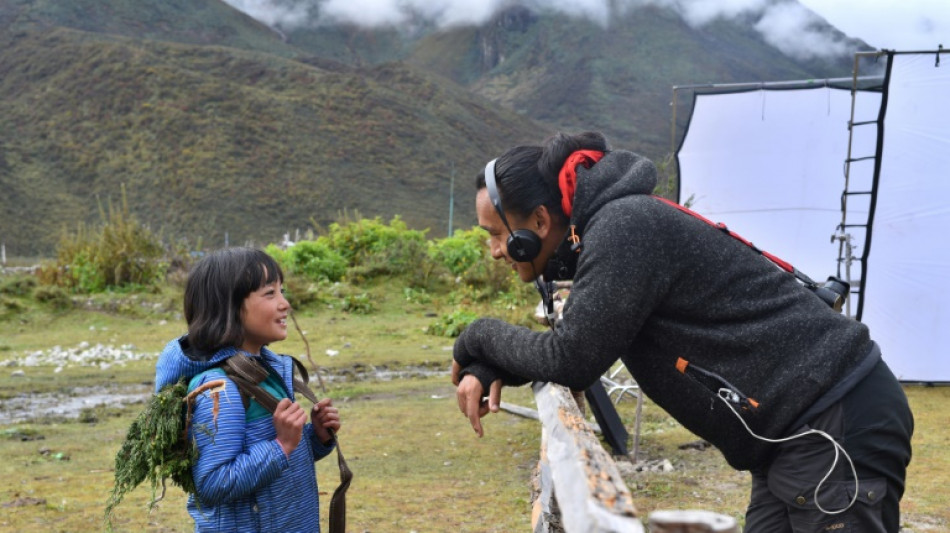
Filmed in one of the remotest corners in one of the world's most inaccessible countries, "Lunana: A Yak in the Classroom", is the first Bhutanese film ever nominated for an Academy Award.
At an altitude of 3,400 metres (11,150 feet), Lunana, where it was shot on location, is home to around 50 people and lies up to 10 days' trek from the nearest motorable road.
Winters are long and harsh, and solar power is the only electricity source, creating major logistical challenges.
Equipment and supplies for the film were carried in by 75 mules, while more than 70 helicopter trips transported the cast and crew.
The movie explores a society in transition through Ugyen, a discontent teacher with dreams of making it big as a singer in Australia, but who is transferred to Lunana, a village of yak herders and fungus collectors.
His initial reaction to Lunana is overwhelmingly negative, but the locals -- real-life villagers playing themselves -- slowly spark a change of heart.
The script is laced with Bhutanese mysticism and environmental messages, while the action takes place against a natural backdrop of vast vistas and snow-capped peaks.
"It is a story about yak songs, it is a story about the value of yak dung," said first-time director Pawo Choyning Dorji.
"It touches upon this universal human story, about seeking what you want, where you belong, seeking happiness.
"That is something that is really needed in our world," he told AFP.
"With the pandemic we have become a society where we want to separate, we want to build boundaries, we want to build walls, we want to highlight what makes us different, what makes us better or they worse than us.
"I wanted to show a simple story where all of us could find and celebrate this universal human quality."
In January the film was selected as one of five nominees for Best International Feature Film at the Oscars taking place next month.
- 'Happy country' -
Bhutan is known for its concept of Gross National Happiness, prioritising well-being as well as economic development, and Ugyen wears a T-shirt emblazoned with the phrase in the film's opening scenes.
But growth has brought greater desire, and thousands of Bhutanese have left their Himalayan homeland in recent years in search of better financial and educational opportunities.
Australia is their favourite destination, so much so that Bhutanese now refer to the "Australian Dream", and the country opened an embassy in Canberra in October.
Teachers are highly respected in Bhutan and along with doctors are the highest-paid government employees, at most ranks earning more than civil servants of equivalent grade, but hundreds of them are resigning every year.
"There are so many Bhutanese who seem to be leaving this so-called 'happy country' to look for happiness elsewhere," said Dorji.
"There's nothing wrong with that," he added. "That's just how life is."
Lunana epitomises the changes Bhutan is undergoing: 3G mobile technology was installed in the village just as the film crew were wrapping up production.
Dorji says the local school's star pupil Pem Zam -- who in the movie tells Ugyen that teachers "touch the future" -- "messages me on Facebook".
- Homemade butter -
"Lunana: A Yak in the Classroom" is only the second Bhutanese film ever to be submitted to the Oscars, after "The Cup" in 1999, made by Dorji's spiritual and cinematographic teacher, Khyentse Norbu. "The Cup" was critically acclaimed but did not make the shortlist for an award.
"Lunana" has already accumulated 18 prizes on the international film festival circuit, but the director said he had "no expectations" from Hollywood.
Many Bhutanese are hearing about the Oscars for the first time as a result of the movie.
One monk told Dorji that he offered a kilogram of homemade butter and 50 Bhutanese ngultrum ($0.60) at a temple to pray for Lunana's success.
"Other films have these big budgets pushing their campaign, we don't," said Dorji.
"But we are a campaign that is carried by the hopes, aspirations and prayers of a whole country."
D.Schneider--BTB