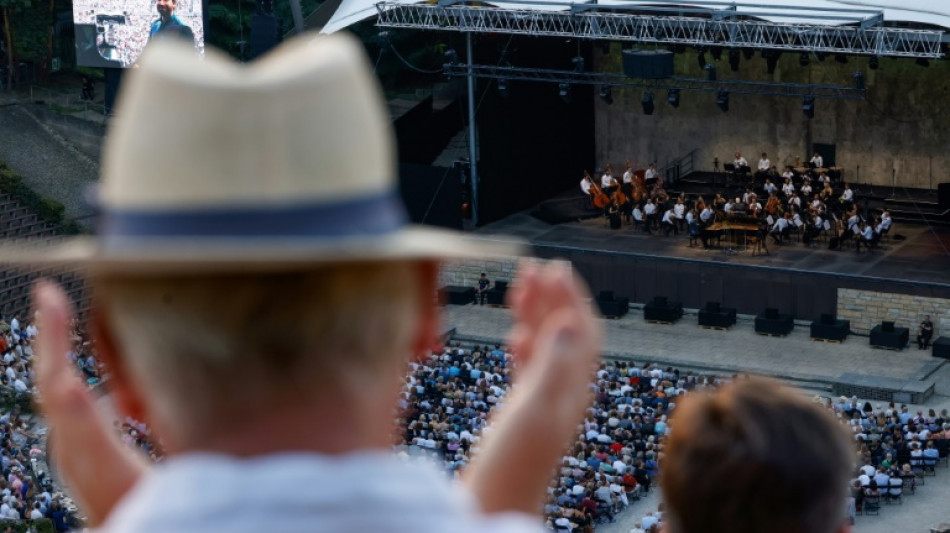
In tune: Classical concert-goers' hearts, breathing synchronize / Photo: © AFP/File

 German far-right aims to lead Saxony-Anhalt govt in December

 Little damage as Hurricane Polo sweeps over Mexico's Pacific coast

 Manchester City guilty of breaking financial rules - Premier League

 FIFA boss Infantino blasted as would-be 'emperor' by UEFA's Ceferin

 Stocks move lower despite oil prices dropping
 AI driving up innovation investment: UN

 UN Security Council extends Haiti mission by 6 months

 Man Utd do not deserve medals if Man City stripped of titles: Rooney

 Vana Completes Expanded Staking as Part of the Vega Upgrade, Publishes Expanded VANA Token Economics

 Spain to cap gas price hikes, extend fuel discounts

 'We just need rain': Germany's Rhine river hits new low

 Yemen health system at 'breaking point': WHO
 Ireland undecided on second Israel match: coach
 France's Le Pen defiant after top ally hit by antisemitism claims

 Tom Cruise trades stunts for satire as toxic tycoon 'Digger'
 MEXC Unveils "WE SEE YOU" Brand Visual Refresh, Putting People Behind Every Trade in Focus

 Thai capital cleans up after deadly floods
 NATO, EU allies rally to Estonia after 'sabotage' blamed on Russia

 Families demand justice for Cameroon's 'nightmare' wave of murdered women

 Tebas says Man City should face 'most severe' sanctions if guilty of rule breaches

 Pochettino calls Man City success 'a period of deception'
 Settler attack on West Bank village injures Israeli forces, drawing rare rebuke

 Mystery over UK airbase scare after reports no explosives found

 Spanish govt races to adopt housing law under protest pressure

 Estonia slams Russian 'sabotage' after arson attack on defence company

People who listen to music together often report feeling a powerful connection to each other as a result of their collective experience.
A new study published in the journal Scientific Reports on Thursday now finds that physical responses -- including heart rate, breathing and the electrical conductivity of skin -- synchronize between audience members at classical concerts.
Individuals who rated more highly for personality traits such as openness were more likely to synchronize, while those with neurotic dispositions were less likely to align.
"When we talk about very abstract things such as aesthetic experiences, how you respond to art and to music, the body is always involved there," Wolfgang Tschacher, a psychologist at the University of Bern who led the research as part of the Experimental Concert Research project, told AFP.
This theory is known as "embodied cognition" -- the idea that the mind is not only connected to the body but that the body influences the mind -- which, while arguably intuitive to lay people, has been controversial in scientific circles.
To investigate, Tschacher and colleagues observed 132 audience members across three classical concerts.
All three played the same string quintet pieces: Ludwig van Beethoven's "Op. 104 in C minor," Johannes Brahms' "Op. 111 in G major," and "Epitaphs" by the contemporary composer Brett Dean.
The authors used overhead cameras and wearable sensors to monitor the participants, who filled in questionnaires about their personalities before the concert, and whether they enjoyed the performance and what their mood was afterward.
Overall, they found statistically significant synchronization on several measures -- people's hearts beat faster or slower during the same musical passages, as did their levels of "skin conductance."
Skin conductance is closely related to the body's flight or fight response. When it's high it indicates a state of arousal and can be linked to goosebumps on the skin; when it's low we are in a state of relaxation.
The cameras even caught alignment of body movements, which the authors wrote "appears noteworthy, as the audiences of all concerts were seated in dimmed lighting" and spread out due to the pandemic.
However, though people's breathing rates aligned, they did not actually inhale and exhale in unison.
- The power of music -
As one might expect, people whose personality types indicated "openness to new experiences" and "agreeableness" were more disposed towards synchronizing with others.
Those who rated highly for neuroticism, "a person who tends towards fearful behavior, warding off things, being more depressed," in Tschacher's words, were less likely to synchronize -- but so too were extroverts, which might seem counterintuitive.
"Extroverted people are very social, they tend to intermingle with people, they want to be in power, and they want to have a certain self-value," he said, adding he had seen this result in previous research too. While extroverts are outgoing, they focus less on the music.
For Tschacher, the findings are more evidence in favor of the "embodied cognition" theory and also help explain why public parades or military marches help build cohesion between participants.
And he expects the effects would be "even stronger" in other musical genres.
"There are additional reasons that people will synchronize in pop concerts, people move, they dance, and that's that is synchronized by the music and that would give even clearer results," he said.
E.Schubert--BTB