Ukraine's cultural crucible embraces the art of war / Photo: ©

 Man City could face 'drastic' sanctions after reported guilty verdict: ex-chairman

 Furious Fury says row between rival promoters could scupper Joshua bout
 'Invincible' 223cm teen basketball player stars as China win bronze
 Tenth woman found dead in South Africa's string of killings
 Japan schoolboy, 11, wins gold while empty seats blight Asian Games
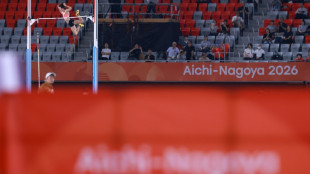 Japan organisers 'not satisfied' as empty seats blight Asian Games
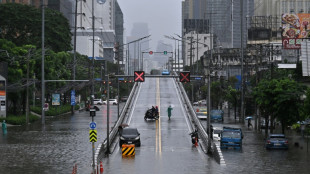 Canals full, roads submerged as Bangkok declares flood disaster
 China, US to open AI 'communication channel' after summit
 Nepal tunnel survivor wants to help post-flood rebuild

 New China sprint star, 17, vows 'no limits' after Asian Games gold
 Japanese 11-year-old wins Asian Games eSports gold
 TikTok agrees to teen limits in US settlement following Meta
 Venezuela's oil cradle pins hopes on US energy deals

 US, China buy time with trade truce as pressure builds
 'Leo, Leo': Young Catholics give pope rockstar welcome in France

 Lula bans sports betting days ahead of Brazil's election

 Guatemala ensures survival of vulnerable 'fossil' fish

 Mancini finds positives in Italy loss, accepts fans' jeers
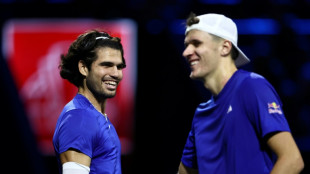 Alcaraz helps Europe into Laver Cup lead

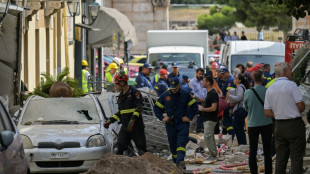 Six missing after building collapses in historic Athens district
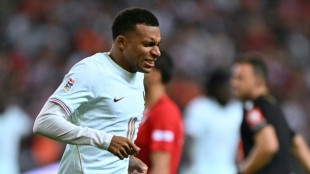 Mbappe scores but suffers knee injury as Zidane gets debut France win
 Mancini's Italy return spoiled by Belgium defeat

 Rodri confident in Man City innocence despite reported charges

 Jay-Z rape accuser says she made 'false accusations'
 Senegal draw first match under Vieira and Nigeria survive scare
A brick-sized printer head scoots back and forth, spraying a furled plastic banner with the silhouette of a mythical fighter pilot.
Next door a drying glossy poster shows a tractor carting off a crippled Russian tank.
A nearby computer is loaded with a caricature of a slain invader. From his skeletal remains sprouts the stem of a sunflower, a national emblem of Ukraine.
Since Russia invaded Ukraine three weeks ago, the Zovnishnya Reklama print works has been a publishing hive for unashamedly patriotic billboards, posters, banners and stickers.
The back alley studio -- enveloped in the heady odour of ink -- is one of many outlets flooding the western city of Lviv with wartime messaging urging Ukraine on to victory.
"For us it is not propaganda," says manager Volodymyr Kotovych, 26, clambering over reams of industrial paper stacked like logs on the workshop floor.
"These are patriotic slogans that motivate our people and our soldiers to have a better fighting spirit."
- Call to arms -
Lviv is known as the cultural capital of Ukraine. Residents gamely concede the capital Kyiv is the heart of the country but contend their hometown houses the nation's soul.
In peacetime the city advertised its artful anima everywhere. Walls were plastered with invitations to stage performances and gallery exhibitions. The tunes of musical buskers overlapped in the cobbled streets.
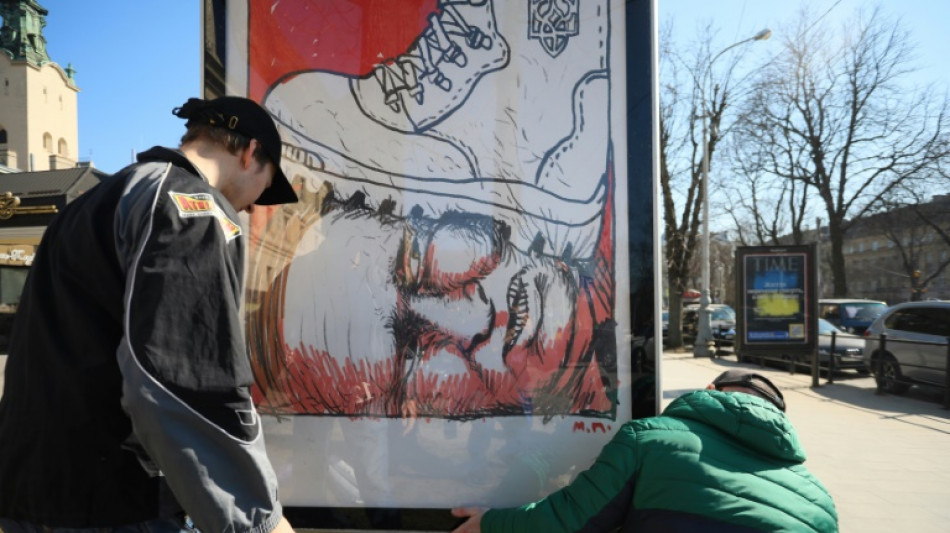
But since Russia launched its invasion on February 24, the city of 700,000 has been decked with graphic and triumphant calls to arms -- from official channels, private enterprises and guerilla artists.
One billboard depicts Russian President Vladimir Putin's crumpled face in the dirt under a sketched boot emblazoned with the Ukrainian trident.
Another apes the style of World War II propaganda -- a snarling Russian bear is torn asunder by a smaller vicious badger sporting the yellow armband of the Ukrainian armed forces.
"Whoever attacks us with the sword will die by that sword," it declares, soliciting donations for the war effort.
From the opera theatre, three billowing drapes depict the folk heroes of the conflict.
The first lauds the "Ghost of Kyiv", a feted fighter ace. Another heralds border guards who died at their posts. The third, an engineer who martyred himself to thwart a Russian armoured advance.
The feats -- and even existence -- of some of the men depicted is contested but all are rousing characters in a story Ukraine is telling itself about the path to victory.
Kotovych clearly feels there is a kernel of emotional truth in the tales, even if they aren't entirely accurate.
The outlet he manages has given over 80 percent of its time to making such prints, as traditional advertising work has dried up under the strictures of wartime.
For him, the distinction between their work and propaganda is the grassroots demand for expressions of solidarity during a national trial.
"Propaganda happens in Russia, where people are told one thing but the truth is something else entirely," he said.
"This is done in the service of the people."
- Souvenirs of war -
Elsewhere in Lviv, there is evidence that Kotovych is correct -- spontaneous art has sprung up supporting Ukraine in the war.
A city centre archway is glued with an A4 poster of the Russian eagle, slashed across by the Ukrainian national colours of blue and yellow.
An overpass is stencilled with the image of a Molotov cocktail -- a symbol of the popular resistance to Russia's invasion.
Sheafs of photocopied flyers are crudely taped around gutters with the black and white image of a soldier, his brow furrowed in determination, as jets soar overhead.
Tourist shops along the narrow routes of the city centre are already marketing the emerging art to the public, further proof of its popularity.
At Kram, a souvenir boutique lined with merchandise, tote bags bear the image of President Volodymyr Zelensky, his clenched fist held high.
Chocolate bar wrappers are inked with portraits of national poet Taras Shevchenko in an army uniform.
"Propaganda or not, the Russians came to our land and we need to defend ourselves," says 21-year-old cashier Mykhailyna Yarmola.
In peaceful times Lviv -- just 70 kilometres (45 miles) from the Polish border -- was a tourist hotspot drawing in droves of visitors.
Now the traffic is overwhelmingly outgoing.
The UN says around 3.5 million have fled the country since the war began, leaving fewer and fewer to be buoyed up by arts and trinkets proffering hope.
Yarmola gestures at a confectionary branded with a message of defiance towards Russian warships -- their most popular item.
"People take them as a gift or as a souvenir if they are leaving for elsewhere, to Poland, as refugees," she says.
O.Bulka--BTB