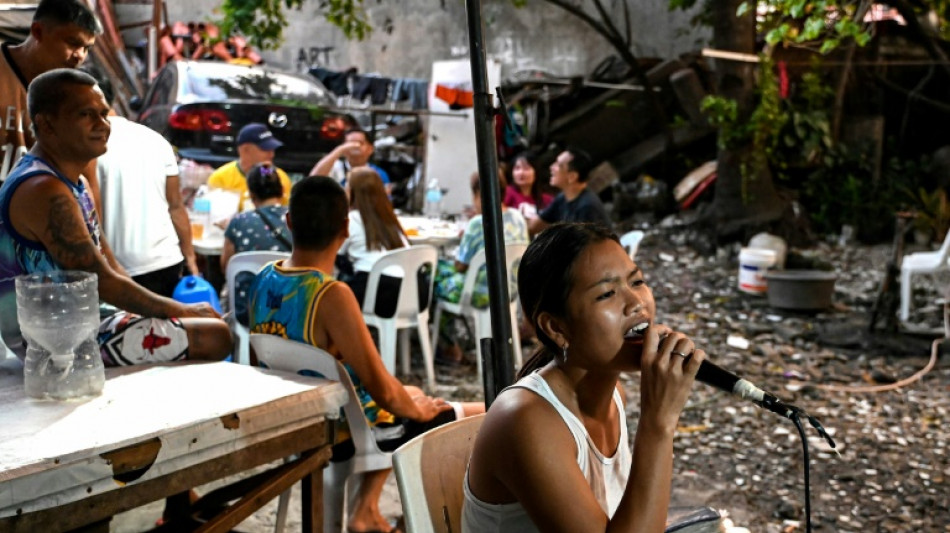
'We love singing': Filipinos find joy in karaoke / Photo: © AFP

 UN to hold fourth informal poll of secretary-general candidates
 Who are the Emiratis behind crisis-hit Manchester City?

 Singer Angelique Kidjo urges Africans to 'create together'

 Alleged Rihanna mansion shooter mentally fit for trial, says judge
 Mystery over UK airbase scare as police find petrol not explosives
 OpenAI unveils low-cost AI model, a day after shelving Astra upgrade
 Premier League confirms Man City guilty of serious financial breaches
 Brazil's Lula turns to Bad Bunny tune to criticise Trump ahead of polls
 Nigerian dancer eyes world record after seven-day marathon
 Swiss regulator concludes Julius Baer bank probe

 Brazil's patron saint pulled into latest election scrap

 Football overload leaves players near 'breaking point', warns Tebas
 Paris Eiffel Tower says chief to step down after uproar over removing women staff
 Amaze Holdings (NYSE: AMZE) Executes Binding LOI to Acquire BullionFX | Alchemy, a Decentralized Gold-Backed Financial Ecosystem for Valued at US$155 Million

 Clashes between French teens, police as school blockades intensify
 Stocks move sideways despite oil moving lower

 African leaders to gather in Egypt for business summit
 UK decides against charging foreign visitors for museums

 Dallaglio to sell England World Cup winners' medal

 Brazil come from behind to beat Australia 4-2 in friendly
 Ruthless An retains Asian Games badminton crown as Kunlavut triumphs

 Alonso to stay with F1 team Aston Martin in 2027
 China badminton 'still strong' despite Asian Games slump
 'Exceptional' Turner painting shown in Rome before sale
 European stocks climb as oil dips
At a busy tricycle terminal in Manila, driver Edgar Soriano slips a coin into a karaoke machine and belts out his favourite song while waiting for passengers.
Karaoke is wildly popular in the archipelago nation where it's never too early -- or too late -- to grab a microphone and sing a tune.
Machines can be found everywhere from cheap bars in far-flung villages to modern KTV joints in the cities, and many families have their own or rent one for parties.
For as little as five pesos (nine US cents) a song, many in the poverty-afflicted country can experience a few minutes of joy in the day.
Soriano, 53, smiles as he stands in a tiny eatery on a hot weekday afternoon singing the lyrics of British musician Albert Hammond's "When I'm Gone", which he seems to know by heart.
The karaoke machine is one of six at the terminal, but drivers and passengers waiting for a ride appear unbothered by the competing songs reverberating through speakers.
"I always sing that song, it's my favourite," said Soriano, wearing a long-sleeved Jordan top and tracksuit pants.
After consulting a well-thumbed plastic folder of songs, street sweeper Bernardo Aguire, 67, settles on Frank Sinatra's "My Way", and pops a coin into the slot.
It is a bold choice in a country where the song has reportedly gotten people killed -- allegedly because they sang it poorly.
Aguire, unfazed by the stories that have become an urban legend, finishes his rendition unscathed.
Felomina Hernane, 52, owns the eatery where the karaoke machine cranks up at 8:00 am and doesn't stop until 10:00 pm or later, seven days a week.
She bought the machine to attract customers and it's been a boon to earnings, bringing in as much as 18,000 pesos a month.
"It's a huge help for my business," Hernane told AFP.
Hernane said singing makes the drivers happy.
"It entertains them," she said.
"It's a way to relax after driving."
- 'It takes away my stress' -
In a crowded neighbourhood in Manila, tricycles deliver karaoke machine casings to stores where they are fitted with speakers, amplifiers and televisions.
Their prices depend on the quality of the electronics inside them, with a basic machine starting at around 19,000 pesos and a premium version topping 46,000 pesos.
Alfred Condez works at a store overflowing with machines in various stages of assembly. It takes several hours for employees to finish wiring one, and customers are often happy to wait.
"We love singing," said Condez, 40.
As if to prove his point, he picks up a microphone and stands on the footpath to test an assembled machine's sound quality, his deep voice echoing into the noisy street.
The busiest period for the karaoke assembly business is November and December, when Filipinos hold Christmas and New Year parties, said Condez. His shop sells as many as 10 machines a day in those months.
Karaoke took off in the Philippines in the 1980s, said Krina Cayabyab, a vocal instructor and associate professor in the University of the Philippines' music department.
But she said the country's love of singing was deeply rooted in its colonial past, starting with the Spanish and then the Americans, whose music was absorbed by Filipinos.
"It's really tied into that reproducing and borrowing of stuff that Filipinos would hear," Cayabyab said.
Singing is one of the few affordable entertainment options for many Filipinos.
In a hardscrabble district of Manila, children and young adults gather outside a small store where the karaoke machine is in high demand.
"My friends and I are just hanging out because it's boring at home," said Honey Servito, 24.
"I'm not really a singer, it's just that when we have nothing better to do at home, my friends and I go here and sing," she said.
"It takes away my stress and boredom."
O.Bulka--BTB