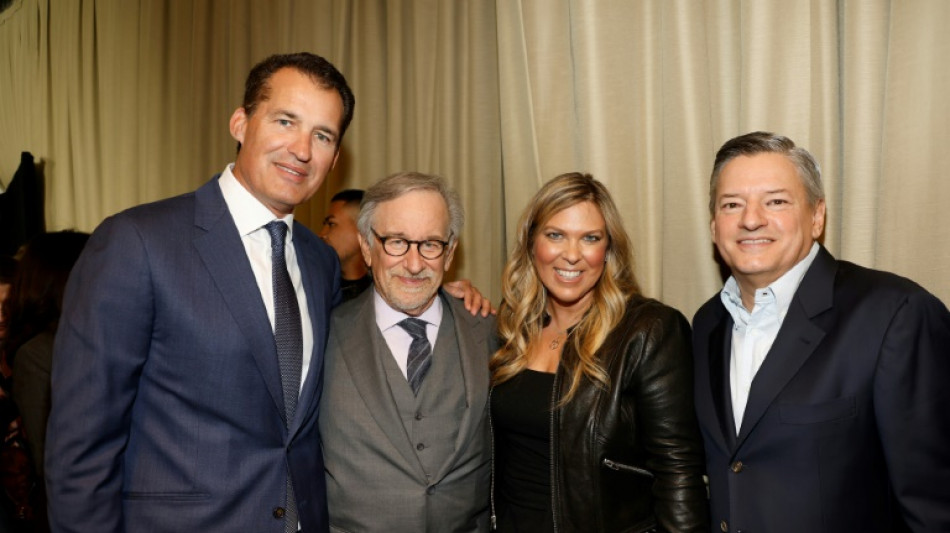
Netflix and Spielberg combine for nature doc 'Life on Our Planet' / Photo: © GETTY IMAGES NORTH AMERICA/AFP/File

 UN to hold fourth informal poll of secretary-general candidates

 Who are the Emiratis behind crisis-hit Manchester City?

 Singer Angelique Kidjo urges Africans to 'create together'

 Alleged Rihanna mansion shooter mentally fit for trial, says judge
 Mystery over UK airbase scare as police find petrol not explosives

 OpenAI unveils low-cost AI model, a day after shelving Astra upgrade
 Premier League confirms Man City guilty of serious financial breaches
 Brazil's Lula turns to Bad Bunny tune to criticise Trump ahead of polls

 Nigerian dancer eyes world record after seven-day marathon
 Swiss regulator concludes Julius Baer bank probe
 Brazil's patron saint pulled into latest election scrap

 Football overload leaves players near 'breaking point', warns Tebas

 Paris Eiffel Tower says chief to step down after uproar over removing women staff

 Amaze Holdings (NYSE: AMZE) Executes Binding LOI to Acquire BullionFX | Alchemy, a Decentralized Gold-Backed Financial Ecosystem for Valued at US$155 Million
 Clashes between French teens, police as school blockades intensify

 Stocks move sideways despite oil moving lower

 African leaders to gather in Egypt for business summit

 UK decides against charging foreign visitors for museums

 Dallaglio to sell England World Cup winners' medal
 Brazil come from behind to beat Australia 4-2 in friendly

 Ruthless An retains Asian Games badminton crown as Kunlavut triumphs

 Alonso to stay with F1 team Aston Martin in 2027
 China badminton 'still strong' despite Asian Games slump

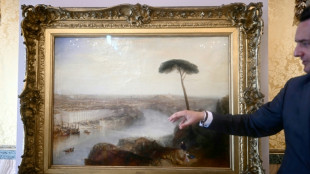 'Exceptional' Turner painting shown in Rome before sale

 European stocks climb as oil dips

"Life on Our Planet," the new natural history series from Netflix and Steven Spielberg, sets out to tell the entire, dramatic story of life on Earth in a serialized, "binge watch" format.
Streaming globally from Wednesday, the show's eight episodes transport viewers through Earth's five previous mass extinction events, each recreated with computer-generated visual effects.
As Morgan Freeman's narration reminds us, life has always found a way to endure every catastrophic event thrown at it over four billion years, from brutal ice ages to meteorites.
Each time, species that survive the destruction do battle for the next era's dominance in a "Game of Thrones"-style fight -- only between vertebrates and invertebrates, or reptiles and mammals, instead of Starks and Lannisters.
"What we wanted to do, our intention at the very beginning, was to serialize the story of life. Make it a kind of binge watch. Because the story is so dramatic," said showrunner Dan Tapster.
"I think, and I hope, that is something that we've achieved, which is possibly a world-first in the natural history space."
Aside from a series of cliffhanger finales, "Life on Our Planet" finds dramatic tension with a series of ordinary, loveable underdogs who "win" evolution against the odds -- at least for a few hundred million years.
The influence of executive producer Spielberg's company, Amblin Television, encouraged a series with "a lot more emotion" and "pathos" than other natural history programs, said Tapster.
The show picks out key species, such as the first fish with a backbone, or the first vertebrate to migrate from ocean to land.
With 99 percent of all the species that ever lived now extinct, filmmakers had no shortage to choose between.
"There's about at least a billion species that are no longer with us, and we had to narrow that down to 65," said Tapster.
But those selected are often unlikely heroes -- plucky survivors, such as the odd-looking Arandaspis fish, which take their chance to shine as larger ocean beasts falter, and reshape the future of life.
Arandaspis "is a bit rubbish, it's weird... But it's in (the show), because it has a really crucial role" in evolution, said visual effects supervisor Jonathan Privett.
"One of the things I really love about that scene also is that Arandaspis has just got a hint of 'ET' about him," added Tapster.
- 'Authentic' -
The series employs visual effects from Industrial Light & Magic, the company established by "Star Wars" creator George Lucas, which pioneered the groundbreaking 3D dinosaurs for Spielberg's "Jurassic Park" three decades ago.
Monsters of the ancient past, from dinosaurs to the far earlier, sea-dwelling Cameroceras with their giant 25-foot (8-meter) shells, are rendered over the top of real backgrounds shot by the filmmakers.
To do this, producers had to scour the planet for contemporary landscapes that most closely resemble the habitats of creatures up to 450 million years ago.
"The animals really sit in a real world. I think it's seamless, and I think it's a very authentic way of taking us back into that time," said producer Keith Scholey.
Filmmakers also had to use visual effects tools to painstakingly remove pesky modern newcomer species, like fish, mammals -- and even grass.
"Grass was the bane of our lives," recalls Tapster.
Grass "only really took over the world about 30 million years ago... that, for us, meant we had to do a lot of gardening."
- 'Dominant species' -
The show enters a crowded marketplace, going up against David Attenborough's latest BBC series "Planet Earth III," which also launched this week.
It follows Apple TV+'s "Prehistoric Planet," also narrated by Attenborough, which uses computer-generated effects to recreate the age of dinosaurs.
But "Life on Our Planet" also aims to stand out from the competition due to the timely message embedded within its narrative.
Despite the show's interest in cliffhangers and plot twists, it is not much of a spoiler to say that it ends with life surviving, and humans on top.
Yet with a sixth mass extinction event already under way due to humankind's impact on Earth, there is a deeply sobering warning too.
"The five events we've had so far, there has been one common denominator -- and that is, the dominant species as you go into that extinction never came out," says series producer Alastair Fothergill.
"We are creating the sixth one, and I think you probably think we are the dominant species at the moment ..."
Tapster added: "In a strange way, there is a message of hope within that.
"Because not only is this the first extinction event that is being caused by a species, but we also have the ability to stop it."
B.Shevchenko--BTB