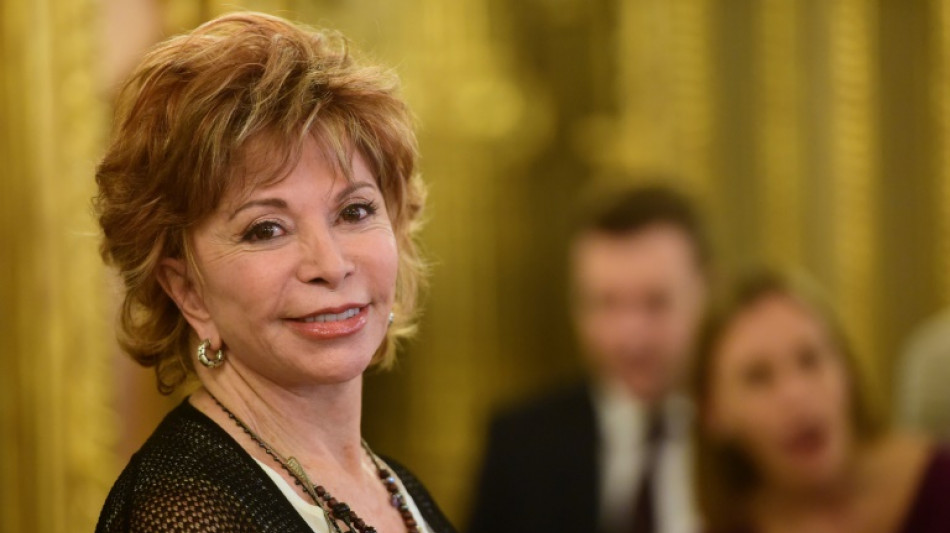
Isabel Allende: In Chile, the 'old fogeys' need to go / Photo: ©

 Stocks rise on AI buzz, oil prices cool

 India narrowly survive huge scare against minnows Japan

 Missing F-35 fighter parts 'not sensitive', says Australia minister
 Cambodia showcases scams crackdown with global conference

 Afghan cyclist who disguised herself as man wins Asian Games silver

 Typhoon Dujuan leaves four dead in Japan, 45,000 houses without power

 G7 leaders condemn Houthi strikes on Saudi Arabia
 Google data centre sparks protests in Austria

 Shin Ohashi: Junk food-loving teen and Japan's next big swimming hope
 Stocks rise on AI buzz, drop in oil prices

 China's robot dancers limber up for America's Got Talent final

 Despite military might, Saudi struggles to crush the Houthis
 Trump to tout deals, defend Iran war in UN speech
 Sri Lanka to issue verdict in landmark Easter attack trial

 No green light to lift EU sanctions on Russian oligarchs, talks to resume

 UK agrees support for Saudi in struggle with Houthis: reports
 EU foreign policy chief calls for continued sanctions on Russia
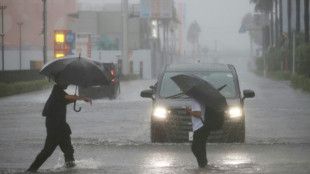 Flights scrapped, evacuations urged as Typhoon Dujuan wallops Japan

 Fonseca to take break from tennis

 A Cuban zoo, and its animals, in epic battle for survival

 Infantino proposes consulting federations to reform FIFA

 El Nino weather pattern enters record territory: scientist
 OpenAI calls for US to lead global effort on AI standards
 South African ostriches plucked alive for luxury fashion: report

 US networks halt Trump coverage in revolt over White House ban

The "old fogeys" of Chilean politics must go, says Isabel Allende -- a stance that is true to form for the novelist, whose latest book "Violeta" is a sweeping epic depicting the transformation between past and present.
A new generation has taken power in Chile, and Allende, perhaps the most popular Spanish-language writer on the planet, is welcoming the dawning political era with open arms.
"In Chile, the old fogeys of the political and financial world have got to go home -- or to an asylum!" the Chilean author tells AFP during a recent video interview.
Gabriel Boric, a leftist who was elected Chile's youngest-ever president at age 35 last month, is already unsettling markets and turning traditional Latin American politics upside down by unveiling a young, women-majority cabinet.
Allende is cheering him on.
"It is a young generation that is taking power," she says.
She applauds his cabinet choices -- and also notes that this young government will have to implement a new Constitution in Chile.
"And that... is an opportunity for us to ask ourselves what sort of country we want," she says.
The changes make her hopeful, especially as they point towards equality for women and Indigenous people.
"And we must try to ensure that all this is part of the country without damaging the economic system, which has made progress in Chile but is very badly distributed, creating such terrible inequality that people are furious," she says.
- 'Broader vision' -
Change, the journey between the past and the present, has long been a theme of Allende's nearly 30 books, which have been translated into more than 40 languages and sold some 70 million copies.
In her new novel "Violeta," she tells the story of an independent woman who was born during one pandemic and dies during another.
Along the way, she witnesses the many transformations of a South American country that seems very much like Chile.
"The idea came to me after the death of my mother. She died shortly before the (Covid-19) pandemic, and she was born as the Spanish flu was coming to Chile, in 1920," Allende says.
The novel takes place during her mother's lifetime, which she describes as "a period in the 20th century of wars, depressions, dictatorships in Latin America, revolutions.
"I created a protagonist who resembles my mother in many ways, but who is not her and who had a much more interesting life."
The difference, she says, is that "Violeta can support herself, which gives her great freedom. My mother depended first on two husbands, and then on me."
In the novel, Violeta and her family leave the capital and move to the south of the country, where they live alongside people of more humble backgrounds.
It was important for Allende to show those class differences, she says, describing a "caste system" in Latin America "which in some places is quite impenetrable."
"And Chile is a country with many class prejudices, more than other countries, perhaps in part because there was little immigration in its early days.
"So Violeta, if she had remained in her social class, if she had lived the corresponding life, would never have gained a broader vision of the country, and of life."
- Stranger in a familiar land -
That kind of "broader vision" is reflected in Allende's own life also.
The author was born in Lima in 1942 -- but she has been abroad for many years, and now lives near San Francisco in the United States.
She describes a sensation familiar to anyone who has lived far from home for a long time, of being a stranger wherever she goes.
Whenever she returns to Chile, she says, "The first week I am happy, but then I realize that I am a foreigner there, too. It is my destiny.
"In the United States, I speak English with an accent. Anyone who sees me on the street knows that I am a Latina and that I am an immigrant.
"And in Chile, I have lived abroad for 40 years, and the country has changed a lot.
"In my head and in my heart is a country that no longer exists."
- Why stop? -
The journey between the past and the present is also reflected in her writing process, she says.
Some things don't change, such as the date she begins writing.
"I start all my books on January 8, so on the seventh I have to take nerve pills," Allende explains.
"The nerves have never left me, but I've learned that if I show up with discipline before the keyboard each day, something comes out."
She has also become "a little more relaxed," she says -- and she has learned that it is "no good" to have an outline.
"That paralyzes me and I lose all inspiration. I let the story change," she says.
"I enjoy writing so much. People tell me: 'You shouldn't have to write any more, you're getting too old for that.'
"But I love it. Why would I want to stop?"
Y.Bouchard--BTB