Gustave Eiffel: French tower builder who sparked skyscraper frenzy / Photo: © AFP/File

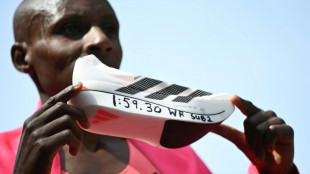 'No limits': Marathon world record holder Sawe chasing history
 Countdown begins to biggest-ever Rugby World Cup
 Bangladesh women lose ground after quota reform
 Vietnam admits 'differing opinions' on Hanoi development
 Stocks temper gains as oil pares heavy losses, US data in focus
 New Zealand denies breaching climate commitments to EU
 Albert becomes youngest US scorer in 4-2 win over Chile
 Pirate island's plunging population shows Greece's demographic decline
 With elections ahead, Latvia's Russian-speakers reject Moscow's help
 Brazil football clubs face massive sponsorship blow from betting ban
 ChatGPT maker wants to be the App Store for AI as safety concerns grow
 Women fight fires and sexism in Indonesian Borneo

 Forsling's OT blast lifts Florida over Carolina in NHL opener

 Hurricane Polo sweeps over Mexico's Pacific coast, heads inland
 Grynspan pulls ahead in race to lead UN: diplomat

 Trump touts AI boss pledge to self-regulate
 Oil down, but stocks lower as bond yields rise
 England break down stubborn Czechs to claim first Nations League win
 UN Security Council extends Haiti anti-gang force by 6 months
 Manchester City guilty of Premier League charges: What comes next?

 Man City chief Soriano slams Premier League 'conspiracy theory'
 Hurricane Polo sweeps over Mexico's Pacific coast
 Man City must be relegated after guilty verdict says club's former chairman

 German far-right aims to lead Saxony-Anhalt govt in December
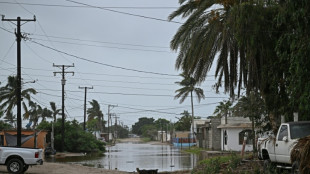 Little damage as Hurricane Polo sweeps over Mexico's Pacific coast
French engineer and entrepreneur Gustave Eiffel will forever be remembered for building the much-loved tower that has dominated the Paris skyline for over a century.
But the father of the Eiffel Tower also designed hundreds of other landmarks across the globe, and even patented a system of underwater "bridges" to run under the Channel.
Here are five things to know about the engineer and inventor, who died 100 years ago on December 27, 1923, at the age of 91.
- Bonickhausen Tower? -
Eiffel designed the tower that would bear his name for the World Fair in Paris in 1889.
But the tower, which came to symbolise France, could very easily have had a German name.
Eiffel, who had German roots, was born Alexandre Gustave Bonickhausen dit Eiffel in 1832 in Dijon but he dropped the German part of his surname after the 1870 Franco-Prussian war, fearing it could damage his career.
Erected in record time, the 7,000-tonne, 300-metre (1,052-foot) "Iron Lady" was the tallest human-made structure in the world for four decades.
Commenting on its place in history, the Bureau International d'Expositions, which organises World Expos, says it "marked the pinnacle of iron architecture, and set the pace for the skyscraper frenzy that would follow in the 20th century".
- Projects on five continents -
The Tower came towards the end of Eiffel's career, during which he built around 500 structures across five continents.
He built his reputation as a builder of railway bridges but also used his metal wizardry to build the Pest railway station in Hungary, lighthouses in Finland and Madagascar, the structure of the Saigon Central Post Office in Ho Chi Minh City and the iron framework of the Statue of Liberty in New York.
He also designed portable bridges, delivered around the world in kits.
- Channel tunnel 100 years early -
Never short of ideas, Eiffel proposed to build what he described as a bridge under the Channel to link France with Britain.
His 1890 design envisaged a system of concrete-coated metal tubes built on supports resting on the sea bed.
The project never saw the light of day, but 104 years later the Channel Tunnel linking Britain and France, which measures 169 Eiffel Towers placed end-to-end, was launched to great fanfare.
- Panama fiasco -
Eiffel was as much an entrepreneur as engineer. In 1887, his company won the contract to build locks for the Panama Canal -- the biggest deal of his career.
But poor management by Ferdinand de Lesseps, the Frenchman who had overseen the successful Suez Canal, caused the project to collapse, resulting in one of the biggest financial scandals of 19th century.
De Lesseps and Eiffel were both charged with fraud and sentenced to prison and hefty fines.
Although their convictions were later overturned, Eiffel's reputation had taken a battering and he retired from business.
- Radio Eiffel -
He devoted the last 30 years of his life to scientific research, with a particular focus on meteorology and aerodynamics.
The wind tunnel he built in a hangar at the foot of the Eiffel Tower was used to test more than 20 planes.
It is still used today by the construction, aviation, shipping and automotive industries to test the effects of wind and air.
He also used research to save his illustrious tower, which was commissioned on the understanding that it be dismantled after 20 years.
He installed a meteorology station on the third floor, but it was the addition of a giant radio antenna in 1921 that saved it from the wrecking ball.
L.Dubois--BTB