'Immense' collection of dinosaur footprints found in Italy / Photo: © AFP

 Alex Bodi and Prof. Dr Dieter Lazik sign a contract for ALPHA WHEY and BODI Energy Drink

 Swiss reject plan to toughen neutrality: projection

 UK police call in bomb disposal team near air force base

 Bangkok floods send thousands into shelters after days of rain

 Assefa just misses women's world record at Berlin Marathon

 Dramatic winners Zimbabwe to end five-year exile by tackling DR Congo

 Pope to meet victims of clerical sex abuse on France trip

 How young is too young as child prodigies win big at Asian Games

 UK Labour party meets buoyed by Burnham but eager for concrete plans

 Thousands protest ahead of Mexican president's report on missing students

 Bangkok floods force thousands into shelters

 AI startup urges optimism from Europe despite safety fears

 'Godlike, invincible': Japan hails 11-year-old Games history-maker

 Nepal's hydropower ambitions face climate reality check

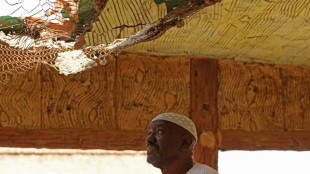 Power cuts, rubble: millions come home to find Sudan's capital unlivable

 Internationals keep Presidents Cup lead with late fightbacks

 Tuchel to 'keep pushing' England to reach Spain's level

 Alcaraz saves match points to keep Europe ahead in Laver Cup

 Spain success driven by hunger to improve, says De La Fuente

 Lyon collapse at Stade Francais to suffer first Top 14 loss

 Oyarzabal and Spain sink England again as Modric shines for Croatia

 Housing protesters camp in central Madrid after mass demonstration

 Louise Trotter expands her palette at Bottega Veneta

 Pope prays at Lourdes after huge Paris mass

 USA trims International lead after Presidents Cup four-balls

Hundreds of metres of dinosaur tracks with toes and claws have been found in the Italian Alps in a region that will host the 2026 Winter Olympics, authorities said Tuesday.
"This set of dinosaur footprints is one of the largest collections in all of Europe, in the whole world," Attilio Fontana, head of the Lombardy region in northern Italy, told a press conference.
The tracks, which are over 200 million years old, were discovered in the Stelvio National Park, in an area between the towns of Bormio and Livigno, which host part of the games.
Nature photographer Elio Della Ferrera first spotted the imprints in September in an almost vertical rocky slope.
Some measured up to 40 centimetres (16 inches) in diameter.
The collection "extends for hundreds of metres and also represents a series of animal behaviours, because in addition to seeing animals walking together, there are also places where these animals meet", Fontana said.
Della Ferrera called in palaeontologist Cristiano Dal Sasso from Milan's Natural History Museum, who assembled a team of Italian experts to study the site.
"It's an immense scientific heritage," Dal Sasso said in the region's press release.
"The parallel walks are clear evidence of herds moving in synchrony, and there are also traces of more complex behaviours, such as groups of animals gathered in a circle, perhaps for defence."
- Sharp claws -
The tracks, currently covered by snow and off the beaten track, are preserved in Upper Triassic dolomitic rocks, dating back approximately 210 million years.
Most of the footprints are elongated and made by bipeds. The best-preserved ones bear traces of at least four toes.
That suggests they belong to prosauropods, herbivorous dinosaurs with long necks and small heads, which are considered the ancestors of the large sauropods of the Jurassic period like the Brontosaurus, the experts said.
Prosauropods had sharp claws, and adults could reach up to 10 metres in length.
There may also be tracks of predatory dinosaurs and archosaurs, the ancestors of crocodiles, the press release said.
The prints are on an almost-vertical slope due to the formation of the Alpine chain.
But when the dinosaurs walked through the area, it was formed of tidal flats that stretched for hundreds of kilometres, and the environment was tropical.
"The tracks were made when the sediments were still soft and saturated with water, on the broad tidal flats surrounding the Tethys Ocean," ichnologist Fabio Massimo Petti said, referring to a prehistoric ocean.
"The plasticity of those very fine calcareous muds, now transformed into rock, has in areas preserved truly remarkable anatomical details, such as impressions of the toes and even the claws," he said.
The footprints were then covered by sediments which protected them, but with the uplift of the Alps and the erosion of the mountainside, they have been brought back into view.
"As the layers containing the tracks are diverse and overlapping, we have a unique opportunity to study the evolution of animals and their environment over time," geologist Fabrizio Berra said.
"Like reading the pages of a stone book."
I.Meyer--BTB