Takanakuy, the Andean 'fight club' that clears the air for a new year / Photo: © AFP/File

 'No limits': Marathon world record holder Sawe chasing history
 Countdown begins to biggest-ever Rugby World Cup
 Bangladesh women lose ground after quota reform
 Vietnam admits 'differing opinions' on Hanoi development
 Stocks temper gains as oil pares heavy losses, US data in focus
 New Zealand denies breaching climate commitments to EU
 Albert becomes youngest US scorer in 4-2 win over Chile
 Pirate island's plunging population shows Greece's demographic decline
 With elections ahead, Latvia's Russian-speakers reject Moscow's help
 Brazil football clubs face massive sponsorship blow from betting ban
 ChatGPT maker wants to be the App Store for AI as safety concerns grow
 Women fight fires and sexism in Indonesian Borneo

 Forsling's OT blast lifts Florida over Carolina in NHL opener

 Hurricane Polo sweeps over Mexico's Pacific coast, heads inland
 Grynspan pulls ahead in race to lead UN: diplomat

 Trump touts AI boss pledge to self-regulate

 Oil down, but stocks lower as bond yields rise
 England break down stubborn Czechs to claim first Nations League win
 UN Security Council extends Haiti anti-gang force by 6 months

 Manchester City guilty of Premier League charges: What comes next?
 Man City chief Soriano slams Premier League 'conspiracy theory'

 Hurricane Polo sweeps over Mexico's Pacific coast
 Man City must be relegated after guilty verdict says club's former chairman

 German far-right aims to lead Saxony-Anhalt govt in December
 Little damage as Hurricane Polo sweeps over Mexico's Pacific coast
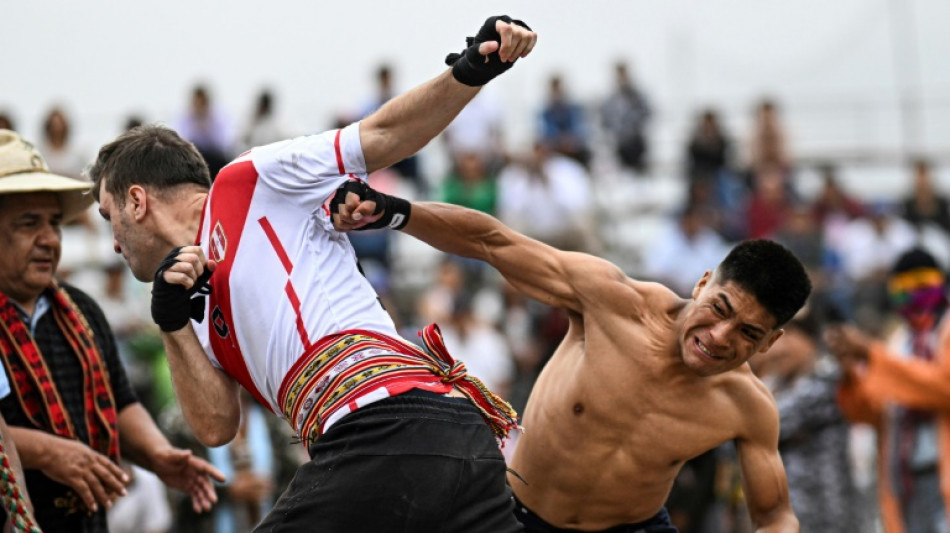
The fighting begins and ends with a hug, part of a singular ritual that has residents of the Peruvian Andes punching and kicking in a year-end fight competition known as Takanakuy.
Before the dueling starts in an open-air arena, male fighters remove their elaborate headgear -- stuffed birds, foxes or even goat heads worn as symbols of strength or to bring good luck.
Many participants in the holiday tradition come from the town of San Juan de Lurigancho in Chumbivilcas province, part of the Cusco department southeast of Peruvian capital Lima.
The atmosphere is more celebratory than grim. Wearing traditional costumes or leather jackets and boots, men and women join to do the Huaylia, a traditional Andean dance.
The party, however, will end in a fight.
- Settling neighborly disputes -
It's all part of the Takanakuy, a Quechua-language word that means "to hit each other."
The tradition, which dates to Spanish colonial times, evolved over the centuries to become a means of settling accounts between neighbors in areas where there was no authority.
Before, the fights were "about land disputes, and this was the way to resolve problems between families, between neighbors," 33-year-old hairdresser and fighter Froilan Rosas told AFP.
Some people fight to defend personal or family honor.
The Takanakuy takes place every December 25 in the Peruvian regions of Cusco, Apurimac, Huancavelica and Arequipa, as well as in the Bolivian Andes. Some regions stage a variation: the women-only Warmi Takanakuy.
The goal is to end the year in peace, residents say.
- 'Ends with a hug' -
The party pauses, and the fighting begins.
A fighter challenges another by calling out his or her first and last name. The person challenged is free to refuse, and may offer a substitute.
Before stepping into the ring, male fighters -- some shirtless -- bind their hands with cloth and swap their shoes for boots.
In this club, duels are brief, lasting no more than a minute, with only punching and kicking allowed.
A referee presides over the fight, and four judges decide the winner.
"This is a ritual," said Julio Boza, a burly 72-year-old and one of the organizers. "It starts with a fight and, after fighting, ends with a hug."
Above all, Boza added, "It is a way to resolve everything that we have had in the year. This is the time to resolve it."
On this day there were 10 fights before dozens of fans. Anyone, even foreigners, can join in.
Although Takanakuy once was based largely on existing rivalries, today it is more a sport for the young.
"We're boys, so we want to measure our strength, to know how we're doing," said Omar Huachaca, 30, a merchant from Cusco.
"More than anything, the blood in our veins brings us to the party."
L.Dubois--BTB