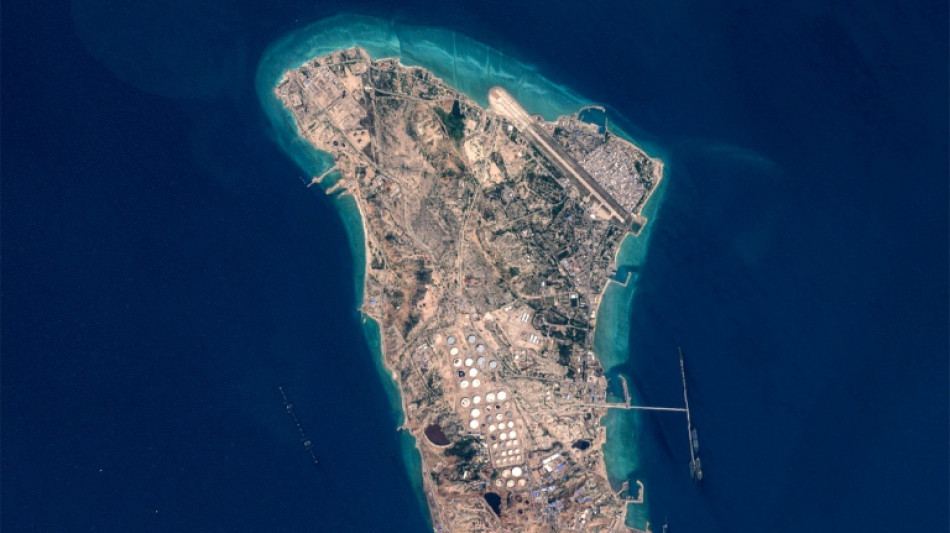
What could Trump achieve by threatening Iran's Kharg Island? / Photo: © EUROPEAN SPACE AGENCY/AFP

 'Tough to stay here': Nepal flood survivors wait for homes

 Malaysia closes schools in capital, parts of country due to haze
 Buccaneers stun Cowboys for first win of NFL season
 Activists hope trial will stop 'forever chemicals' at Italy plant
 Guardians rally for 9-5 victory over White Sox to stay alive in MLB playoffs
 Asian stocks mixed amid AI concerns, oil dips after surge

 Wallabies expect fast-paced All Blacks in Bledisloe opener
 Tech scammer Elizabeth Holmes focus of documentary by absurdist Nathan Fielder
 Climate hopes shift from politics to the courts
 Will Nobel Peace Prize pick make waves at the White House?
 Trump rules out new Iran attack before US midterm elections
 Far-right influencer shows Israel's coarse political turn

 Seals and sea lions get hearing tested at Australia zoo

 Mourinho's Real Madrid playing catch-up in Clasico countdown
 Joy as USS Lincoln back home after troubled Gulf deployment
 OpenAI says Iran, Russia influence ops busted
 Anthropic bans 'cruel' behavior against its Claude AI
 Anne Carson's Nobel literature prize 'a proud moment for Canada': PM

 Montagliani to seek CONCACAF re-election in boost for Infantino: reports

 Oil surges, stocks sink on jitters over US plans in Iran war

 John Cena and Jessica Biel hit the gas in 'Matchbox: The Movie'

 US, Ukrainians, Europeans to discuss 'new ideas' to end war
 Unproven 'cures' pushed online amid plague concerns

 Nigeria looks to ease fuel prices as election looms
 Prosecutors in Maradona death trial seek sentences up to 12 years

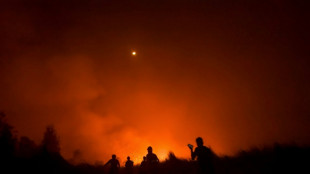
A scrubby island in the Gulf that is roughly one third the size of Manhattan, Kharg Island is the nerve centre of the Iranian oil industry -- and at the heart of US President Donald Trump's latest efforts to pressure Tehran.
On Monday Trump vowed that a failure by Iran to agree a deal to end the war could see the United States "completely obliterating" the export hub.
A day earlier, he had said the United States could take the island, eyed by the Pentagon for ground operations, "very easily".
So what are Trump's options, and how might Iran react if he presses on this pressure point?
- What is Kharg Island? -
It may be a mere scrap of land, but Kharg handles around 90 percent of Iran's crude exports, according to a report by US bank JP Morgan.
Located in the north of the Gulf, around 30 kilometres (20 miles) from the Iranian coast and more than 500 kilometres from the Strait of Hormuz, it has no oil wells.
But it has Iran's largest oil terminal, oil pipelines, storage tanks and related infrastructure.
It also has military facilities, some of which have already been hit by Israeli-US strikes.
On March 13, "US forces executed a large-scale precision strike on Kharg Island", Centcom, the US military command for the region, said.
"The strike destroyed naval mine storage facilities, missile storage bunkers and multiple other military sites. US forces successfully struck more than 90 Iranian military targets on Kharg Island, while preserving the oil infrastructure."
Sources close to US intelligence services told US broadcaster CNN Iran had deployed additional troops and defence systems to the area in recent weeks, including MANPAD-type surface-to-air missiles and mines.
- Trump's options? -
There appear to be three routes for US forces wishing to seize the island -– an airborne attack; an amphibious operation; or a combination of the two.
The Pentagon is currently moving US paratroopers and Marines into the area.
"(The) US combat force build-up sets the stage for (a) potential ground offensive in Iran," said US think tank Soufan.
Centcom former commander General Joseph Votel told The War Zone website this month it would not take that many soldiers to seize Kharg.
"On a small island like Kharg, I imagine you'd need a battalion of Marines. We are therefore talking about a force of 800 to 1,000 men, perhaps a little fewer, certainly not much more," he said.
But taking Kharg and holding onto it "are two different things", stressed Professor Phillips O'Brien of the University of St Andrews in Scotland.
He said the US military would struggle to retain the island within range of Iranian missiles and drones.
Just 60 kilometres away is the city of Bushehr, an important military centre "from which the Iranians defend the entire northern part of the Gulf, including Kharg", noted Pierre Razoux of French research centre FMES.
- Why do it? -
Trump's war goals remain hazy. It is unclear whether he primarily wants to force Iran to reopen shipping lanes in the Strait of Hormuz; force regime change in Tehran; coerce the Iranians into concessions on their nuclear or ballistic missile programmes.
In the short term, capturing Kharg could give Washington leverage to force Iran to negotiate -– presumably on Trump's terms, given the country's dependence on oil revenue, the Soufan Center said.
It might not have much effect in reopening the Gulf to shipping, however, because Iran controls a string of other islands in the Strait of Hormuz.
And if the Iranians choose not to cede to Trump's demands, "What does the US do?", O'Brien wondered.
"Does the US then, out of spite, level all the economic facilities on Kharg?
"That could easily boomerang back in American faces. It means oil prices skyrocket even more and stay high for much longer," he said.
"It also means Iran will be incentivised to shut down the traffic in the Straits for even longer. If they cannot get their own oil out, why let anyone else's?"
G.Schulte--BTB