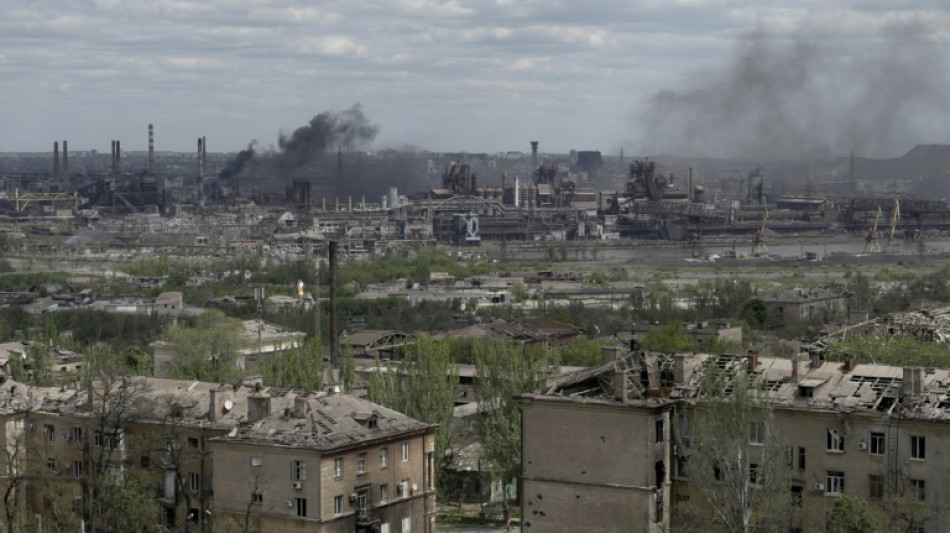
Oscar-nominated '20 days in Mariupol': from normality to ruins / Photo: © AFP/File

 Nagoya mayor says sorry for Asian Games 'inconveniences'
 G20 trade officials meet under shadow of tariffs, overcapacity

 India's fat dog vote goes viral
 Asian Games crowds in spotlight as 998 see hosts in 50,000 stadium

 The eight stadiums for the 2027 Rugby World Cup

 Thieves swipe drugs under nose of Fiji police, swap with flour
 South Korea demands North apologise for DMZ mine blasts
 In Nepal's flood zone, teachers mourn students who never returned

 US Supreme Court lifts limits on third-country deportations

 Antonelli eager to 're-establish order' as F1 returns to Malaysia

 Paw-fect candidate: Australia finds new koala rescue dog
 One third of world population exposed to harmful air pollution: monitor

 North Korea denies South's claim it was apparently behind DMZ mine blasts

 West Bank's violent settlers part of a new generation fuelled by ideology

 US-led coalition ends mission in Iraq
 Pope-backed White Sox join Braves with MLB playoff wins

 NBA close to picking new $12-13bn Vegas team owners: report
 LA28 Olympics torch relay to visit all 50 states
 Spain brush aside Croatia in Nations League, England down Czechs

 Trump hails 'morally binding' AI self-regulation pledge
 Yamal inspires Spain to Croatia romp on World Cup homecoming

 UN to hold fourth informal poll of secretary-general candidates
 Who are the Emiratis behind crisis-hit Manchester City?

 Singer Angelique Kidjo urges Africans to 'create together'

 Alleged Rihanna mansion shooter mentally fit for trial, says judge
Laying out the horrors of the early days of Russia's invasion of Ukraine, documentary "20 days in Mariupol" was on Tuesday nominated for an Oscar.
Almost two years on from the start of Russia's attack, the film recounts the dying days of a major city.
"Wars start with silence", filmmaker Mstyslav Chernov says on day one of the 2022 onslaught, as he enters Mariupol by car with his colleague, Associated Press photographer Evgeniy Maloletka.
The journalists, both Ukrainian, know that the southern strategic port will be one of the first targets for Moscow's troops.
Chernov films the last images of a still "normal" city before it was reduced to rubble.
As the shelling begins, the pair encounter a horrified woman asking what she should do.
"They don't shoot civilians," Chernov reassures her, telling the woman to return to her home -- only to add in voice-over: "I was wrong".
Her neighbourhood is bombed soon after and the filmmakers find her again in a gym where hundreds of families are sheltering.
Images of so many men, women and children leave the viewer wondering how many lives will be claimed by the war.
Chernov has a premonition that "something terrible" is coming to Mariupol.
Just three days into their attack, Russian forces began encircling the city, while a quarter of its population had fled.
Those left behind would face carnage.
Chernov said on Tuesday that he hoped the Oscar nomination would bring more people to see the film.
"I feel that I owe the people of Mariupol, and it's my duty to make sure that their stories not forgotten," he said.
- 'Film it! Show it!' -
One week into the war, Chernov and Maloletka are the only international reporters still in Mariupol.
On their perch at the hospital -- one of the only sites enjoying some degree of protection -- they witness the deaths of children and parents' fathomless grief.
Managing to show respect even through the chaos, Chernov films weeping doctors' desperate struggle to save the life of a four-year-old girl, Evangelina.
A father is seen moaning over the dead body of his "beloved son" Ilya, 16, while the parents of 18-month-old Kyrill simply collapse.
"Film it! Show it!" one doctor at the end of his tether urges the cameraman.
The lens captures stretcher-bearers' frantic dashing, people lying in the corridors shaken by bombardment, blood, suffering and nurses taking a brief cigarette break.
"The world has fallen apart and we're smoking," one says with a smile, as if to keep the horror at bay.
Getting their images to the outside world becomes an obsession for the two journalists, even as Mariupol is under siege and cut off.
They encounter wild-eyed people and bodies lying in the street as they step out to search for mobile signal and to film the city's death throes.
People stripped of emotion calmly loot a shop in front of the camera as the owner pleas and a soldier barks for "solidarity".
"The city has changed so fast," Chernov narrates.
As the camera records bodies tossed into mass graves, he adds: "My brain will desperately want to forget all this, but the camera will not let it happen".
"If the world saw everything that happened in Mariupol, it would give at least some meaning to this horror," he hopes.
- Maternity hospital -
On March 9, the war's 14th day, Mariupol's maternity hospital was bombed.
The AP journalists' images of that day have become landmark documents of the war and of atrocities attributed to Russian forces in Ukraine.
When the pair hear Moscow has accused them of staging the pictures with actors, they hunt out the survivors.
But they learn that Iryna, a pregnant woman whose picture on a stretcher was seen worldwide, died with her baby.
They follow the difficult birth of a baby girl to one of the survivors in their quest to get proof out to the world.
In the end, Ukrainian special forces were sent in a high-stakes mission to retrieve the journalists and keep them out of Russian hands as the invaders entered the city.
Leaving Mariupol in a Red Cross convoy, Chernov cannot help but think of those he is "abandoning", whose "tragedies will never be known".
At least 25,000 people died in the 86-day siege of Mariupol, according to authorities in Ukraine, where the fighting remains fierce.
L.Janezki--BTB