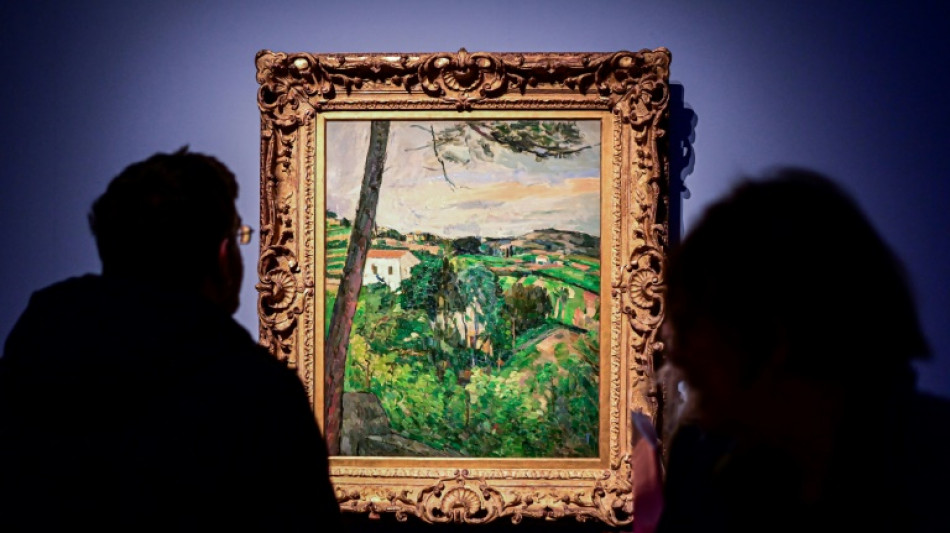
Cezanne and Renoir: Clash of the titans in Milan / Photo: © AFP

 Oil companies close in on Venezuela despite hurdles

 Turkey freezes ex-minister's assets as fund scandal grows

 Guardiola backs Man City after bombshell guilty verdicts

 G20 trade ministers open talks under strain of Trump tariffs

 France in talks with UK to end 2025 migrant accord: ministry

 Europe's surging inflation spreads gloom in stock markets
 Truth commission demands compensation for Sweden's Sami people
 Japan win marathon penalty shootout to set up South Korea gold-medal clash

 Djokovic grinds out opening-round win at China Open

 Northern Ireland police probe blockade of disputed parade
 UK PM Burnham reopens divisive debate on rejoining EU

 Man City future in doubt after guilty verdict

 'Do something,' begs Iranian woman after death sentence over protests

 China extends 52-year unbeaten record as Games organisers say sorry

 In Manchester, people say City scandal is 'shame for football'
 Stocks lacklustre as inflation data weighs on sentiment

 Israel-bound plane rerouted, pilots wounded in reported fight

 Truth commission on Sweden's Sami people seeks redress

 Energy costs spark inflation surges in France, Italy
 South Korea break China hearts to reach Asian Games football final

 Eala storms into Asian Games semi-finals to thrill adoring fans

 Turkey freezes ex-minister's assets as fund crisis grows

 What we know about the North Korean POW dispute

 Most equities rise after oil price plunge, US data in focus
 Polar oceans transformed as warming melts ice habitats: research

One structured and austere, the other sensual and joyous -- Paul Cezanne and Auguste Renoir were two founding fathers of Impressionism, but a new Milan exhibition explores their sharply different styles.
Marking 150 years since the founding of the art movement, 52 masterpieces by the two Frenchmen are on loan from Paris for an unprecedented show at the Palazzo Reale -- alongside two by Picasso, whom they inspired.
The paintings date from the 1870s to the early 20th century.
Renoir and Cezanne "were both part of the Impressionist adventure, before moving away from it. Cezanne turned towards extremely strong geometric structures, while Renoir kept his vibrant and sensitive touch", said Cecile Girardeau, curator of the exhibition.
The solitary, rather gloomy Cezanne had struck up a friendship in the 1860s with the jovial Renoir.
As the years went on, the pair remained friends despite their different personalities and painting styles, with Renoir visiting Cezanne's home in the south of France several times between 1880 and 1890.
- Bold brushwork -
Impressionism was born in April 1874 when a group of painters -- including Cezanne, Renoir and others such as Claude Monet -- broke away from the government-backed Paris Salon to hold their own independent show.
Their works were characterised by rapid dabs and brushstrokes that explore the effects of light and colour.
Many of the paintings in Milan -- on loan from the Musee de l'Orangerie and the Musee d'Orsay in Paris -- address similar subjects, from landscapes to nudes or still life.
But the artists' approaches varied, from Cezanne's bold brushworks focused on shapes to Renoir's more sensual touch that often sought to capture dappled light.
Girardeau, curator at the Musee de l'Orangerie, noted the differences between two still life paintings -- Cezanne's "Straw vase, sugar bowl and apples" (1890-1894) and Renoir's "Peaches" (1881).
"Cezanne tried to give us the essential structure of objects and it is through this that he makes us understand his view of the world," she told AFP.
By contrast, "Renoir captures the immediacy of the moment, gives us the sensation of the tablecloth, its folds, the softness of the fruit and the reflection of the light on the earthenware."
The artists' workshops have been recreated for the show: Renoir's from Cagnes-sur-Mer in the south of France and Cezanne's from his family home of the Bastide du Jas de Bouffan, the family home in Aix-en-Provence.
Time seems to have stood still as the light falls on the studios, the brushes, dried tubes of paint and wooden frames bearing witness to their masters' work.
- Joie de vivre -
The painters' personalities came out in their paintings.
The sober Cezanne described wanting to portray nature "according to the cylinder, the sphere, the cone", whereas the exuberant Renoir described a painting as a "joyful, pretty thing".
Cezanne's portraits are austere, the subjects staring into space without the hint of a smile, while Renoir's exude a sense of gentle serenity or, in the case of his voluptuous female nudes, of sensuality.
Their differences reflect their backgrounds. Cezanne was the son of a banker, who had no need to sell his art, while Renoir was from a family of poor artisans.
"Cezanne certainly didn't have a spontaneous natural talent and had to study hard at painting," said Stefano Zuffi, an art historian and co-curator of the exhibition.
"He nevertheless achieved an exceptional synthesis between a very rigorous, very geometric sense of composition and on the other hand, the spontaneity, the freshness, the colour of nature's light," Zuffi added, calling him a "genius".
By contrast, "Renoir's greatness consists of his inexhaustible 'joie de vivre'," he said.
"For him, life was beautiful and painting was a way to make it even more beautiful."
K.Thomson--BTB