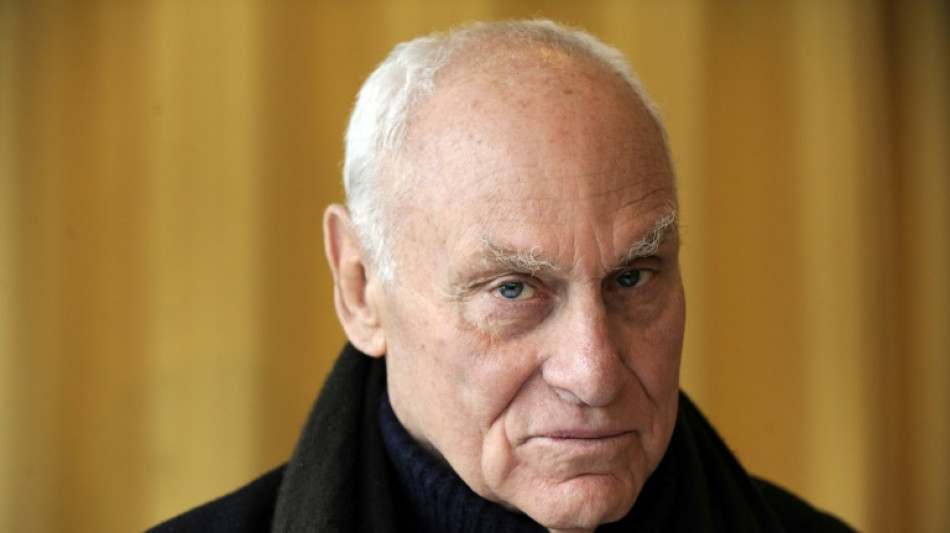
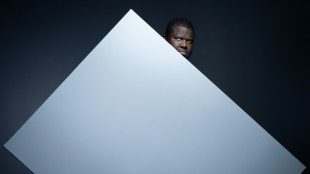
US sculptor Richard Serra, known for towering minimalism, dies at 85 / Photo: © AFP

 Oil companies close in on Venezuela despite hurdles

 Turkey freezes ex-minister's assets as fund scandal grows

 Guardiola backs Man City after bombshell guilty verdicts

 G20 trade ministers open talks under strain of Trump tariffs

 France in talks with UK to end 2025 migrant accord: ministry

 Europe's surging inflation spreads gloom in stock markets
 Truth commission demands compensation for Sweden's Sami people
 Japan win marathon penalty shootout to set up South Korea gold-medal clash

 Djokovic grinds out opening-round win at China Open

 Northern Ireland police probe blockade of disputed parade

 UK PM Burnham reopens divisive debate on rejoining EU

 Man City future in doubt after guilty verdict

 'Do something,' begs Iranian woman after death sentence over protests

 China extends 52-year unbeaten record as Games organisers say sorry

 In Manchester, people say City scandal is 'shame for football'
 Stocks lacklustre as inflation data weighs on sentiment

 Israel-bound plane rerouted, pilots wounded in reported fight

 Truth commission on Sweden's Sami people seeks redress

 Energy costs spark inflation surges in France, Italy

 South Korea break China hearts to reach Asian Games football final

 Eala storms into Asian Games semi-finals to thrill adoring fans

 Turkey freezes ex-minister's assets as fund crisis grows

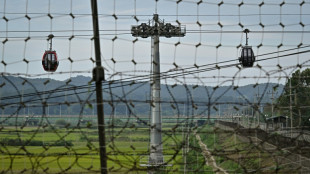 What we know about the North Korean POW dispute

 Most equities rise after oil price plunge, US data in focus

 Polar oceans transformed as warming melts ice habitats: research

Contemporary American artist Richard Serra, known for his massive yet minimalist steel sculptures, died Tuesday at age 85, US media reported.
His strikingly large pieces are installed all over the world, from Paris museums to the Qatari desert, and have sometimes sparked controversy over their imposing nature.
Serra died of pneumonia Tuesday at his home on Long Island, New York, his lawyer John Silberman told The New York Times.
Born in San Francisco in 1939 to a Spanish father and a mother of Russian Jewish origin, Serra studied English literature at the University of California before going on to study visual arts at Yale.
When asked in an early 2000s interview about what memory from his childhood might suggest who he would become, Serra said: "A little kid walking along the beach for a couple of miles, turning around, looking at his footprints and being amazed at what was on his right one direction, when he reversed himself was now on its left."
He says it "startled him and he never got over it."
His signature giant scale was present in the off-kilter reddish-brown rectangles installed in Paris's Grand Palais for his 2008 "Monumenta" exhibit, and in the swirling and twirling steel plates enveloping visitors in their curves seen in the Guggenheim Museum in Bilbao, Spain.
Serra, who credited influences from France, Spain and Japan on his artistic style and his evolution from painting to sculpting, moved to New York in the late 1960s, operating a furniture removal business to make ends meet. He even employed the composer Philip Glass as his assistant.
That was also the period in which Serra composed a manifesto detailing the ways he could create a work of art: he listed 84 verbs, such as "roll" and "cut," and 24 elements, including "gravity" and "nature," which he could employ to forge a composition.
Serra did not begin to work predominantly in steel until the 1970s, in an echo of the summer steel mill jobs of his youth.
He designed sculptures specifically for the spaces they were destined to occupy, and said he was interested in examining how his works interacted with their environments.
"Certain things... stick in your imagination, and you have a need to come to terms with them," Serra told US interviewer Charlie Rose in the early 2000s.
"And spatial differences: what's on your right, what's on your left, what it means to walk around a curve, looking at a convexity and then looking at a concavity -- just asking fundamental questions about what you don't understand, those things have always interested me," he said.
That exploration of sculpture in its environment is visible in one of Serra's most controversial works, titled "Tilted Arc," which was installed in New York in 1981.
The 12-foot (4-meter)-high rust-coated metal plate curved its way through the Federal Plaza in Manhattan for 120 feet, set at an angle that made it look like it could topple over at any second. The structure so disturbed local residents that it was removed in 1989 following a long legal battle.
K.Thomson--BTB