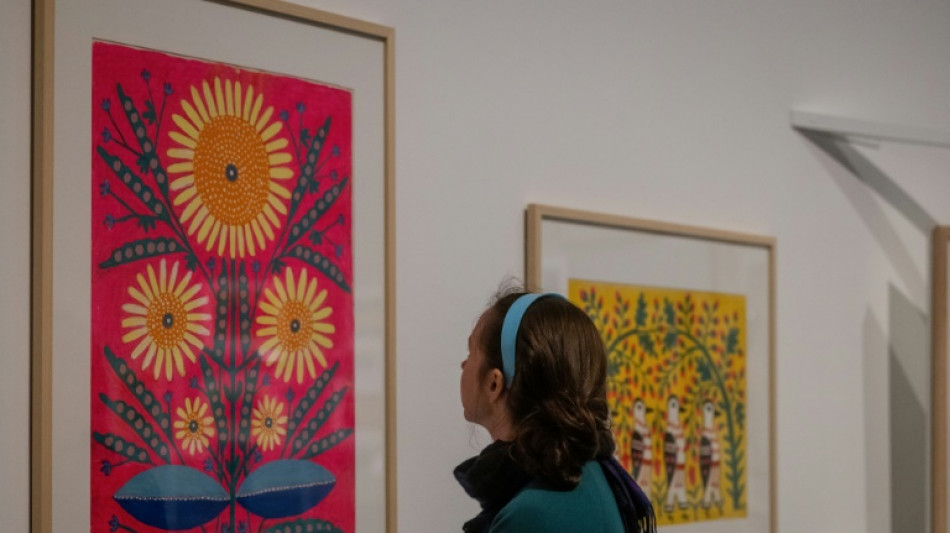
Poland shows colourful Ukraine art of hope and resistance / Photo: © AFP

 US pushes against overproduction with eye on China at G20 meeting
 Swiss FA withdraws support for FIFA chief Infantino
 Man City's meteoric rise clouded by financial scandal

 Polish activists open first abortion pill locker in Warsaw
 NHL Avalanche ink Bednar to four-year coaching deal
 Polish activists opens first abortion pill locker in Warsaw

 Turkey says news site closed for 'LGBTQ propaganda'
 Oil companies close in on Venezuela despite hurdles
 Turkey freezes ex-minister's assets as fund scandal grows

 Guardiola backs Man City after bombshell guilty verdicts
 G20 trade ministers open talks under strain of Trump tariffs

 France in talks with UK to end 2025 migrant accord: ministry
 Europe's surging inflation spreads gloom in stock markets
 Truth commission demands compensation for Sweden's Sami people
 Japan win marathon penalty shootout to set up South Korea gold-medal clash

 Djokovic grinds out opening-round win at China Open

 Northern Ireland police probe blockade of disputed parade
 UK PM Burnham reopens divisive debate on rejoining EU

 Man City future in doubt after guilty verdict
 'Do something,' begs Iranian woman after death sentence over protests
 China extends 52-year unbeaten record as Games organisers say sorry
 In Manchester, people say City scandal is 'shame for football'
 Stocks lacklustre as inflation data weighs on sentiment
 Israel-bound plane rerouted, pilots wounded in reported fight

 Truth commission on Sweden's Sami people seeks redress

Days after invading Ukraine, Russian forces fired rockets at a museum housing colourful paintings by the late Ukrainian folk artist Maria Prymachenko, admired by Pablo Picasso and Marc Chagall. The building burned down but her joyful work survived.
Residents of the northern town of Ivankiv managed to rescue the pictures, turning the imaginative painter into a symbol of endurance and hope.
Prymachenko's light through darkness approach despite a lifetime of hardships can be appreciated starting Friday in Poland's capital, now home to thousands of refugees from neighbouring Ukraine.
The exhibition features dozens of gouache paintings of rural life and fantastical creatures in a childlike style and a palette resplendent with flamboyant tones of highlighter pink, sunflower yellow and blood orange.
"Beyond being a famous painter, Maria Prymachenko is also a great symbol of Russia's failure to erase Ukrainian identity and culture," said Vitalii Bilyi, counsellor at the Ukrainian embassy in Warsaw.
"And thanks to this exhibition we can spread the word," he told AFP at a press preview of the show entitled "A tiger came into the garden", which runs until June at the Museum of Modern Art in Warsaw.
- 'Bouquet to the Unknown Soldier' -
Prymachenko was born in the village of Bolotnya in 1909 and over nearly nine decades survived polio, the Ukrainian famine, both world wars -- losing her husband to the second -- and the Chernobyl nuclear disaster.
"She showed strength of spirit and painted all her life. The paintings, while colourful, show different aspects of life and the Ukrainian tragedy," said Myroslava Keryk, head of the Ukrainian House Foundation which promotes the country's culture in Poland.
"And they provide hope of victory, that we will persevere and the war will end," she told AFP.
Prymachenko produced her commentary on everyday life by pairing images of animals or nature with little poems, often with grammatical mistakes because of her lack of education, Keryk said.
An example from the exhibition is a meditation on hunger featuring a cheery yellow and pink depiction of a billy goat and the title "Dear little goat, have you eaten, have you drunk?"
Another shows bright pink ornamental tulips against a sombre background with a caption that begins: "A bouquet to the Unknown Soldier. Honour and glory to you, dear warriors!"
- 'Live like flowers bloom' -
The war widow painted a whole series dedicated to fighting men, which several decades later "has an incredible topical anti-war message", said co-curator Szymon Maliborski.
"These are works that allow Prymachenko to, on the one hand, avoid having to directly depict war, but on the other hand show a grappling with loss, the death of a loved one," he told AFP.
A sunny painting of exotic blue birds is offset by the poem, "Four parrots sit in a cherry tree humming. The boys go to the army and the girls see them off -- wishing them luck".
This contrast between optimism and trauma was typical for the painter who had wished for "people to live like flowers bloom", according to Maliborski.
She often "mixed the solemn with the comical, adding a dash of humour or acceptance to her criticism," he said.
"There's a kind of coming to terms with the world and wanting to change it simultaneously. The awareness that human nature is what it is yet fighting for it to be better."
J.Bergmann--BTB