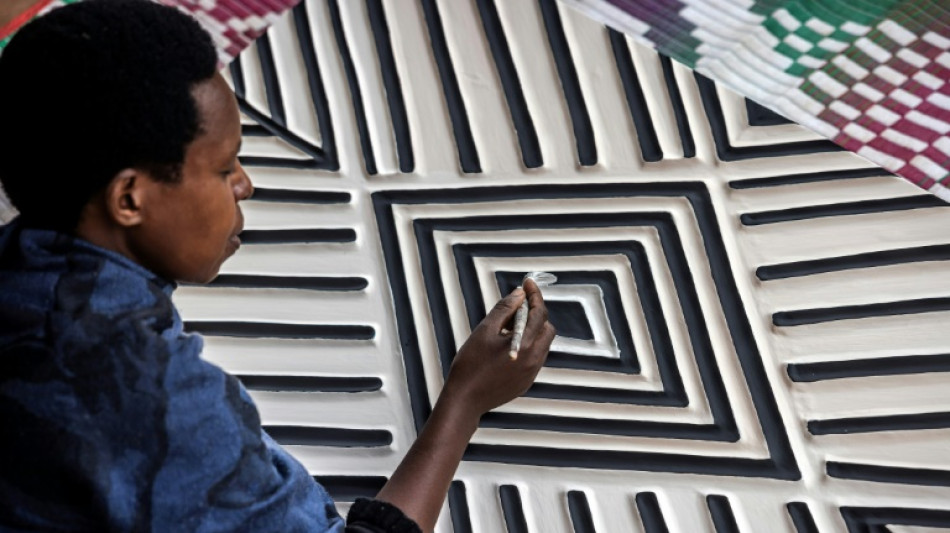
Reviving a traditional art form in Rwanda after genocide / Photo: © AFP

 US pushes against overproduction with eye on China at G20 meeting

 Swiss FA withdraws support for FIFA chief Infantino

 Man City's meteoric rise clouded by financial scandal

 Polish activists open first abortion pill locker in Warsaw

 NHL Avalanche ink Bednar to four-year coaching deal

 Polish activists opens first abortion pill locker in Warsaw

 Turkey says news site closed for 'LGBTQ propaganda'
 Oil companies close in on Venezuela despite hurdles
 Turkey freezes ex-minister's assets as fund scandal grows

 Guardiola backs Man City after bombshell guilty verdicts
 G20 trade ministers open talks under strain of Trump tariffs

 France in talks with UK to end 2025 migrant accord: ministry

 Europe's surging inflation spreads gloom in stock markets

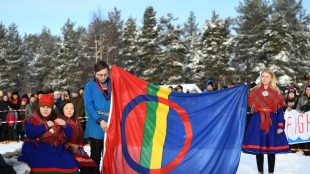 Truth commission demands compensation for Sweden's Sami people

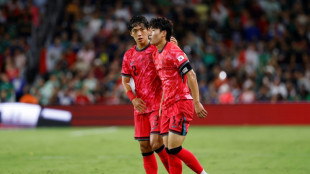 Japan win marathon penalty shootout to set up South Korea gold-medal clash

 Djokovic grinds out opening-round win at China Open

 Northern Ireland police probe blockade of disputed parade

 UK PM Burnham reopens divisive debate on rejoining EU

 Man City future in doubt after guilty verdict
 'Do something,' begs Iranian woman after death sentence over protests

 China extends 52-year unbeaten record as Games organisers say sorry
 In Manchester, people say City scandal is 'shame for football'

 Stocks lacklustre as inflation data weighs on sentiment

 Israel-bound plane rerouted, pilots wounded in reported fight

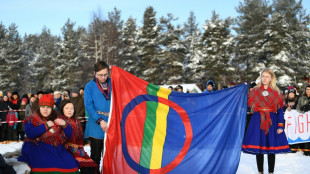 Truth commission on Sweden's Sami people seeks redress

A 200-year-old Tutsi art form made with cow dung, Rwanda's imigongo painting tradition has experienced a revival in the Great Lakes nation three decades after the 1994 genocide, becoming a symbol of culture and unity.
Known for its raised black and white patterns, imigongo is widely believed to have been invented by a Tutsi prince in the 19th century.
Prince Kakira mixed cow dung and ash to create a material which he used to paint three-dimensional patterns on the walls of his palace in eastern Rwanda's Gisaka kingdom.
The tradition was named after "umugongo", the Kinyarwanda word for "spine", owing to its curved lines, and became popular among rural households where women would use dung and natural pigments made with soil, clay and aloe sap to decorate their homes.
Basirice Uwamariya, founder of the Kakira Imigongo Cooperative in eastern Kirehe district, told AFP she started making art when she was 15.
But the 1994 genocide targeting the Tutsi minority nearly wiped out the tradition, with almost all 15 members of Uwamariya's cooperative killed in a bloodbath that claimed around 800,000 lives across Rwanda, including moderate Hutus.
She lost her husband and multiple relatives, leaving her to fend for herself and her two sons.
"I lived in darkness, in silence," the 53-year-old said, recalling the loneliness that pushed her to revive the cooperative in 1996 and invite other genocide survivors to join her.
Since then, imigongo has evolved.
Traditional patterns exist side by side with modern designs featuring various colours. Natural pigments have been replaced by commercial paints.
Imigongo designs have made their way to upmarket studios and fashion boutiques, adorning garments and wooden artefacts alike, with a market that includes foreigners and Rwandans.
According to Theoneste Nizeyimana, manager of Azizi Life Studio in the capital Kigali, the tradition was once largely limited to eastern Rwanda.
"But after the genocide destroyed everything... people started thinking about how they can bring back their culture. Today, imigongo is appreciated by all Rwandans, not just Tutsi," he told AFP.
"Imigongo is something that brings people together," he said, pointing out that the Kigali boutique and studio holds painting classes for students whose ages range from four to 75 years old.
It also makes business sense, he said, with its instantly recognisable patterns helping to market "made in Rwanda" designs around the world.
B.Shevchenko--BTB