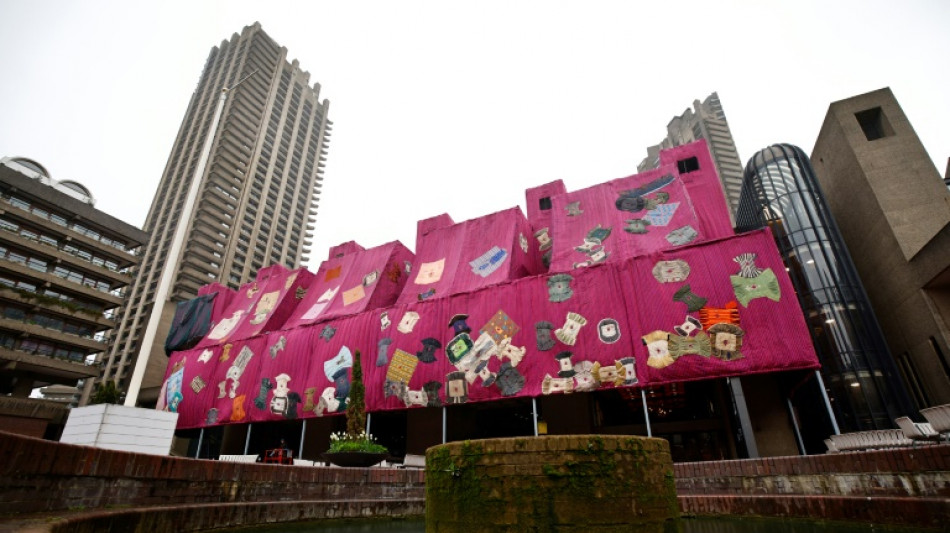
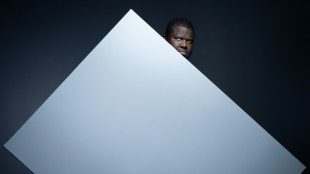
Ghanaian artist Ibrahim Mahama adds splash of colour to London complex / Photo: © AFP

 US pushes against overproduction with eye on China at G20 meeting
 Swiss FA withdraws support for FIFA chief Infantino
 Man City's meteoric rise clouded by financial scandal

 Polish activists open first abortion pill locker in Warsaw
 NHL Avalanche ink Bednar to four-year coaching deal
 Polish activists opens first abortion pill locker in Warsaw

 Turkey says news site closed for 'LGBTQ propaganda'
 Oil companies close in on Venezuela despite hurdles
 Turkey freezes ex-minister's assets as fund scandal grows

 Guardiola backs Man City after bombshell guilty verdicts

 G20 trade ministers open talks under strain of Trump tariffs

 France in talks with UK to end 2025 migrant accord: ministry
 Europe's surging inflation spreads gloom in stock markets
 Truth commission demands compensation for Sweden's Sami people
 Japan win marathon penalty shootout to set up South Korea gold-medal clash
 Djokovic grinds out opening-round win at China Open

 Northern Ireland police probe blockade of disputed parade
 UK PM Burnham reopens divisive debate on rejoining EU

 Man City future in doubt after guilty verdict
 'Do something,' begs Iranian woman after death sentence over protests
 China extends 52-year unbeaten record as Games organisers say sorry
 In Manchester, people say City scandal is 'shame for football'
 Stocks lacklustre as inflation data weighs on sentiment
 Israel-bound plane rerouted, pilots wounded in reported fight

 Truth commission on Sweden's Sami people seeks redress

An installation by Ghanaian artist Ibrahim Mahama wrapping part of a brutalist central London cultural complex in pink-purple woven cloth and urine-stained robes was unveiled Tuesday.
The public commission at the Barbican Centre's Lakeside Terrace, named "Purple Hibiscus" after Chimamanda Ngozi Adichie's eponymous 2003 novel, has been hand-sewn in collaboration with hundreds of craftspeople in Ghana.
The 2,000 square metres (2,1528 square feet) of brightly coloured fabric panels feature scores of traditional robes, known as "batakaris", previously worn and cherished by everyone from Ghanaian royals to everyday people.
Passed down from generation to generation, Mahama began collecting them more than a decade ago for eventual use in his artworks.
Known internationally for creating massive installations that clad buildings, "Purple Hibiscus" is his first large-scale UK public commission.
For it, he worked with networks of female weavers in his native Ghana to embroider the robes onto the striking fabric now draped over a sliver of the famously grey concrete Barbican complex.
"I've always been interested in labour, the conditions of labour, the history of labour, and also how labour is inflicted on bodies," Mahama told AFP about conceptualising the artwork.
Some of the robes have been urinated on or had "other things" doused on them by their previous owners, because "the idea is to break the soul away from the material," he explained.
"They somehow believe that their soul, of the family, is somehow contained within the cloth," the artist added, noting it had often been difficult to convince people to hand over the valued items.
Sometimes adorned with amulets, they were once mythically thought of as armour to protect against the bullets of colonial soldiers.
On display in the Barbican until mid-August, the exhibit resonates with the district's history of mass destruction during World War II and as a one-time home to the cloth trade.
The light and bright purple and pink fabric, stitched with the history-laden fragile robes, deliberately contrast with the hard-edged surroundings and typically grey London sky overhead.
"It's supposed to somehow allow us... to reflect on the human condition, and beyond the human condition, also into the question of life," said Mahama.
The artist appears unconcerned by the potential impact of London's notoriously wet weather on his painstakingly assembled installation.
"It will last as long as it can last," he said.
"Once you produce any art piece that is supposed to be in the public, the artist has to be ready to accept the fact that anything can happen to it."
O.Bulka--BTB