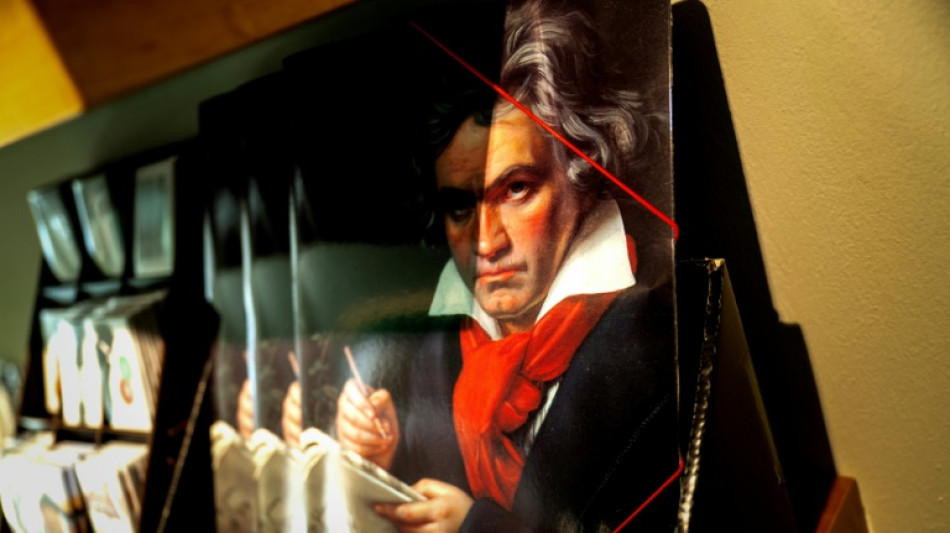
Ode to joy: How Austria shaped Beethoven's Ninth / Photo: © AFP

 Fury, Joshua kick off 'battle of Britain' in good spirits
 Ronaldo leaves Portugal training camp after coach says he is dropped

 Florence Pugh stars in 'East of Eden' adaption on Netflix

 Watchdog finds no criminal misconduct over US Fed renovations despite Trump probe

 In Manchester, City fans 'devastated' while rival fans call for relegation

 UK-France Channel migrant exchange deal scrapped: London

 Portugal boss denies 'incident' with Ronaldo

 Israel PM says one of the pilots of rerouted flight tried to crash plane

 Manchester City: Main points of damning judgement and possible sanctions

 Italy looking for 'identity' under Mancini says Scalvini

 The voices of Spain's housing camp protesters

 Romanian parliament rejects pro-EU PM candidate

 Court halts Tennessee's first execution of woman in 200 years

 Israelis march between once-closed West Bank settlements

 'Welcome back,' says Macron, as UK PM opens door to EU return

 Israel PM says pilot of rerouted flight tried to crash plane

 Demuro hopes to deliver Japan a 'magical' Arc victory

 'Devastated' AI scandal author Orelien returns to Quebec

 US reports firm Q2 economic growth, inflation steady

 Energy costs spark inflation surge across Europe

 Parma appoint Italy World Cup winner Gilardino

 West Indies pile up record 405-7 in second ODI against India

 Romanian parliament rejects pro-EU PM candidate amid political deadlock

 Passenger on rerouted flydubai flight says pilot tried to crash plane

 Russia targets Kyiv power supply as freezing winter approaches

The night Ludwig van Beethoven's monumental Ninth Symphony rang out in a Vienna concert hall for the first time almost exactly two centuries ago, the great German composer was anxious for all to go well.
He needn't have worried. The audience erupted in spontaneous applause during the performance, but Beethoven was already so hard of hearing that he had to be turned around by a musician to notice it.
While he was born in Bonn in 1770, Beethoven spent most of his life in Vienna after moving to the Austrian capital as a 22-year-old.
Despite receiving repeated offers to relocate, the legendary composer never left Vienna, where he had found his home from home, surrounded by supportive fans and generous patrons.
"It was the society, the culture that characterised the city that appealed to him so much," said Ulrike Scholda, director of the Beethoven House in nearby Baden.
The picturesque spa town just outside Vienna deeply shaped Beethoven's life -- and the last symphony he would complete, she said.
- Under pressure -
"In the 1820s, Baden was certainly the place to be", with the imperial family, the aristocracy and a Who's Who of cultural life spending their summers there, Scholda said.
Beyond his hearing loss, Beethoven suffered from various health problems ranging from abdominal pains to jaundice, and regularly went to Baden to recuperate.
Enjoying long walks in the countryside and bathing in Baden's medicinal springs helped him recover, while simultaneously inspiring his compositions.
In the summers leading up to the first public performance of his Ninth Symphony in 1824, Beethoven stayed at what is now known as Baden's Beethoven House, which now serves as a museum.
It was there that he also composed important parts of his final symphony.
A letter Beethoven sent from Baden in September 1823 details the pressure he felt to finalise the symphony to please the Philharmonic Society in London which had commissioned the work, Scholda said.
- 'Less war, more Beethoven' -
Upon completing the symphony in Vienna, weeks of intense preparations followed, including an army of copyists duplicating Beethoven's manuscripts and last-minute rehearsals that culminated in the premiere on May 7, 1824.
The night before, Beethoven rushed from door to door by carriage to "personally invite important people to come to his concert", said historical musicologist Birgit Lodes.
He also managed to "squeeze in a haircut", Lodes added.
At almost double the length of comparable works, Beethoven's Ninth broke the norms of what until then was a "solely orchestral" genre by "integrating the human voice and thus text", musicologist Beate Angelika Kraus told AFP.
His revolutionary idea to incorporate parts of Friedrich von Schiller's lyrical verse "Ode to Joy" paradoxically made his symphony more susceptible to misuse, including by the Nazis and the Communists.
The verses "convey a feeling of togetherness, but are relatively open in terms of ideological (interpretation)," Kraus said.
Since 1985, Beethoven's "Ode to Joy" from the fourth movement has served as the European Union's official anthem.
Outside the Beethoven House in Baden, which is marking the anniversary with a special exhibition, visitor Jochen Hallof said that encountering the Ninth Symphony as a child had led him down a "path of humanism".
"We should listen to Beethoven more instead of waging war," Hallof said.
And on Tuesday night that certainly will be the case, with Beethoven's masterpiece reverberating throughout Europe with anniversary concerts in major venues in Paris, Milan and Vienna.
C.Kovalenko--BTB