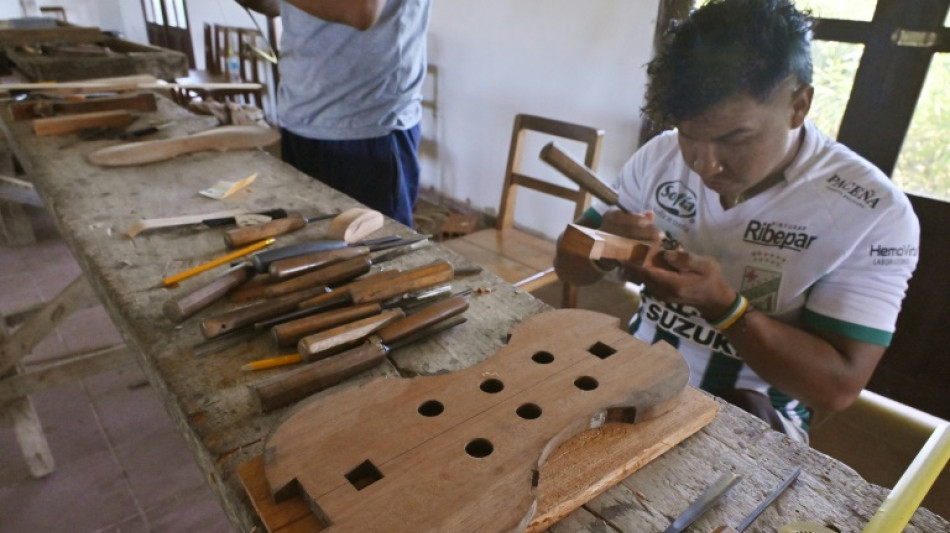
Violin village: Artisanal hub in Bolivian Amazon / Photo: © AFP

 Oil companies close in on Venezuela despite hurdles

 Turkey freezes ex-minister's assets as fund scandal grows

 Guardiola backs Man City after bombshell guilty verdicts
 G20 trade ministers open talks under strain of Trump tariffs

 France in talks with UK to end 2025 migrant accord: ministry

 Europe's surging inflation spreads gloom in stock markets

 Truth commission demands compensation for Sweden's Sami people

 Japan win marathon penalty shootout to set up South Korea gold-medal clash

 Djokovic grinds out opening-round win at China Open

 Northern Ireland police probe blockade of disputed parade

 UK PM Burnham reopens divisive debate on rejoining EU

 Man City future in doubt after guilty verdict

 'Do something,' begs Iranian woman after death sentence over protests

 China extends 52-year unbeaten record as Games organisers say sorry
 In Manchester, people say City scandal is 'shame for football'

 Stocks lacklustre as inflation data weighs on sentiment
 Israel-bound plane rerouted, pilots wounded in reported fight

 Truth commission on Sweden's Sami people seeks redress

 Energy costs spark inflation surges in France, Italy

 South Korea break China hearts to reach Asian Games football final
 Eala storms into Asian Games semi-finals to thrill adoring fans

 Turkey freezes ex-minister's assets as fund crisis grows

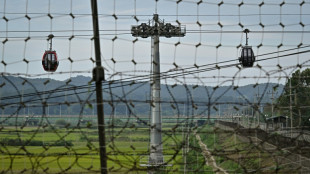 What we know about the North Korean POW dispute

 Most equities rise after oil price plunge, US data in focus

 Polar oceans transformed as warming melts ice habitats: research

Nestled in the Bolivian Amazon, the small, majority-Indigenous town of Urubicha has become an unexpected hub of violin makers, also known as luthiers.
Out of a population of some 8,000 people, most of whom are native Guarayos, some 40-50 work directly in the trade, local resident Waldo Papu tells AFP.
"I have not seen a place where so many violins are made," he said.
Papu heads up the Urubicha Institute of Artistic Training, Choir and Orchestra -- one of the most well-known baroque music schools in Bolivia with about 600 students.
About 20 or so students are learning to make violins, carrying on the tradition practiced by elders such as Hildeberto Oreyai.
The master craftsman, 76, tells AFP he was led into the practice by his father.
He takes two weeks to make a classical four-stringed instrument.
"You have to work with the instrument. It is done with patience, so that it comes out well," he said in a mixture of Spanish and Guarayo, one of Bolivia's 37 official Indigenous languages.
Each violin is made from cedar or mara -- a local hardwood -- and sells for the equivalent of about $580.
- Roots in tradition -
A widower with five children and several grandchildren, Oreyai speaks little and has had hearing problems for a while.
With his luthier's ear impaired, he tunes practically by heart.
"I really like to play," he says, sitting outside his rustic workshop.
Unlike some others in the town, Oreyai has been unable to convince any descendants to take up the violin-making trade he first learned from his grandfather.
Urubicha lies over 300 kilometers (200 miles) north of the departmental capital Santa Cruz.
In the early 19th century, Franciscan missionaries arrived in the area of current-day Guarayo and noticed that the Indigenous peoples were skilled artisans and, above all, musically talented.
Anthropologists believe that may be rooted in the Guarayos' beliefs around death.
For one's soul to reach the Great Ancestor, as they identify their god, it must sing and play the "tacuara" or bamboo flute, historian Juan Uranavi says.
The soul rides on a caiman to the ancestor, but if it does not know how to play the tacuara well, "because of some carelessness in his life," the caiman tips him over into the river to devour him, Uranavi told AFP.
Taking advantage of their musical proclivities, the Franciscans used the violin as a tool to evangelize the local population.
At first, the instruments could only be played in church, but later "the natives themselves learned from the missionaries" to make and play them, Papu said.
One student learning the violin-making trade is 38-year-old Hernan Yarita, who is soon to graduate as a luthier.
He tells AFP he wants his violins to reach his fellow villagers first.
"There are children who do not have a violin and we have this vision of making them for ourselves, for our relatives," Yarita says.
B.Shevchenko--BTB