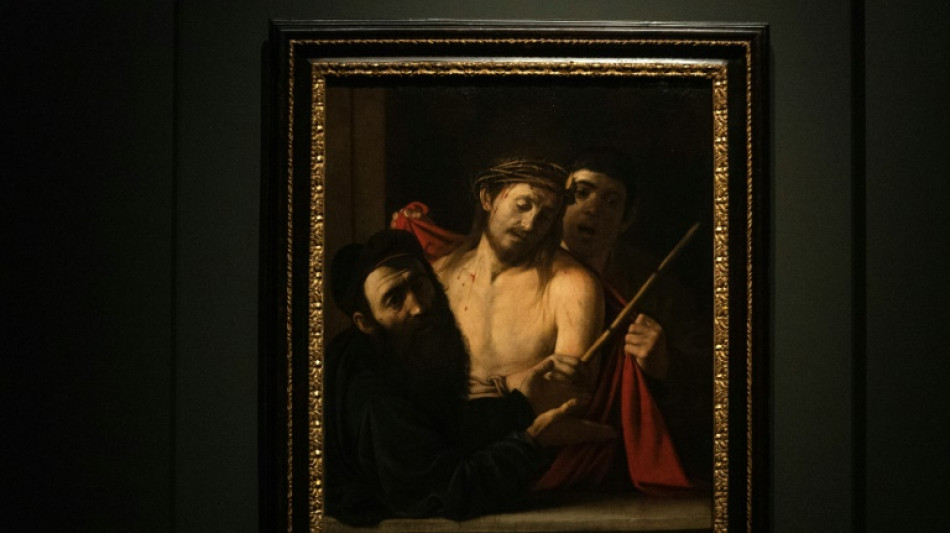
Spain unveils 'lost Caravaggio' that nearly sold for a song / Photo: © AFP

 Japan win marathon penalty shootout to set up South Korea gold-medal clash

 Djokovic grinds out opening-round win at China Open

 Northern Ireland police probe blockade of disputed parade
 UK PM Burnham reopens divisive debate on rejoining EU

 Man City future in doubt after guilty verdict
 'Do something,' begs Iranian woman after death sentence over protests

 China extends 52-year unbeaten record as Games organisers say sorry
 In Manchester, people say City scandal is 'shame for football'
 Stocks lacklustre as inflation data weighs on sentiment

 Israel-bound plane rerouted, pilots wounded in reported fight

 Truth commission on Sweden's Sami people seeks redress

 Energy costs spark inflation surges in France, Italy

 South Korea break China hearts to reach Asian Games football final

 Eala storms into Asian Games semi-finals to thrill adoring fans

 Turkey freezes ex-minister's assets as fund crisis grows

 What we know about the North Korean POW dispute

 Most equities rise after oil price plunge, US data in focus
 Polar oceans transformed as warming melts ice habitats: research

 Lost shark becomes viral star in South Korea
 Dangote to launch $16bn refinery in Kenya

 North Korean leader 'extremely obese': Seoul spy agency

 Yankees and pope-backed White Sox start MLB playoffs with wins
 Malaysia's ex-PM Mahathir in hospital for observation

 'No limits': Marathon world record holder Sawe chasing history
 Countdown begins to biggest-ever Rugby World Cup

A painting by Italian master Caravaggio, once mistakenly thought to be by an unknown artist and nearly auctioned off for a song, was unveiled at Madrid's Prado Museum on Monday.
Painted between 1605-1609, the dark, atmospheric canvas depicts a bloodied Jesus wearing a crown of thorns, his hands tied, as he is presented to the crowd by the Roman governor Pontius Pilate just before his crucifixion.
Entitled "Ecce Homo" -- Latin for "Behold the Man" -- it is one of around only 60 known works by the Renaissance artist.
Three years ago, a Madrid auction house had been due to put the canvas under the hammer with an opening price of 1,500 euros ($1,800 at the time), mistakenly attributing it to an artist from the circle of 17th-century Spanish painter Jose de Ribera.
But just hours before the auction, the culture ministry blocked the sale on concerns it was actually painted by Michelangelo Merisi da Caravaggio, whose works are worth millions.
The last-minute intervention came after the Prado said it had "sufficient documentary and stylistic evidence" to suggest the canvas was a Caravaggio.
The artist, who lived a violent and chaotic life (1571-1610) pioneered the Baroque painting technique known as chiaroscuro, in which light and shadow are sharply contrasted.
Earlier this month, the museum said experts confirmed the painting was "without doubt, a Caravaggio masterpiece", calling it "one of the greatest discoveries in the history of art".
Now restored, the old master artwork went on display to the public for the first time Monday in a one-piece exhibition called "The Lost Caravaggio". It will remain on display for nine months.
- 'Extremely important' -
The exhibition was made possible by the "generosity" of its new owner, who agreed to temporarily lend the work, the museum's director Miguel Falomir told a news conference on Monday, without revealing who it was.
The painting's emergence is "extremely important for the history of art because there has been no new work by Caravaggio had been identified for more than 45 years", explained David Garcia Cueto, who is responsible for Italian paintings at the Prado.
Experts who have studied its history say this oil on canvas became part of the private collection of Spain's King Felipe IV in the mid-17th century before being put on display at the residence of his son, Charles II.
It was then bequeathed to the San Fernando Royal Academy of Fine Arts near Madrid's central Puerta del Sol before being passed on to Spanish diplomat and later premier Evaristo Perez de Castro in 1823.
When he died, it passed to his descendants, only to disappear from view for nearly two centuries until it resurfaced in April 2021.
Its reappearance stunned Caravaggio experts who were "absolutely unanimous" in their recognition of the painting's provenance, Cueto said.
"All the Caravaggio specialists are in agreement which means we are certain that this is a painting by the great master of this period," he said.
- 'Clearly a Caravaggio' -
Art historians use various methods to determine the legitimacy of an artwork, including forensic examination of the canvas and paint to determine its age, the technology and styles of the era it was created in, and the techniques of the artist or their students.
One expert involved in the authentication process was Maria Cristina Terzaghi, an art history professor from Italy's Roma Tre University who said the canvas underwent "radiographic" techniques and a "meticulous examination".
She flew into Madrid after the auction was halted, saying her examination left her in no doubt: "It was clear it was a work by Caravaggio," she told AFP at the time.
For her, the evidence was ample: from "the head of Christ" to the glow of his torso, the colour of his cloak and "the three-dimensional nature of the three figures, who are offset in a transition that is almost cinematic".
Spanish media reports said the owner was a British national living in Spain who had paid 36 million euros ($39 million) for the 400-year-old canvas.
"The painting won't end up in the home of the buyer" who wants to loan it to "public art collections for now," Jorge Coll, head of London's Colnaghi art gallery which handled the sale, told El Pais daily.
But Prado director Falomir said its future was in the hands of its owner.
"It is a privately-owned artwork so the owner will have the last word," he said.
J.Bergmann--BTB