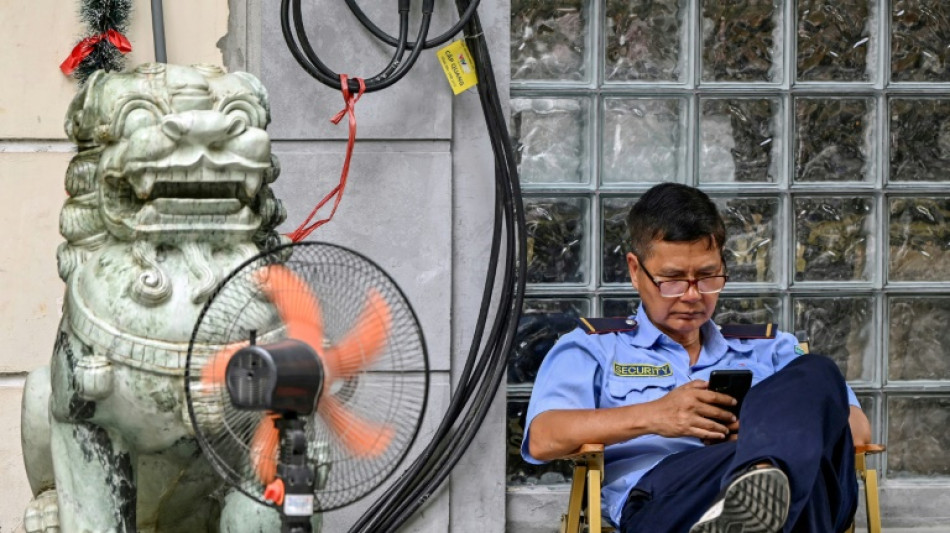
'Draconian' Vietnam internet law heightens free speech fears / Photo: © AFP/File

 Stocks move lower despite oil prices dropping
 AI driving up innovation investment: UN

 UN Security Council extends Haiti mission by 6 months

 Man Utd do not deserve medals if Man City stripped of titles: Rooney

 Vana Completes Expanded Staking as Part of the Vega Upgrade, Publishes Expanded VANA Token Economics
 Spain to cap gas price hikes, extend fuel discounts

 'We just need rain': Germany's Rhine river hits new low
 Yemen health system at 'breaking point': WHO

 Ireland undecided on second Israel match: coach

 France's Le Pen defiant after top ally hit by antisemitism claims

 Tom Cruise trades stunts for satire as toxic tycoon 'Digger'

 MEXC Unveils "WE SEE YOU" Brand Visual Refresh, Putting People Behind Every Trade in Focus

 Thai capital cleans up after deadly floods

 NATO, EU allies rally to Estonia after 'sabotage' blamed on Russia

 Families demand justice for Cameroon's 'nightmare' wave of murdered women

 Tebas says Man City should face 'most severe' sanctions if guilty of rule breaches

 Pochettino calls Man City success 'a period of deception'

 Settler attack on West Bank village injures Israeli forces, drawing rare rebuke

 Mystery over UK airbase scare after reports no explosives found
 Spanish govt races to adopt housing law under protest pressure

 Estonia slams Russian 'sabotage' after arson attack on defence company
 Slovenia sees surge in '.si' sites after Trump hypes 'super intelligence'

 'Like a dream' for An as Games organisers 'sorry' for latest mix-up
 Tokyo suffers longest streak of rainy days on record

 Indonesia charges train driver over crash that killed 16 women

Social media users in Vietnam on platforms including Facebook and TikTok will need to verify their identities as part of strict new internet regulations that critics say further undermine freedom of expression in the communist country.
The law, which comes into force on Christmas Day, will compel tech giants operating in Vietnam to store user data, provide it to authorities on request, and remove content the government regards as "illegal" within 24 hours.
Decree 147, as it is known, builds on a 2018 cybersecurity law that was sharply criticised by the United States, European Union and internet freedom advocates who said it mimics China's repressive censorship of the internet.
Vietnam's hardline administration generally moves swiftly to stamp out dissent and arrest critics, especially those who find an audience on social media.
In October, blogger Duong Van Thai -- who had almost 120,000 followers on YouTube, where he regularly recorded livestreams critical of the government -- was jailed for 12 years on charges of publishing anti-state information.
Months earlier, leading independent journalist Huy Duc, the author of one of the most popular blogs in Vietnam -- which took aim at the government on issues including media control and corruption -- was arrested.
His posts "violated interests of the state", authorities said.
Critics say that decree 147 will also expose dissidents who post anonymously to the risk of arrest.
"Many people work quietly but effectively in advancing the universal values of human rights," Ho Chi Minh City-based blogger and rights activist Nguyen Hoang Vi told AFP.
She warned that the new decree "may encourage self-censorship, where people avoid expressing dissenting views to protect their safety -- ultimately harming the overall development of democratic values" in the country.
Le Quang Tu Do, of the Ministry of Information and Communications (MIC), told state media that decree 147 would "regulate behaviour in order to maintain social order, national security, and national sovereignty in cyberspace".
- Game over -
Aside from the ramifications for social media firms, the new laws also include curbs on gaming for under-18s, designed to prevent addiction.
Game publishers are expected to enforce a time limit of an hour per game session and not more than 180 minutes a day for all games.
Nguyen Minh Hieu, a 17-year-old high school student in Hanoi who admits he's addicted to gaming, told AFP that the new restrictions would be "really tough" to follow -- and to enforce.
Games are "designed to be addictive" he said. "We often spend hours and hours playing match after match."
Just over half of Vietnam's 100 million population regularly plays such games, says data research firm Newzoo.
A large proportion of the population is also on social media, with the MIC estimating the country has around 65 million Facebook users, 60 million on YouTube and 20 million on TikTok.
Under the new laws, these tech titans -- along with all "foreign organisations, enterprises and individuals" -- must verify users' accounts via their phone numbers or Vietnamese identification numbers, and store that information alongside their full name and date of birth.
They should provide it on demand to the MIC or the powerful ministry of public security.
The decree also says that only verified accounts can livestream, impacting the exploding number of people earning a living through social commerce on sites such as TikTok.
Neither Facebook parent company Meta, YouTube owner Google, nor TikTok replied to requests for comment from AFP.
Human Rights Watch is calling on the government to repeal the "draconian" new decree, which the campaign group said threatens access to information and freedom of expression.
"Vietnam's new Decree 147 and its other cybersecurity laws neither protect the public from any genuine security concerns nor respect fundamental human rights," said Patricia Gossman, its associate Asia director.
"Because the Vietnamese police treat any criticism of the Communist Party of Vietnam as a national security matter, this decree will provide them with yet another tool to suppress dissent."
E.Schubert--BTB