Sudan band's music empowers sidelined ethnic group / Photo: © AFP

 Internationals keep Presidents Cup lead with late fightbacks

 Tuchel to 'keep pushing' England to reach Spain's level

 Alcaraz saves match points to keep Europe ahead in Laver Cup

 Spain success driven by hunger to improve, says De La Fuente

 Lyon collapse at Stade Francais to suffer first Top 14 loss

 Oyarzabal and Spain sink England again as Modric shines for Croatia

 Housing protesters camp in central Madrid after mass demonstration

 Louise Trotter expands her palette at Bottega Veneta

 Pope prays at Lourdes after huge Paris mass

 USA trims International lead after Presidents Cup four-balls

 Russia accuses Europe of blocking Ukraine talks, as strikes drag on

 'He said hello': Families pray with pope on Paris avenue

 Pope celebrates giant Paris mass, flies to Lourdes

 Thousands march in Madrid over eviction of 87-year-old woman
 England women back to winning ways with last-gasp defeat of New Zealand

 Trump rejects Iran proposal for deal to reopen Hormuz

 England's Cox says injured Buttler leaves 'big shoes to fill'
 Ruthless Perpignan upset sloppy Bordeaux-Begles

 Deadly abbey attack feeds anti-Ukrainian sentiment in Poland

 Antonelli says he drove 'safety-first' on his worst weekend of season

 Fernandez fights back to reach Singapore Open final

 Giant statue of Pope Leo XIV takes shape in Peru workshop

 Ukraine crush holders Italy to reach first BJK Cup final

 Pope celebrates giant Paris mass in landmark visit

 Germany selects Munich for Olympics host bid

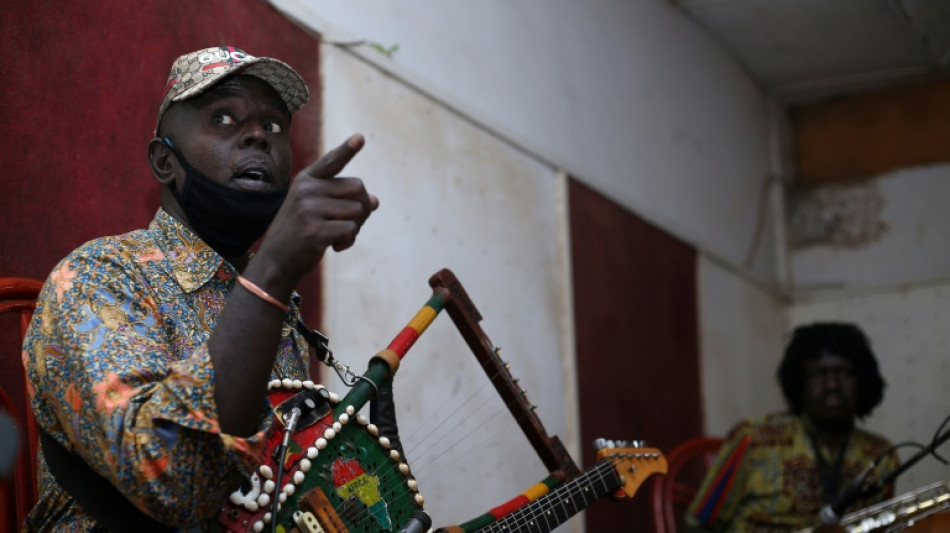
Noureddine Jaber, a musician with a unique part-guitar, part-tamboura instrument, is giving voice to Sudan's long-marginalised eastern communities through a new album.
Hailing from the Red Sea city of Port Sudan, Jaber belongs to the Beja people, a group of nomadic herders and breeders with unique languages, culture, food and music.
They have borne the weight of disenfranchisement especially under autocratic president Omar al-Bashir who was ousted in 2019.
But the title of his first album, due out later in June, conveys a different message: "Beja Power."
During Bashir's three-decade rule, non-Arab groups complained that his government allowed Arab culture to dominate, giving little representation to the country's many ethnic minorities.
Also known as "Noori", Jaber grew up devouring the rich heritage of distinct tunes of the Beja people who trace their roots back millennia.
Though he first formed his band in 2006, it was only in recent months that he was able to record his first album, at the age of 47.
"Beja music is the window to the struggles of its people," said Jaber, who called his six-member band "Dorpa", which means "the band of the mountains" in Bedawit, a Beja language.
"The Beja have long been marginalised and we are trying to convey their voice through music."
Though their region is a maritime trade hub known for its lush fertile fields, and rich gold mines, it is also one of the most impoverished parts of Sudan, itself one of the poorest countries in the world.
At a studio in Omdurman, the capital Khartoum's twin city, Jaber leads his band through rehearsal, producing a mellow, toe-tapping sound somewhat similar to jazz.
"Let's play the 'Saagama'," Jaber tells his bandmates: a bassist, saxophonist, rhythm guitarist, bongos player, and a conga drummer.
In his hand he holds his unique "tambo-guitar", an instrument he fashioned from a guitar neck and his father's vintage tamboura, a type of lyre played in East Africa.
Jaber's invention is embossed with small shells and a map of Africa.
- 'Very special rhythm' –
"Saagama", which means migration in Bedawit, is one of the album's most evocative tracks, inspired by ancient melodies from Sudan's east.
Unlike him, the rest of the band all hail from different parts of ethnically diverse Sudan.
They say it took them years to learn the Beja music scales and tones, traditionally played on drums and the tamboura.
"I've never been to east Sudan. I only learned the music from Noori," conga player Mohamed Abdelazim told AFP.
"The way they play drums in the east is different, very distinct. It has its own very special rhythm."
According to Jaber, the Beja's under-representation in Sudanese culture is part of why many fail to recognise their music.
Under Bashir, he told AFP, "the rule was for the Arab culture to prevail while other African ethnicities fade."
Beja musicians regularly faced restrictions, with authorities often stopping their performances.
"It could be for anything, lack of permits or because the audience were mixed groups" of men and women together, in contrast to those of Arab performers, Jaber said.
Abdelhalim Adam, the band's bassist, is originally from the ethnic Folani tribe of the Darfur region, on the other side of the country in Sudan's west.
For him, joining the band was particularly meaningful.
"The Beja's struggle is similar to our tribes in North Darfur," Adam said. "They are as marginalised."
Darfur was ravaged by civil war that began in 2003 when ethnic minority rebels took up arms against Bashir's Arab-dominated government, which unleashed the Janjaweed militia blamed for atrocities.
Hundreds of thousands were killed and millions have been displaced since.
The Beja also rebelled against Bashir's government for more than a decade. Communities in the east then joined nationwide calls for his ouster in the protests which began in 2018.
A glimmer of hope shone following Bashir's overthrow and the installation of a fragile transition to civilian rule which pledged to end marginalisation in Sudan.
But even then, Beja tribes complained of marginalisation.
Last year, they blockaded the main seaport of Port Sudan shortly before a military coup led by army chief Abdel Fattah al-Burhan upended Sudan's transition.
As Beja tribes continue to call for wider representation, Jaber has zeroed in on music as his avenue to highlight the struggles of his people.
"It's an effective way for our story to travel and attract the world's attention," he says. And it is also a way "to preserve our heritage."
P.Anderson--BTB