World Press Photo cast doubt on 'Napalm Girl' photographer's identity / Photo: © JIJI Press/AFP/File

 Wedding Etiquette: When Is It Appropriate to Bring a Plus-One?

 North Dakota Enacts Bipartisan Insulin Price Cap Amid National Push

 Readers Question Naughty Dog’s ‘Intergalactic’ Hype and GTA 6 Marketing Strategy

 Westminster Council Unanimously Rejects Green Party Motion in 'Zionism is not racism' Vote

 Kingfishr Announces UK and European Spring Tour Following April Album Release

 General Hospital actor Randall England dies at 75

 Bunnie XO artwork taken down from Jelly Roll’s Nashville bar

 Arlington sentinel rebukes Pete Hegseth entourage for laughter near memorial

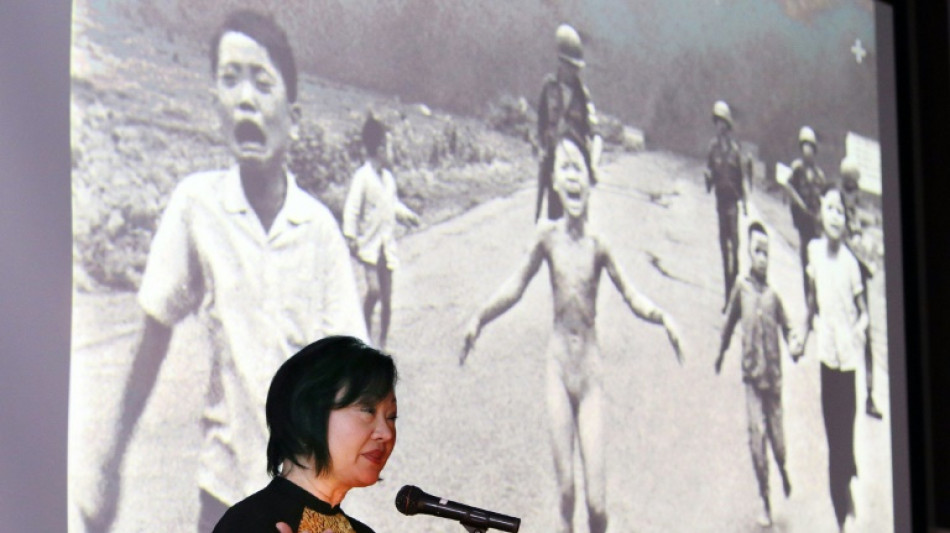
World Press Photo said Friday it removed US-Vietnamese photographer Nick Ut's name as the person credited for one of history's most iconic pictures, the Vietnam War image "Napalm Girl", amid doubts over its authorship.
The organisation, which awards one of the world's most prestigious photojournalism prizes, said it carried out its own investigation into the haunting 1972 photo -- which shows a nine-year-old girl fleeing naked from a napalm strike -- after the premiere of the film "The Stringer".
The documentary chronicles an investigation into rumours that the image, which helped change global perceptions of the US war in Vietnam, was taken by a little-known local freelancer, not Ut, the Associated Press (AP) staff photographer who won a Pulitzer Prize for the photo.
World Press Photo, which awarded its Photo of the Year prize to Ut in 1973 for the black-and-white image -- whose official title is "The Terror of War" -- said the film had "prompted deep reflection" at the organisation.
After investigating from January to May, it determined that "based on analysis of location, distance, and the camera used on that day", two other photographers "may have been better positioned to take the photograph than Nick Ut".
"World Press Photo has suspended the attribution of 'The Terror of War' to Nick Ut, from today," it said in a statement.
"It is possible that the author of the photograph will never be fully confirmed. The suspension of the authorship attribution stands unless it is proved otherwise."
The Amsterdam-based organisation named the two other potential authors as Nguyen Thanh Nghe and Huynh Cong Phuc, both present for the infamous scene in the southern village of Trang Bang on June 8, 1972.
Nguyen said he was certain the photo was his in interviews for "The Stringer", which premiered at the Sundance film festival in January.
AP, which said earlier this month it would continue crediting the photo to Ut, said in a statement it stood by that decision.
But it acknowledged its own investigation had raised "real questions that we may never be able to answer" about the picture's authorship.
"We have found that it is impossible to prove exactly what happened that day on the road or in the bureau over 50 years ago," it said.
Ut insisted the image was his in a February Facebook post, calling claims to the contrary "a slap in the face".
The girl in the picture, Kim Phuc, survived her injuries, and is today a Canadian citizen and outspoken advocate for child war victims.
World Press Photo emphasised that the authenticity of the image itself was not in question.
"It is without question that this photograph represents a real moment in history that continues to reverberate in Vietnam, the United States, and globally," said executive director Joumana El Zein Khoury.
L.Dubois--BTB