
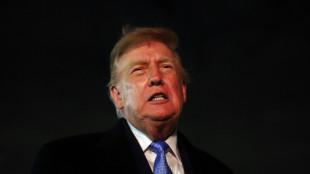
Trump's budget hacksaw leaves public broadcasting on precipice / Photo: © AFP/File

 Messi and Alcaraz love it, now padel takes step closer to Olympics

 Tolls mount in Thailand, Myanmar floods

 Why India's opposition wants top poll official out

 PU Prime Strengthens UAE Momentum with Strong Showing at Forex Expo Dubai 2026

 Eight dead in Thailand floods since mid-September

 Oil prices spike after Trump rejects Iran truce offer

 Taylor Swift sets new record at MTV VMAs

 Seoul seeks apology after Ukraine reveals transfer of North Korean POWs

 Messi on target again but Miami downed by Columbus

 In Washington's political cauldron, a fight over foie gras

 Flavio Bolsonaro: political heir in his father's shadow

 Ravens grab last-second win in Rio as Commanders stop Seahawks

 USA rallies to capture 11th consecutive Presidents Cup

 Phillies clinch, Astros wrap up division on final day of MLB season

 Commanders hand champion Seahawks their first loss

 Dupont scores twice to send Toulouse top of Top 14

 Ireland beat Israel but no handshakes due to war in Gaza

 Tense standoff over flashpoint N.Ireland parade lasts into night

 Stunned McNulty wins 'miracle' road race world title

 Re-released 'Avengers: Endgame' snaps-up N. America box office lead

 American McNulty wins shock road race world title

 Serbia's President Aleksandar Vucic announces resignation

 Tuchel urges Bellingham to play with 'rage'

 Russian strikes on Ukraine kill 8

 Bavuma, Miller hit centuries as South Africa clinch series

Hundreds of television and radio stations across the United States risk seeing their resources evaporate, after President Donald Trump prevailed Friday in scrapping federal funding for public broadcasting.
The cuts follow Trump's accusations of ideological bias and will deal a bitter blow to information dissemination nationwide, including rural areas with limited news resources.
At the Republican president's urging, lawmakers along party lines approved the clawback of $1.1 billion in funding already allocated by Congress over the next two years to the Corporation for Public Broadcasting.
Created in 1967 by president Lyndon Johnson, the non-profit CPB finances a minority share of the budgets of national radio and television mainstays NPR and PBS.
But the unprecedented rescission will also critically impact some 1,500 local radio and TV stations, from the East Coast to Alaska, that air part of the public broadcasters' content.
"Without federal funding, many local public radio and television stations will be forced to shut down," warned CPB president Patricia Harrison.
- Connection -
Stations have been sounding the alarm for months. Prairie Public Broadcasting, which has served North Dakota for 60 years, estimates it could lose 26 percent of its budget between combined cuts in state and CPB funding.
For Vermont Public, a broadcaster in the US Northeast, $4 million in funding is at stake.
"We're going to be forced to make some really difficult decisions about what local programming stays and what local programming we have to cut," said Ryan Howlett, who heads the financial arm of South Dakota Public Broadcasting, which oversees a dozen local radio stations and as many local TV stations.
In this rural and conservative state, "you're going to lose a connection point that binds us together," he told AFP.
Trump has made very public his hostility to the media, which he often brands "fake news" and the "enemy of the people," a driving force behind his political rhetoric.
In early May, Trump issued an executive order requiring an end to the subsidization of NPR and PBS, saying "neither entity presents a fair, accurate, or unbiased portrayal of current events to taxpaying citizens."
"These are partisan, leftwing outlets that are funded by the taxpayers, and this administration does not believe it's a good use of the taxpayers' time and money," White House Press Secretary Karoline Leavitt said Thursday.
Howlett emphasized that there is little such criticism in local communities in South Dakota. "We're part of people's everyday lives," he said.
- Turning point -
The elimination of CPB funding, advocated by the "Project 2025" blueprint of the conservative Heritage Foundation think tank, marks a turning point. Other attempts in the past had met with opposition from lawmakers, including Republicans in rural areas.
Dan Kennedy, a journalism professor at Northeastern University in Boston, stressed it is in those very areas where the funding cuts are likely to have "a devastating effect."
For remote communities, "these stations are an absolute lifeline," he said. "This is where people go to find out a tornado is coming," or about other emergency news.
Such arguments were rejected by Heritage Foundation fellow Mike Gonzalez, who wrote the chapter on public broadcasting in the Project 2025 blueprint.
For him, "state and local governments can devise and set up systems that take care of the problem, on a much cheaper basis than the entire public broadcasting apparatus, and without the attendant ills that accompany the present system."
The end of the federal funding is undoubtedly a blow to local news in the United States.
Due to declining readership and the consolidation of titles under larger corporations, more than a third of the nation's newspapers have shuttered since 2005, a loss of 3,300 titles, according to a report from the Medill School at Northwestern University.
According to a recent map drawn by analysis firm Muck Rack and the Rebuild Local News coalition, there are now only 8.2 journalists per 100,000 Americans, down from 40 in the early 2000s.
L.Janezki--BTB